Beyond the F-Bombs: What Will Hardy’s Viral Meltdown Reveals About the Utah Jazz Rebuild

Sarah Johnson
December 9, 2025
Brief
Will Hardy’s viral F-bomb timeout is more than frustration. It exposes the Utah Jazz’s deeper identity crisis, rebuild contradictions, and looming decisions on Lauri Markkanen, young guards, and coaching power.
Will Hardy’s Viral Meltdown Says More About the Jazz’s Identity Crisis Than Their Effort
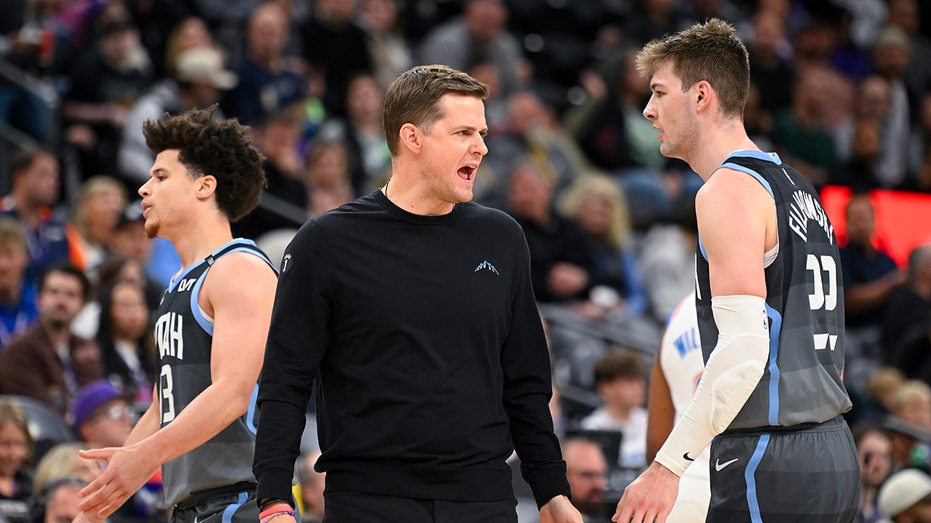
When a coach’s F-bomb tirade becomes more memorable than anything his team did on the floor, you’re not just looking at a bad night — you’re looking at a franchise at an inflection point. Will Hardy’s expletive-laced timeout speech during a 30-point loss to an Oklahoma City team missing its MVP wasn’t simply about effort. It was the public eruption of deeper structural problems inside a Utah Jazz rebuild that has yet to decide what it wants to be.
Utah’s blowout defeats, Hardy’s frustration, and the viral nature of the moment all point to a franchise caught between timelines: veterans playing at near All-Star levels, young guards still learning how to win, and organizational incentives pushing toward patience and draft capital. That tension is now spilling onto the court — and onto social media.
The bigger picture: from model stability to perpetual reset
To understand why this moment matters, you have to look at what the Jazz used to represent. For nearly a decade, Utah was the league’s poster child for stability: multiple 50-win seasons, a top-ranked defense anchored by Rudy Gobert, Donovan Mitchell’s rising stardom, and a clear identity built around rim protection, pick-and-roll, and disciplined half-court execution.
That era ended abruptly in the 2022 offseason. The Gobert and Mitchell trades to Minnesota and Cleveland were framed as a smart reset: cash in aging or disgruntled stars for massive draft hauls, lean into flexibility, and rebuild around length, shooting, and versatility. Utah’s front office executed the teardown exceptionally well on paper — they assembled picks, cap space, and intriguing players faster than most rebuilding teams.
Three seasons later, the bill for that in-between strategy is coming due:
- The Jazz are no longer a defensive juggernaut; they’re routinely blown off the floor early, as OKC’s 45–20 first quarter showed.
- They have offensive talent — Lauri Markkanen averaging 27.6 points, Keyonte (misspelled as "Keynote" in some coverage) George at 22.2 — but not a cohesive two-way identity.
- They’re too good to be the league’s worst, but not good enough to matter in May. Their 8–15 start and Hardy’s 93–176 overall record reflect that purgatory.
In that context, Hardy’s message — “I’m tired of f—ing doing this every game… f—ing play harder” — sounds less like a one-off rant and more like the frustration of a coach tasked with reconciling contradictory mandates: develop, compete, and lose just enough to keep the lottery relevant.
What this really means: effort, scheme, and misaligned incentives
Effort is the language coaches use when they want to challenge players without diagramming an entire system failure on live TV. But getting run off the floor, again and again, is rarely just about trying harder.
Look at the specifics:
- Oklahoma City hit 21 threes and built a 25-point lead in the first quarter alone, despite missing Shai Gilgeous-Alexander.
- Utah is coming off consecutive blowout losses — 146–112 to the Knicks, then 131–101 to the Thunder.
- These aren’t grind-it-out defeats; they’re non-competitive starts where the game is effectively over by halftime.
That pattern typically signals three intertwined problems:
- Defensive identity vacuum. Since Gobert’s departure, Utah has never really replaced its defensive backbone. They’ve cycled through schemes — more switching, more perimeter pressure — but without a true rim deterrent or multiple plus defenders, breakdowns show up early and snowball fast. When a team gives up 45 in the first quarter, it’s not just effort; it’s structure, communication, and personnel fit.
- Young guard learning curve. George’s 22.2 points per game is exactly what front offices want to see from a third-year guard. But young high-usage guards almost always come with defensive and decision-making costs. Add an exciting rookie like Ace Bailey who also needs reps, and you get lineups that can score but struggle to get stops, especially against well-spaced, veteran systems like OKC’s.
- Mixed signals from the top. Rebuilds live or die on clarity. Are you prioritizing development or wins? Are veterans like Markkanen central pieces or trade assets? When that clarity isn’t there, players feel it. Some are auditioning for their next contract or next team; others are trying to establish themselves as long-term pillars. That can quietly undermine the “all-in together” mentality Hardy is demanding.
In that light, Hardy’s profanity isn’t just anger — it’s a coach trying to enforce standards in an environment where the organizational incentives don’t always align with those standards.
Expert perspectives: the limits of the hard-edged coach speech
This kind of moment has a long history in the NBA. Think of Gregg Popovich lighting up his Spurs, Tom Thibodeau’s timeouts where he barely sits, or even Doc Rivers calling out “soft” play in front of cameras. Sometimes it galvanizes a team; sometimes it accelerates a split.
Sports psychologist Dr. Kensa Gunter has often noted that public call-outs are a high-risk tool: “When players believe a coach’s anger comes from belief in their potential, it can deepen buy-in. When it feels like blame without solutions, it speeds up disengagement.”
That’s the crux of the risk for Hardy. He’s a young coach (still in his 30s), with no playoff appearances and a 17–65 season on his résumé. That gives him less institutional leverage than a Popovich or Spoelstra. For a message like this to land, players have to believe three things:
- The coach is right about what’s wrong.
- The coach has a clear plan to fix it.
- The organization will back the coach if tough decisions have to be made.
Without those, viral anger can easily morph into a narrative that the coach is “losing the locker room,” especially if losses pile up.
Data and trends: Utah’s slide in a rapidly modernizing West
The Jazz’s current struggles are amplified by how quickly the Western Conference has modernized around them.
- Three-point arms race: Oklahoma City hitting 21 threes isn’t just a hot night; it reflects a league-wide trend. Teams are now regularly taking 40+ threes per game. If you can’t defend the arc — or at least run teams off the line — you’re mathematically buried early.
- Positional size and versatility: The Thunder are a prototype of the new model: long wings, multiple ballhandlers, five-out spacing, everyone able to pass and shoot. Utah’s roster is still a bit mismatched between older, more traditional roles and newer stretch concepts.
- Rebuild timelines: Historically, franchises that successfully pivot — think the Thunder themselves post-Westbrook, or the Grizzlies after the Grit and Grind era — show a clear identity by Year 3 of the rebuild, even if the record isn’t great. Utah, entering that same window since the Gobert/Mitchell trades, still feels more like a collection of interesting pieces than a cohesive vision.
The most worrying number isn’t the 8–15 record; it’s the repeated blowouts. One or two 30-point losses in a season can be noise. Multiple non-competitive games in a short span, including against a contender missing its best player, is a signal about fragility — mental, tactical, or both.
What’s being overlooked: the Markkanen dilemma and the development paradox
Most of the quick-hit coverage focuses on Hardy’s language and the Jazz’s record. What’s getting less attention are the strategic dilemmas underneath:
- The Lauri Markkanen crossroads. Markkanen is playing at a borderline All-NBA offensive level: 27.6 points, strong efficiency, and still just entering his prime. But by the time George and Bailey are fully formed winning players, will Markkanen still be in his peak window — and will he want to be? Utah has to decide soon whether he is the franchise’s centerpiece or its best trade chip to reset the timeline again.
- The development versus standards paradox. Hardy is asking for playoff-caliber effort and attention to detail from a roster that is, by design, weighted toward development. That’s a philosophical question for the organization: do you live with inconsistent effort and mistakes as the cost of growth, or do you impose veteran-level accountability and risk slowing the development of young players who play more freely without fear of the bench?
- Culture in the social media era. Timeout rants used to stay inside the huddle. Now, a courtside fan angle can define a national narrative in hours. That changes player psychology. They’re not just being called out in front of 12 teammates; they’re being called out in front of millions. Younger players, who live online, often respond differently to that dynamic than past generations.
Looking ahead: three likely paths from here
What happens next will tell us more about the Jazz’s true direction than the rant itself.
- The short-term bounce. Sometimes a public challenge works. Utah’s next game against Memphis becomes an early-season culture test. If the Jazz come out with sharper defense, more physicality, and stay connected through adversity, Hardy can point to this moment as a turning point.
- Rotation and roster consequences. If the effort doesn’t change, expect tangible responses: shortened rotations, defensive-first lineups, or even mid-season trades sending a message that the franchise values compete level as much as raw talent. That could mean leaning into players whose effort is consistent, even if their ceiling is lower.
- The bigger reset question. If the losses and blowouts continue, the focus will shift from the players’ effort to Hardy’s job security and the front office’s broader plan. A third straight losing year with no clear identity forces ownership to decide whether the problem is execution or vision.
The irony is that Hardy’s fiery timeout might ultimately matter less for how it impacted a single game and more for how it accelerates decisions the organization has been postponing.
The bottom line
Will Hardy’s F-bomb-filled timeout wasn’t just a coach losing his temper during a bad loss. It was a public flare signaling a deeper crisis: a franchise that hasn’t fully reconciled its rebuilding realities with its competitive ambitions. Utah has talent, especially in Markkanen and George, and fresh hope in rookie Ace Bailey. But without a clear defensive identity, consistent standards, and organizational alignment on timelines and priorities, the Jazz will keep oscillating between promise on paper and disappointment on the court.
Whether this viral moment becomes the shock that forces coherence — or just another meme in a losing season — depends less on how angry Hardy gets and more on what the Jazz choose to be over the next 12 months.
Topics
Editor's Comments
What’s striking about this episode isn’t the profanity — NBA huddles have always been profane — but its timing and visibility. We’re in an era where every timeout can be live-streamed by a courtside fan and turned into a referendum on leadership within hours. That compresses the feedback loop on coaches in a way front offices haven’t fully reckoned with. For a team like Utah, mid-rebuild and mid-market, the margin for narrative error is slim: a few viral moments can shape free agent perception, fan patience, and even internal confidence in the long-term plan. The deeper question here is whether the Jazz have been honest with themselves about where they are on the competitive curve. Hardy is coaching like someone trying to make the playoffs; many of the structural choices — heavy development minutes, experimental lineups, an unbalanced roster defensively — look more like a team still prioritizing future upside. That disconnect is unsustainable. Over the next year, Utah’s leadership will have to pick a direction and accept the costs: either embrace the pain of a true, youth-centric rebuild or sacrifice some future flexibility to build a real winning infrastructure around Markkanen now. Straddling both worlds is what’s producing nights where anger becomes the only visible strategy.
Like this article? Share it with your friends!
If you find this article interesting, feel free to share it with your friends!
Thank you for your support! Sharing is the greatest encouragement for us.