Trump’s $1B ‘Family Friendly’ Airport Plan: Health Policy, Political Theater, and Who Really Benefits

Sarah Johnson
December 9, 2025
Brief
Beyond pull-up stunts, Trump’s $1B ‘family friendly’ airport program reveals a deeper shift in public health, family politics, and who profits from the redesign of U.S. travel spaces.
Trump’s $1B ‘Family Friendly’ Airport Push: Public Health Policy or Political Performance?
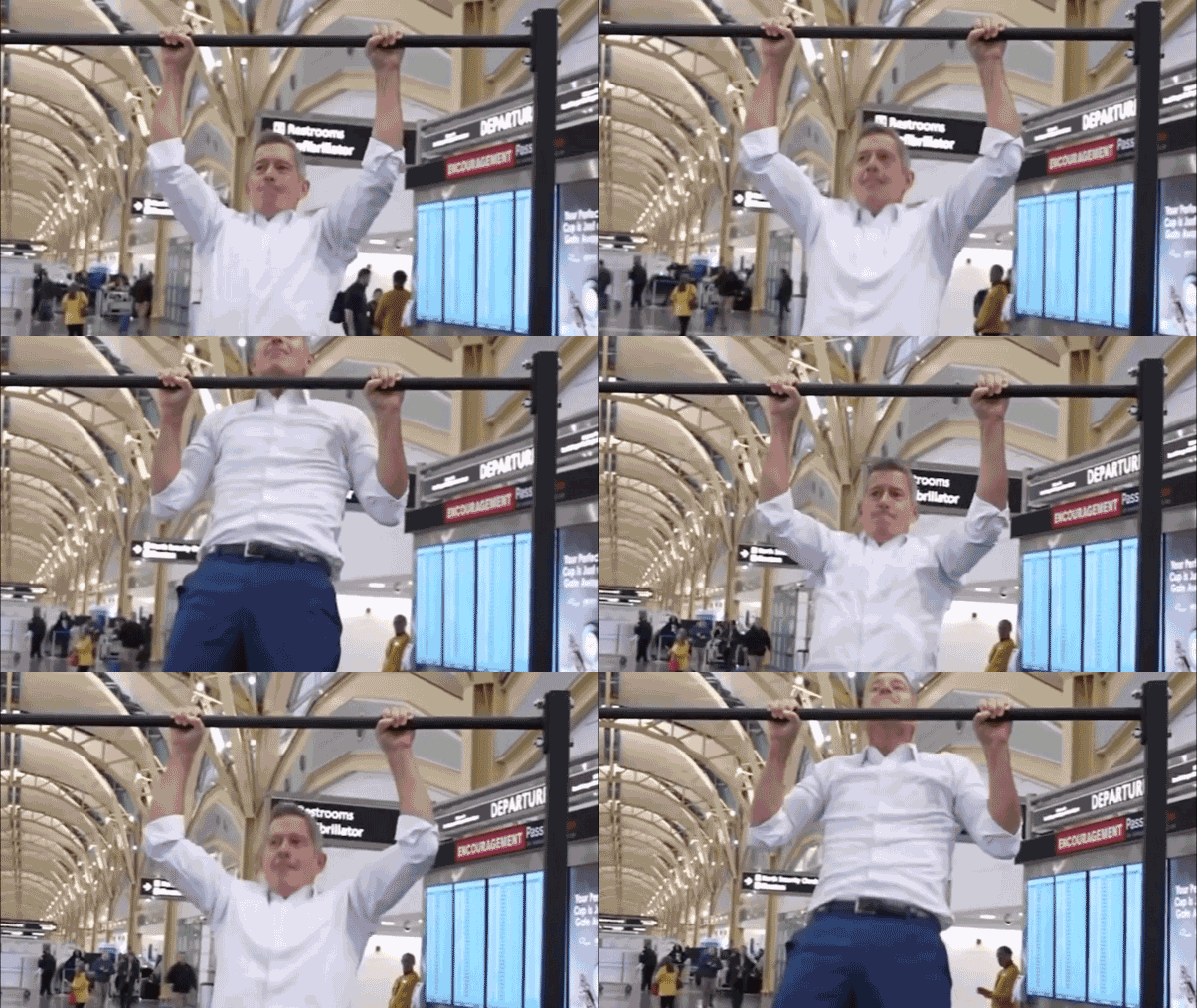
When cabinet secretaries are doing pull-ups in an airport to launch a federal program, it’s a signal that this isn’t just about infrastructure—it’s about narrative. The Trump administration’s $1 billion “Make Travel Family Friendly Again” initiative sits at the intersection of public health, culture war politics, and the commercial transformation of U.S. airports. To understand what’s really going on, we have to look far beyond play areas and nursing pods.
Why This Story Matters
This program isn’t just a feel-good travel upgrade. It reveals how federal power is being used to reshape public spaces around a “Family First” agenda, redefine what counts as legitimate health policy, and channel significant money into airport real estate and vendor ecosystems. It also illustrates how modern administrations increasingly rely on spectacle—here, literal athletic feats—to brand policy as lifestyle.
The Bigger Picture: How Airports Became Social Battlegrounds
For decades, U.S. airports have been evolving from transportation hubs into quasi-shopping malls and controlled social environments. Three trends are crucial to understanding this move:
- Post-9/11 security state: Heightened screening, long waits, and restricted access turned airports into stress zones, especially for families. TSA’s creation in 2001 formalized security as the organizing principle of airport design.
- Commercialization of terminals: From the 1990s onward, airports became revenue generators. Food courts, luxury retail, and premium lounges increasingly targeted higher-income travelers, often at the expense of affordable, healthy options.
- Politicization of family spaces: Nursing rooms, gender-neutral restrooms, and sensory spaces have all become flashpoints in wider cultural debates over gender, disability, and parental rights.
Into this environment, the Trump administration is injecting a “Golden Age of travel” message, backed by $1 billion in federal funds, explicitly framed around families and health. That framing is not neutral. It’s a deliberate attempt to claim the language of public health and family well-being within a populist, nationalist political project.
What This Really Means: Policy, Optics, and Power
1. Public Health by Infrastructure, Without the Controversy
By emphasizing play areas, exercise spaces, and access to “fresh, whole foods,” the administration is choosing a highly visible, low-conflict slice of public health. These are initiatives almost no one will oppose on their face—who’s against a sensory room for kids with autism, or a lactation pod for nursing mothers?
But this approach also sidesteps more contentious health battles: vaccine policy, environmental health regulation, air quality, occupational exposure for airport workers, or equitable access to care. It’s public health as consumer environment, not public health as regulation, insurance coverage, or structural reform.
That choice is strategic. It lets the administration put Health and Human Services (HHS) front and center in a way that feels apolitical, even as it quietly reinforces a view of health as individual choice (eat better, move more), not systemic conditions (pollution, wages, housing, or care access).
2. The New “Family Values”: From Moralism to Logistics
Conservative “family values” politics of the 1980s and 1990s focused heavily on morality: abortion, school prayer, LGBTQ rights. In contrast, this program focuses on logistics: making security lines easier with kids, creating nursing spaces, upgrading food options. That shift is telling.
We’re seeing a move from moral surveillance of families to lifestyle facilitation. The message is: government should help “good families” navigate modern life more comfortably.
The danger is who gets to count as a “good family.” Historically, travel environments have been unequal spaces—families of color experience more scrutiny at security, lower-income travelers are steered toward unhealthy and overpriced food, and disability accommodations are inconsistent. Unless the $1 billion program explicitly incorporates equity standards, it risks reinforcing existing inequalities while branding itself as universally pro-family.
3. Airports as Showrooms for Political Branding
The pull-up stunt is more than a gimmick. It’s a visual metaphor: strong, energetic, masculine leadership promising to physically embody health and vigor. That plays directly into broader Trump-era aesthetics—toughness, performance, turning governance into visual spectacle.
Launching the program at Reagan National Airport is equally symbolic: a nod to conservative political heritage and to Reagan’s own airport-as-theater legacy (think of his deregulation era and the firing of air traffic controllers in 1981, which helped reshape labor relations in aviation).
4. Who Really Benefits from the $1 Billion?
The headline benefit is families. The practical beneficiaries, however, will include airport authorities, construction firms, real estate developers, and food-service vendors—specifically those able to align with the program’s “healthy” and “family-friendly” branding.
Vendors like Farmer’s Fridge, cited by Kennedy, are poised to gain leverage. Federal encouragement—even without direct subsidies—can act as a soft endorsement, nudging airports to sign contracts with a particular kind of vendor. That can reshape the entire terminal marketplace, favoring companies with the capital and infrastructure to meet national standards.
This raises questions:
- Will small local vendors be squeezed out by national “healthy” brands?
- How will contracts be awarded, and under what transparency rules?
- Will airports in wealthier metro areas absorb a disproportionate share of the $1 billion, widening geographic inequality?
5. The Disability and Neurodiversity Dimension
The mention of sensory rooms for children with special needs is one of the most significant—but underexplored—elements. Sensory rooms, typically designed for autistic children or those with sensory processing disorders, acknowledge that noisy, crowded airports are not neutral spaces. They’re sites of sensory assault for some people.
That’s a quietly radical acknowledgment: disability is not just in the person, but in the environment. If followed through, this could mark an important evolution in how federal transportation policy addresses neurodiversity. The risk, however, is tokenism—building a few rooms for press releases without embedding accessibility requirements in design guidelines, staff training, and operations.
Expert Perspectives
Public health, transportation, and political communication experts would likely see this initiative through very different lenses.
Dr. Leana Wen, emergency physician and public health professor, has often argued that public health must be “where people are,” not confined to clinics. This airport strategy fits that logic—but she would likely emphasize that healthy food options and play spaces are only part of the equation. Without attention to air quality, worker protections, and broader inequities, airport wellness can become a middle-class amenity rather than a public health advance.
Dr. Joseph Schwieterman, transportation analyst at DePaul University, has documented how airports are increasingly competing on amenities—from yoga rooms to spas to luxury lounges. He might read this as Washington codifying that competition into policy: turning what used to be local marketing choices into federally guided standards.
Dr. Tressie McMillan Cottom, sociologist and public intellectual, has written about how middle-class parenting culture shapes policy expectations. A program like this, she might argue, reflects and reinforces a “curated childhood” model where good parenting means optimizing every environment—including airports—rather than addressing systemic threats like housing insecurity or healthcare costs.
Data and Evidence: What We Know About Travel, Kids, and Health
- Travel stress is real: A 2017 American Psychological Association survey found that 20–25% of adults reported travel as a significant source of stress, with parents of young children reporting higher anxiety around logistics and safety.
- Airport food is notoriously unhealthy: Prior to the recent wave of “better for you” vendors, studies of airport food environments found a majority of offerings high in sodium, saturated fat, and added sugars. While offerings have improved in some hubs, cost and placement heavily influence what people actually buy.
- Autism and sensory needs: The CDC estimates that roughly 1 in 36 U.S. children are on the autism spectrum. Yet relatively few airports currently offer fully equipped sensory rooms or dedicated training for staff in de-escalating sensory overload situations.
- Family travel volume: Pre-pandemic, estimates suggested that U.S. carriers transported tens of millions of child passengers per year, with holiday peaks creating extreme crowding and stress for parents and staff alike.
This evidence base supports the idea that making airports more family-friendly has real potential benefits—but it also underscores the need for measurable outcomes, not just photogenic ribbon cuttings.
Looking Ahead: What to Watch
1. Allocation of Funds
Key questions for oversight and accountability:
- How is the $1 billion distributed—by passenger volume, need-based criteria, or political considerations?
- Will small and mid-size airports in rural or economically distressed regions receive meaningful support, or will major hubs dominate?
- Are there equity requirements to ensure improvements reach diverse communities, not just high-revenue terminals?
2. Integration with TSA and Security Policy
The mention of family screening lanes and related TSA changes hints at deeper operational shifts. Historically, child-related policies—stroller screening, liquid allowances for breast milk, ID rules for minors—have been a major pain point.
Watch for:
- Whether family lanes truly reduce wait times or simply create new choke points.
- How TSA training protocols evolve for families with disabled children or non-traditional family structures.
- Whether “family-friendly” rhetoric is used to justify other forms of profiling or surveillance under the banner of protecting children.
3. Health Policy Precedent
If this program is framed as a flagship HHS success, it could set a precedent: future administrations—of any party—may increasingly pursue health initiatives through lifestyle environments (airports, schools, malls) rather than through traditional healthcare or regulatory channels.
That would deepen a long-running shift from collective rights-based health policy to consumer-centered, experience-based health policy. It’s easier to give you a salad kiosk than to take on the food industry.
4. The Politics of Image
The pull-up videos will circulate for years across social media, especially in campaign seasons. They’re political assets in themselves—proof points for narratives like “this administration cares about real families” or “they’re making America strong and healthy again.”
Expect future political messaging to return repeatedly to these visuals, especially in contrast to opponents portrayed as “weak,” “elitist,” or “out of touch” with everyday travel experiences.
The Bottom Line
Beneath the playful optics of cabinet secretaries doing pull-ups at Reagan National lies a substantive reimagining of airports as stages for health, family policy, and political branding. The $1 billion “Make Travel Family Friendly Again” initiative has the potential to make travel measurably better for parents, children, and travelers with special needs. It also has the potential to deepen commercial capture of public spaces and reframe public health as a curated consumer experience rather than a collective right.
The real test will be less about how many play areas or nursing rooms get built, and more about who benefits, who’s left out, and whether this is a one-off lifestyle upgrade—or the first step in a broader, more equitable transformation of the way Americans move through shared spaces.
Topics
Editor's Comments
One under-discussed angle here is how this initiative redefines what counts as a legitimate use of federal money in the eyes of the public. For years, large-scale infrastructure funding has struggled against accusations of ‘wasteful spending,’ particularly when it involved transit, climate resilience, or social services. By tying $1 billion to the highly relatable pain points of airport travel with kids, the administration is effectively repackaging infrastructure as a quality-of-life product for the middle class. That’s politically savvy, but it raises a deeper question: what kinds of suffering and inconvenience are considered fundable? Long security lines with cranky toddlers clearly qualify; less visible burdens—like underfunded rural clinics or the daily grind of low-wage care work—often do not. If we accept that the state should step in to smooth the frictions of holiday travel, why is it so much harder to mobilize comparable urgency and resources for the frictions of everyday survival? The answer lies in visibility, media optics, and whose discomfort we prioritize. This program is a case study in how policy follows attention rather than need.
Like this article? Share it with your friends!
If you find this article interesting, feel free to share it with your friends!
Thank you for your support! Sharing is the greatest encouragement for us.