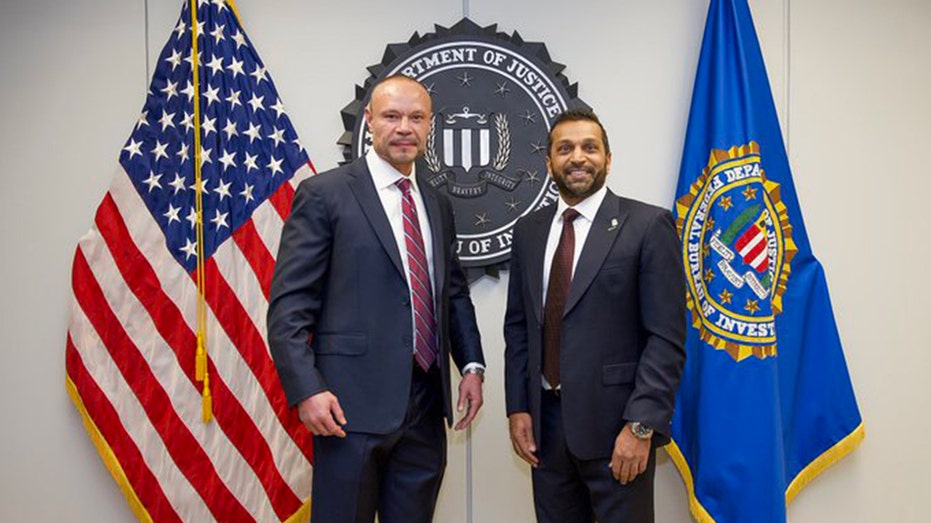
Dan Bongino’s One-Year Revolution at the FBI: Symbolic Reform or Prototype for Politicized Policing?

Sarah Johnson
December 18, 2025
Brief
Dan Bongino’s brief stint as FBI deputy director reveals a deeper shift: partisan media figures are moving inside federal law enforcement to repair trust, reshape narratives, and test a new model of politicized oversight.
Dan Bongino’s Exit From the FBI: What a One-Year Tenure Reveals About the Politicization of Federal Law Enforcement
On its face, Dan Bongino exchanging compliments with FBI Director Kash Patel looks like a routine Washington goodbye. But the circumstances — a high‑profile conservative media figure serving less than a year as deputy FBI director, then departing amid heavy public praise — point to much deeper trends: the ongoing politicization of federal law enforcement, the struggle to rebuild public trust, and an emerging model where media personalities become power brokers inside security institutions themselves.
A departure that says more than the statements
Bongino’s trajectory is unusual even by modern Washington standards. A former Secret Service agent who reinvented himself as a conservative commentator, he stepped away from a lucrative media career in 2025 to join the FBI’s top leadership at what Patel called a “critical time for our nation.” Now, less than a year later, he is leaving, with Patel crediting him for internal reforms, a major operation (“Summer Heat”), and breakthroughs in high‑profile cases like the pipe bomb investigation.
On paper, this is a success story. But the brevity of Bongino’s tenure and the way his departure is being framed — as a completed “mission” rather than a long‑term leadership role — suggests his appointment may have always been more political and symbolic than institutional and sustained.
How we got here: a decade‑long trust crisis for the FBI
To understand why someone like Bongino was brought into the FBI’s top ranks at all, you have to step back to the broader erosion of trust in federal law enforcement:
- 2016–2020: The FBI became a central actor in the bitter political fights over the Clinton email investigation, the Trump–Russia probe, and the handling of FISA warrants. Each side weaponized the Bureau’s actions to feed narratives of either corruption or persecution.
- 2020–2024: Debates over the FBI’s role in investigating extremism, social media content moderation, and the January 6 investigations amplified accusations of bias — especially from conservatives, who increasingly portrayed the FBI as politically compromised.
- Polling data: Surveys from institutions like Pew and Gallup over the past decade have shown a stark partisan split in trust in the FBI, with Republicans’ confidence dropping sharply while Democrats’ views generally improved or held steady. Trust in the “deep state” became a core dividing line in American politics.
Against this backdrop, appointing a conservative media figure with law‑enforcement credentials to a top FBI job served a specific purpose: to reassure a skeptical base that the Bureau was being “taken back” or reoriented, and to demonstrate to Republican voters that their ideological allies held real power inside the institution.
Why Bongino’s role mattered symbolically
Bongino’s appointment checked several boxes at once:
- Law enforcement credibility: His Secret Service background gave him security bona fides that most TV pundits lack.
- Media reach: As the former host of a popular conservative show, he brought direct access to an audience the FBI had struggled to reach or convince.
- Political alignment: His alignment with former President Donald Trump and the broader MAGA movement sent a message that the Bureau’s top ranks were no longer, in his supporters’ view, an insulated “establishment.”
In that sense, Bongino was less just a deputy director and more a bridge: between a deeply distrusted institution and a base that needed visible proof that someone “like them” was inside the command structure.
What the official praise is really telling us
Kash Patel’s laudatory message is not just a personal tribute; it is a carefully crafted narrative about what this era of FBI leadership wants to be remembered for:
- “Helping restore this FBI” — a direct acknowledgment that the Bureau sees itself as having gone through a legitimacy crisis that required “restoration,” not just management.
- “Critical reforms” and “efficiency” — policy language aimed at reassuring both political allies and oversight bodies that concrete structural changes were made, even if the public is given few specifics.
- “People’s voice for transparency” — a striking phrase for a deputy director, suggesting Bongino’s value was as much external communications and narrative management as internal operations.
- “Breakthroughs” in long‑unsolved cases — tying his tenure to tangible law‑enforcement success, particularly on politically charged matters like the pipe bomb investigation.
The message is: this was a mission, it was successful, and it is now complete. That framing helps pre‑empt questions about why someone would leave such a powerful role after less than a year.
Why such a short tenure?
Neither Bongino nor Patel publicly cites friction or failure. The main suggestion, echoed by former President Donald Trump, is that Bongino wants to return to his show. That may be accurate, but it’s also incomplete.
Several structural factors are likely at play (these are informed inferences, not confirmed facts):
- Cultural tension inside the FBI: Career agents and analysts are often wary of overtly political figures in leadership. A high‑profile media personality coming in from outside can easily be seen as a political appointee rather than a professional peer. That tension doesn’t always produce open conflict, but it can make staying long‑term difficult.
- The trade‑off between influence and independence: For a commentator, the value of serving in a top government role can be high in the short term — access, credibility, and story material — but the role also imposes constraints. Ethical rules, classification, and institutional discipline limit what he can say. Over time, that can clash with the incentives of a media brand built on freewheeling, often combative commentary.
- Mission‑framed appointments: Increasingly, politically aligned outsiders are brought into bureaucracies to achieve narrow, time‑bounded goals — specific reform packages, internal purges, or messaging resets — rather than to spend a career as institutional stewards. Bongino’s departure language fits that model.
Inside the “transparency” narrative
Patel credits Bongino as “the people’s voice for transparency.” That phrase carries weight in an era when the FBI is accused of both secrecy and politicized leaks.
Historically, the Bureau has preferred opacity: investigations are confidential, sources protected, internal deliberations hidden from public view. Post‑9/11 and especially post‑2016, that model has been under sustained attack. Lawmakers, activists, and media figures on both the left and right have pushed for more disclosure — though often selectively, when it serves their side.
Bongino’s media background positioned him to:
- Shape how high‑profile investigations were framed to conservative audiences;
- Defend the Bureau’s actions against accusations of bias, as he and Patel did when they insisted the FBI was “operating exactly as the country expects”;
- Push for targeted disclosures in politically salient cases, such as the pipe bomb investigation, while still protecting core intelligence methods.
That role — translating institutional conduct into language palatable to a polarized audience — is new for the Bureau at the deputy director level. It reflects how much law‑enforcement legitimacy now depends not only on what the FBI does, but on how it is perceived by partisan media ecosystems.
The pipe bomb case and the politics of competence
Patel’s reference to Bongino achieving “major breakthroughs” in the pipe bomb investigation, juxtaposed with earlier criticisms of “sheer incompetence” or “negligence” in the Biden administration’s handling of the case, shows how tightly law‑enforcement outcomes are now tied to partisan score‑settling.
Two things are happening at once:
- Substantive concern: Unresolved high‑profile threats — particularly those tied to political violence — genuinely undermine public safety and trust. Completing such investigations is crucial to deterrence and accountability.
- Symbolic contest: The ability to say “we solved what they mishandled” becomes powerful political capital. Operational success doubles as ideological vindication.
Bongino’s association with “breakthroughs” allows current leadership to draw a sharp contrast with previous administrations without appearing overtly partisan; the contrast is implied through language about competence, not party labels.
Expert perspectives: What this signals about the future of federal law enforcement
Scholars of policing and democratic institutions have increasingly warned about the risks of importing factional media figures directly into security leadership roles.
Constitutional law scholar Kimberlé Crenshaw has argued in a broader context that when law‑enforcement legitimacy is filtered through partisan media brands, “public trust no longer rests on institutional integrity but on whether ‘our side’ appears to be in control.” While she was not commenting specifically on the Bongino case, the logic maps directly: if trust hinges on alignment rather than neutrality, institutions become trophies in a political war, not shared civic tools.
National security analyst Juliette Kayyem has similarly warned that “rotating commentators into command roles risks confusing the public about where analysis ends and policy begins,” noting that the performance incentives in cable or digital media are fundamentally different from those inside a security institution.
At the same time, former federal prosecutor Andrew McCarthy has defended the idea of appointing political outsiders to senior Justice Department and FBI roles, arguing that “only people who understand the media and political environment can navigate the pressures bearing down on these institutions today.” Bongino’s tenure represents that philosophy put into practice.
What Bongino’s return to media could mean
If Bongino does, as Trump suggests, return to his show, his brief experience inside the FBI will likely become a central part of his brand:
- Insider credibility: He will be able to speak not only as a former Secret Service agent but as a former deputy FBI director, strengthening his authority when criticizing or defending federal law‑enforcement decisions.
- Shaping the next narrative: His commentary will likely influence how large segments of the conservative public interpret ongoing investigations, surveillance policies, and internal reforms.
- Future political roles: The path from media to government and back often precedes another step: elected office, campaign roles, or further appointments. His elevated profile as a “proven” reformer could be leveraged in future administrations.
This revolving door between media and security institutions is not entirely new, but the speed and visibility of Bongino’s rotation — under a “mission accomplished” narrative — marks an escalation.
What’s being overlooked in most coverage
Much of the surface coverage focuses on personalities, praise, and speculation about Bongino’s next media move. Several deeper questions receive far less attention:
- Substantive reforms: What exactly were the “critical reforms” he implemented? Were there changes in internal disciplinary procedures, FISA practices, political activity rules for agents, or oversight mechanisms? Without detail, “reform” risks being more branding than substance.
- Internal reaction: How did rank‑and‑file agents and career leadership respond to an overtly ideological media figure in such a powerful role? Did morale, retention, or whistleblower activity change?
- Precedent: Does this create a new expectation that each administration will bring in its own partisan communicators into security leadership to speak to their base, potentially whipsawing the institution’s internal culture every few years?
Looking ahead: Three things to watch
- Who replaces Bongino: If Patel chooses another high‑visibility, ideologically aligned outsider, that signals a long‑term strategy of blending media and law‑enforcement leadership. A seasoned internal career official would suggest a pivot back toward institutional continuity.
- How Bongino uses his voice post‑FBI: Will he present his time there as proof that the Bureau has been “fixed,” or will he claim that entrenched forces blocked deeper change? Either narrative will shape public perceptions of the FBI for years.
- Congressional oversight: Expect lawmakers to seize on his tenure — either as evidence that the FBI is finally responsive to political accountability, or as proof that the Bureau is being politicized from the top down.
The bottom line
Dan Bongino’s brief, high‑profile stint as deputy FBI director was never just about one man doing a job. It was a test of a new model: inserting a partisan media figure into the command structure of a federal law‑enforcement agency to rebuild trust with a deeply skeptical political base.
His departure, wrapped in glowing praise and framed as a completed “mission,” suggests that this chapter of FBI politics is closing — but not that the experiment is over. If anything, it may become a prototype: future administrations of both parties could be tempted to install their own media‑savvy surrogates inside institutions that were once expected to stand above the political fray.
The real question now is not whether Bongino “did a great job,” as Trump put it, but whether the United States can sustain a system in which the perceived legitimacy of its most powerful investigative agency depends on whether your favorite media figure is sitting in the corner office.
Topics
Editor's Comments
What makes this story more consequential than the polite public exchanges suggest is how it normalizes the idea that managing perception is a core function of top law-enforcement leadership. The deputy director role has historically been about internal command: supervising investigations, managing resources, and ensuring legal compliance across a vast bureaucracy. In the Bongino-Patel era, that role appears to have been partially reimagined as a hybrid of operations chief and political communicator, with particular emphasis on speaking to one highly polarized segment of the electorate. That shift may be understandable in an environment where trust is fractured and media ecosystems are siloed, but it carries risks. Once both parties learn that placing prominent media allies inside security hierarchies can pay dividends in public perception, future appointments may be driven more by narrative value than by institutional stewardship. The unresolved question is whether the FBI can sustain its claim to impartiality if its leadership pipeline starts to look more like a talent roster from cable news than a professional, nonpartisan command structure.
Like this article? Share it with your friends!
If you find this article interesting, feel free to share it with your friends!
Thank you for your support! Sharing is the greatest encouragement for us.