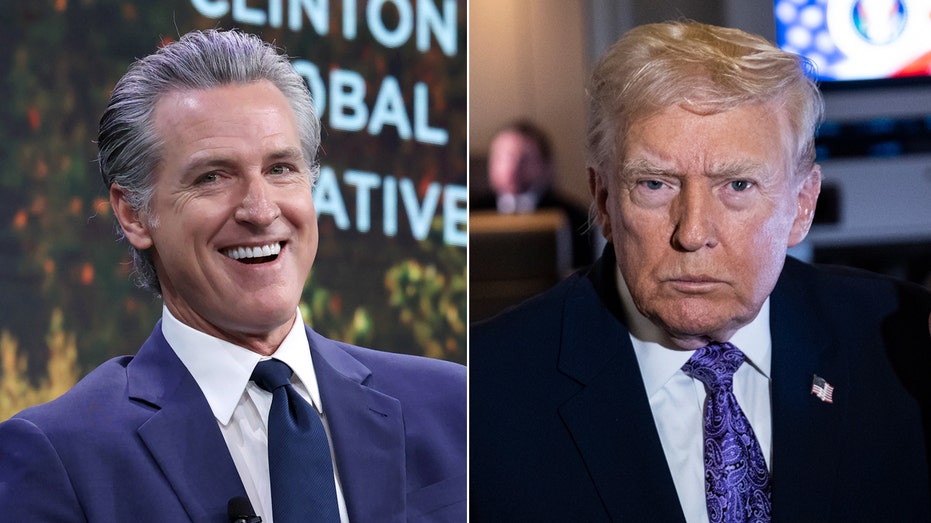
Newsom’s AI ‘Cuffing Season’ Video Shows How Deepfake Politics Is About to Escalate

Sarah Johnson
December 11, 2025
Brief
Gavin Newsom’s AI ‘cuffing season’ video isn’t just trolling Trump. It exposes how AI, meme culture, and criminal imagery are redefining U.S. politics, justice, and immigration debate.
Newsom’s AI ‘Cuffing Season’ Video Is a Warning Shot About the Next Phase of U.S. Politics
Gavin Newsom didn’t just troll the Trump White House with an AI-generated arrest fantasy. He tested the boundaries of how artificial intelligence, criminal imagery, and culture-war memes will fuse into the next era of American politics — where the line between satire, threat, and disinformation is increasingly impossible to police.
Why this matters
On its face, the incident is trivial: a Democratic governor replying to a White House “cuffing season” post about immigration enforcement with an AI video of Donald Trump, Pete Hegseth, and Stephen Miller in handcuffs. But this exchange reveals three deeper shifts:
- The normalization of AI-generated political imagery, including depictions of opponents being arrested or humiliated.
- The migration of policy debate (in this case, immigration) into meme warfare rather than substantive argument.
- The erosion of norms around using the visual language of criminalization against political rivals — at a time when criminal prosecutions of political figures are already inflaming tensions.
How we got here: From TV attack ads to AI fantasies
American politics has long weaponized imagery. The Willie Horton ad in 1988, the Swift Boat attacks in 2004, and the viral Facebook memes of 2016 all relied on emotionally charged visuals to define opponents. What’s new in 2025 is the ease and realism of AI-generated images and video — and the willingness of mainstream officials to use them.
Two key historical threads converged in this moment:
- The meme-ification of politics. The Trump era mainstreamed Twitter/X trolling as a governing style. Trump’s own posts, often mocking opponents with nicknames and edited images, reshaped expectations. Democrats initially criticized this as unpresidential — but gradually adopted similar tactics. Newsom has openly defended his “Trump-style” online behavior as a way to “wake everybody up,” signaling that both parties now treat virality as a form of power.
- The rise of deepfakes and AI in campaigns. Since around 2018, experts have warned that AI-generated videos could be used to fabricate speeches, crimes, or scandals. By 2024, both parties and outside groups had experimented with AI-generated voiceovers and imagery in campaign content, sometimes with minimal disclosure. Regulatory efforts have lagged behind, with only a patchwork of state rules requiring labels on AI political ads.
Newsom’s video sits at the intersection of those trends: it’s an AI deepfake framed as a joke, coming from a sitting governor with national ambitions, aimed at a former president and senior officials — and tied to a live policy fight over immigration enforcement.
What this really signals: Three layers of meaning
1. AI as a tool of humiliation politics
The choice to depict Trump, Hegseth, and Miller in handcuffs is not random. Handcuffs carry a powerful symbolic charge: guilt, punishment, loss of power. In a period where Trump and his allies repeatedly claim that prosecutions against him are “weaponization of the justice system,” an AI image of them being cuffed isn’t just satire — it’s an imagined political outcome.
This accelerates a trend: criminality is no longer a legal status determined in court; it’s a rhetorical weapon deployed in memes, often detached from due process. Once political actors of both parties normalize visualizing opponents as criminals — even in jest — it becomes easier for supporters to justify real-world punitive measures, or to accept violence as a logical extension of the narrative.
2. Immigration policy as culture war theater
The original White House post boasted, “Bad news for criminal illegal aliens. Great news for America,” wrapped in meme language (“CUFFING SZN” with chains emoji). That framing already collapses a complex policy issue into a simple, emotionally satisfying image: America protected, outsiders restrained.
Newsom’s response flips the target of the cuffs: from migrants to the politicians ordering the crackdown. Instead of engaging with the substance — the legality, efficacy, or morality of the immigration policies — he turns it into a dunk contest.
This mirrors a deeper shift: immigration is no longer primarily debated in terms of labor markets, humanitarian obligations, or border management. It’s become a proxy for identity, demographic fear, and partisan belonging. Social media amplifies that, rewarding the sharpest jab rather than the most rigorous argument.
3. The blur between satire and incitement
Peter Navarro’s reaction — accusing Newsom of “inciting more violence” and tying the video to what he calls a weaponized justice system — may sound hyperbolic, but it highlights a genuine tension. When political violence is no longer hypothetical (from January 6 to threats against election officials and state lawmakers), depictions of leaders in chains can hit differently.
There’s a rhetorical cycle at work:
- One side uses charged imagery to claim the moral high ground (e.g., tough on crime, tough on border security).
- The other side responds with equally charged counter-imagery (e.g., leaders as criminals, authoritarianism embodied).
- Each then points to the other’s content as proof of existential threat, justifying more extreme rhetoric and, for some fringe actors, potential violence.
Newsom’s dismissive snowflake emoji response to Navarro’s concern reinforces another pattern: leaders signaling to their base that outrage from the other side is not just wrong, but laughable and weak. It’s emotionally satisfying for core supporters — and corrosive for any shared sense of boundaries.
Expert perspectives: AI, disinformation, and norm collapse
Scholars of digital politics and democratic norms have been warning about this moment.
Dr. Joan Donovan, a leading researcher on media manipulation, has argued that “political elites don’t just respond to meme cultures — they legitimize them. When officials adopt troll tactics, they invite their supporters to escalate.” Newsom’s AI video is exactly the kind of escalation she describes: institutional power meets troll culture.
Professor Tim Wu, a Columbia Law School expert on technology and free expression, has warned that “the danger of deepfakes in politics isn’t only deception — it’s deniability. Once AI imagery is everywhere, any incriminating footage can be dismissed as fake, and any fake can be weaponized as if real.” Even though Newsom’s video is obviously stylized, its normalization of AI political visuals helps build that environment of permanent doubt.
Political scientist Steven Levitsky, co-author of How Democracies Die, has documented how democracies erode when rivals are treated as illegitimate enemies rather than opponents. Depicting top figures of the opposing camp as literally in chains fits that pattern — it visually encodes them as criminals whose removal is a precondition for justice.
Data points: Why AI + meme politics is not a sideshow
- By 2024, surveys from Pew Research Center showed that around half of U.S. adults had heard of or seen AI-generated political content, and significant portions were unsure of its authenticity.
- A 2023 study from the Center for Countering Digital Hate found that misleading or false political images spread faster and wider on major social platforms than text-only misinformation.
- As of late 2024, at least a dozen U.S. states had introduced or passed laws requiring disclosure of AI-generated content in political ads, but enforcement remains patchy and does not cover informal social media posts by officials.
Newsom’s video falls into the regulatory gray zone: it’s political, AI-generated, comes from a public official, and is intended to shape perceptions — but it’s framed as commentary, not as an ad or factual claim. That’s precisely the area where future manipulation is likely to flourish.
What’s being missed in mainstream coverage
Most coverage of the incident reduces it to partisan theater: Newsom versus Trump world, blue state versus red federal power. Several overlooked dimensions deserve more attention:
- Precedent for future campaigns. If a sitting governor can circulate AI arrest imagery of national opponents without consequence, presidential campaigns in 2028 are almost certain to deploy similar or harsher visuals. That will test not just legal boundaries but platform policies and journalistic verification norms.
- Impact on public trust in the justice system. When prosecutions and cuffs become meme props, they encourage the view that criminal law is inherently partisan. That further erodes trust in courts and law enforcement at a time when confidence is already low.
- Reinforcement of base-driven politics. This kind of content is not aimed at persuading undecided voters; it’s designed to energize and entertain an existing base, deepening polarization and making compromise politically riskier.
- Signal about Newsom’s national positioning. While he denies presidential ambitions, Newsom has been carefully building a national profile by confronting conservative leaders and the Trump orbit online. This episode signals how he envisions national-level combat: sharp, visual, culture-war fluent, and willing to court controversy.
Looking ahead: What to watch
- Platform rules on AI political imagery. Major platforms will face pressure to clarify whether AI depictions of real politicians in criminal scenarios require labels, age restrictions, or context boxes. If they don’t act, they tacitly green-light an arms race.
- State and federal regulation. Expect more states to consider laws requiring disclosure of AI in political communications — and legal challenges arguing such laws infringe on political speech. Congress may eventually move toward baseline rules, especially if a serious crisis of misattributed or malicious deepfakes occurs in an election cycle.
- Escalation in imagery. If handcuffs prove viral, the next iterations may be more graphic or explicit. The risk is that what starts as satirical imagery can normalize fantasies of imprisonment or violence against political opponents.
- Immigration policy buried under memes. Meanwhile, the underlying policy debate — about enforcement tactics, due process, and the economic role of migrants — risks being reduced to who “owns” the better cuffing meme. The more the fight migrates to symbolism, the less incentive there is for serious bipartisan negotiation.
The bottom line
Newsom’s AI “cuffing season” video is not just trolling. It’s an early example of how AI tools, criminal imagery, and social media incentives are reshaping political communication. As leaders turn justice-system symbolism into meme fodder, they reinforce a narrative that politics is war and opponents are criminals — precisely the environment in which democratic norms struggle to survive. The question is no longer whether AI will transform politics, but whether political elites will choose to use it in ways that inflame, entertain, or inform. So far, the incentives are tilted heavily toward the first two.
Topics
Editor's Comments
What’s striking here is not that Gavin Newsom chose to troll the Trump White House — that’s become routine theater in American politics — but that he did so using AI-generated criminal imagery at a time when public trust in both the justice system and information ecosystem is already fragile. This is the kind of content that blurs three lines simultaneously: satire versus threat, political speech versus personal targeting, and digital spectacle versus institutional responsibility. It would be a mistake to dismiss it as harmless because “everyone knows it’s a joke.” Jokes are where norms get tested. When a sitting governor signals that it is acceptable to visualize his rivals in handcuffs for likes, he is helping to normalize a political language in which opponents are best understood as criminals-in-waiting. The open question is how quickly the opposing camp will reciprocate with its own AI fantasies, and what that reciprocal escalation will do to the already thin membrane separating online tribal combat from real-world intimidation and, in rare but consequential cases, violence.
Like this article? Share it with your friends!
If you find this article interesting, feel free to share it with your friends!
Thank you for your support! Sharing is the greatest encouragement for us.