A Roman-Looking Jesus in Iznik: How a Tomb Fresco Reframes Early Christianity and Today’s Church Politics

Sarah Johnson
December 14, 2025
Brief
A rare Good Shepherd fresco near Iznik reveals how early Christians in Roman Anatolia imagined Jesus, while intersecting with Pope Leo XIV’s visit, Turkish soft power, and enduring church divisions.
Why a Roman-Looking Jesus in an Iznik Tomb Could Rewrite the Story of Early Christianity
On the surface, this is a striking archaeological discovery: a rare fresco of Jesus as the “Good Shepherd,” found in a third-century tomb near Iznik (ancient Nicaea) in Turkey. But the real story reaches far beyond art history. It touches on how early Christians imagined Jesus, how faith traveled and adapted inside the Roman Empire, and how today’s church diplomacy and Turkish politics are being staged atop deeply contested memories of the past.
This find arrives just as Pope Leo XIV visited Iznik to mark the 1,700th anniversary of the Council of Nicaea and prayed with Eastern and Western Christian leaders for unity. The juxtaposition is remarkable: in the very place where Christianity later defined its creed, we now see a much earlier, more fluid, and very Roman Jesus emerging from the ground.
A Roman Jesus in Anatolia: Why This Fresco Matters
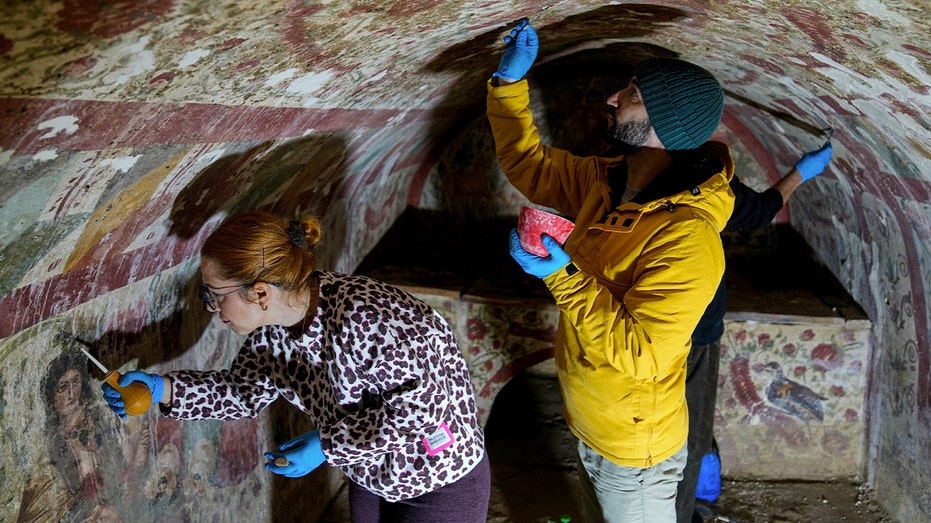
The fresco portrays a young, clean-shaven Jesus, dressed in a toga, carrying a goat on his shoulders — a classical “Good Shepherd” motif that would have been instantly recognizable to Roman-era viewers. Archaeologists suggest it may be the only known example of its kind in Anatolia (Asia Minor), once a key crossroads of early Christianity.
This matters for several reasons:
- Iconography at a turning point: It captures Christianity before its imagery hardened into the bearded, haloed Christ we know from later Byzantine art.
- Evidence of inculturation: It shows Christians were not rejecting Roman culture wholesale, but repurposing its visual language to communicate a new faith.
- Local Christian communities: It confirms a sophisticated Christian presence in the region before the Council of Nicaea, in a period still marked by persecution.
- Modern symbolism: It becomes a visual bridge between Roman, Byzantine, and contemporary religious geopolitics, especially in a Turkey that carefully manages Christian heritage for diplomatic and touristic purposes.
From Catacombs to Councils: The Historical Backdrop
The fresco dates to the third century, when Christians in the Roman Empire lived in a paradox: increasingly numerous and organized, yet periodically persecuted and formally illegal until the early fourth century.
The Good Shepherd motif has deep roots in both pagan and Christian art:
- In Greco-Roman tradition, shepherd figures, especially the kouros carrying an animal, symbolized benevolent care, sometimes linked to gods like Hermes or depictions of philanthropy and pastoral rule.
- In Jewish and Christian scripture, God is depicted as a shepherd (Psalm 23), and Jesus famously says, “I am the good shepherd” (John 10). Early Christians adopted this imagery because it conveyed protection and care without immediately signaling a forbidden new religion.
In the Roman catacombs, some of the earliest known Christian images depict a youthful shepherd carrying a sheep or goat — often ambiguous enough that it could pass as a generic pastoral scene. This ambiguity provided a layer of protection in an era when explicit Christian symbolism could be risky.
Iznik’s ancient identity as Nicaea adds another layer. A generation or two after this tomb was likely sealed, the city hosted the Council of Nicaea in 325, convened by Emperor Constantine. There, bishops hammered out the Nicene Creed to resolve disputes about Christ’s nature, especially the Arian controversy (was Jesus fully divine, or a created being?).
The contrast is revealing:
- In the tomb: Jesus is visually coded as a Roman figure of care and protection, with little theological precision visible on the wall.
- In the council hall: Jesus is defined in highly technical terms: “God from God, Light from Light, true God from true God.”
The fresco thus captures Christianity in its lived, devotional form just before its doctrines were codified in imperial language.
What This Really Tells Us About Early Christianity
1. A Religion at Home in Roman Culture
The Roman-style Jesus undermines a modern assumption that early Christians saw themselves as completely outside or against Roman culture. Many did reject pagan worship, but they lived, traded, dressed, and thought within Roman frameworks.
By using Roman visual conventions (toga, youthful hero type), early Christians were doing something strategic: translating their faith into the cultural grammar people already understood. The Good Shepherd motif becomes a kind of visual bilingualism — speaking both “Roman” and “Christian” at once.
2. The Politics of Persecution and Discretion
The third century saw waves of persecution, notably under emperors Decius (249–251) and Diocletian (beginning 303). In that context, explicit crosses or crucifixion scenes were rare; they were both theologically sensitive and politically dangerous.
The Good Shepherd, by contrast, is softly coded: to insiders, it clearly evokes Christ; to outsiders, it could be just another pastoral scene. The tomb’s underground setting reinforces this duality: a private, sacred space where a community could afford slightly bolder Christian imagery, yet still drawn from the mainstream Roman visual toolkit.
3. An Anatolian Christian Identity More Complex Than East/West
Modern Christian maps tend to divide history into “Western Catholic” and “Eastern Orthodox,” but this fresco reminds us that in the third century, those categories didn’t exist. Asia Minor was a dense patchwork of communities: Greek-speaking, Roman-governed, religiously diverse, and increasingly Christian.
The find suggests that Christians in Anatolia were not merely passive recipients of theology from centers like Rome or Alexandria. They were active experimenters in how to visualize and live out the faith. This matters today as both the Vatican and Orthodox leaders seek to reclaim Nicaea as a shared heritage site, even though many of the early communities who built that heritage no longer exist locally.
4. Visual Theology Before Written Dogma
Art historian Jaroslav Pelikan once noted that “before Christians argued about doctrine, they painted and prayed.” This fresco exemplifies that. Before the Nicene Creed defined Christ as “consubstantial with the Father,” ordinary believers were already expressing who they thought Jesus was through images like this shepherd.
The choice of a young, approachable shepherd rather than a distant enthroned king emphasizes Jesus as protector and guide, less as imperial ruler. In a region administered by Roman authorities, that was a subtle but meaningful choice: Jesus is “one of us” in dress and age, yet stands out by his care for the vulnerable (symbolized by the goat or sheep).
Modern Layers: Pope Leo XIV, Turkish Politics, and the Use of the Past
The timing of the discovery alongside Pope Leo XIV’s visit is striking, and politically useful to multiple actors.
For the Vatican: The fresco anchors the pope’s trip in tangible history. Presenting a Roman-looking Jesus in Turkey underscores the idea that Christianity’s roots are not only in Rome and Jerusalem, but also in Anatolia — the land of Paul’s journeys, early councils, and now, this tomb.
For Turkey’s government: President Recep Tayyip Erdoğan’s decision to present a tile painting of the Good Shepherd fresco to the pope is part cultural diplomacy, part narrative control. It allows Ankara to project itself as guardian of a multi-layered heritage that includes Christian history, even as domestic policy on religious minorities and historic churches remains contested.
By spotlighting a Christian artifact in a majority-Muslim country, Turkey can:
- Signal openness to Christian leaders and Western audiences.
- Boost cultural tourism tied to early Christianity.
- Frame itself as steward, not suppressor, of its pre-Islamic past — on its own terms.
For ecumenical relations: Pope Leo XIV’s joint prayer with Eastern and Western patriarchs over the site of the Nicene Creed echoes the fresco’s quiet message: Christianity once spoke a more shared visual language before later schisms. A Roman-coded Jesus in Anatolia subtly undermines rigid East/West cultural ownership of Christian origins.
Data Points: How This Fits Broader Archaeological Trends
- Early Christian sites in Turkey: Scholars estimate thousands of early Christian structures and burial sites across Anatolia, many under-excavated. High-profile finds, like this fresco, are just the visible tip of a much larger, largely unexplored record.
- Iconographic rarity: While Good Shepherd scenes are relatively common in the Roman catacombs (3rd–4th century), documented examples in Anatolia with clearly Roman attributes for Jesus are rare enough that the lead archaeologist believes this may be unique in the region.
- Tourism and heritage: Turkey has seen steady growth in religious and cultural tourism. Sites tied to early Christianity (Ephesus, Cappadocia, ancient Laodicea) are increasingly marketed; a high-profile Good Shepherd fresco near Iznik fits this pattern and may accelerate investment in the area.
What Might Be Overlooked in Mainstream Coverage
Most headlines emphasize the “rare fresco” and the coincidence of the pope’s visit. But several deeper questions are being missed:
- Whose tomb was this? The social status of the person buried here — inferred from the tomb’s construction, location, and artwork — could reveal whether Christian iconography in the region was primarily elite, middle-class, or communal.
- How local was the style? Was the artist trained in a Roman-Greek workshop tradition based in Anatolia, or do stylistic parallels suggest influence from other regions, such as Syria or Rome itself?
- What does the animal choice mean? Many Good Shepherd images show a sheep. A goat could be a simple variation, or it might reflect local pastoral life or specific theological resonances (goats and sheep are contrasted in Matthew 25).
- Preservation vs. display: How Turkey chooses to conserve, study, and display the tomb will signal its long-term approach to Christian heritage — scholarly priority or political token?
Looking Ahead: Why This Find Will Matter for Years
Several developments to watch:
- Further excavations in Iznik: This tomb may be part of a broader Christian necropolis. Systematic excavation could map out a whole community’s burial practices and artistic choices, offering a local counterpoint to Rome’s catacombs.
- Scientific analysis: Pigment and plaster studies can date the fresco more precisely, identify trade networks for materials, and reveal whether the work was altered or repainted over time.
- Digital documentation: High-resolution 3D scans will be key for both conservation and open research access, reducing the risk that the fresco becomes a solely state-controlled symbol.
- Interfaith and ecumenical use: Expect future papal, Orthodox, and possibly Protestant delegations to visit Iznik, with this fresco becoming a visual touchstone for preaching about unity, roots, and continuity.
- Public debates on Jesus’ appearance: Although this image is more about cultural coding than historical portraiture, it will likely feed into ongoing discussions about how different cultures and eras imagine Jesus — and who “owns” his image.
The Bottom Line
This Good Shepherd fresco is far more than a rare piece of Christian art. It crystallizes a moment when Christianity was still illegal, still negotiating its relationship to Roman culture, and still defining who Jesus was in practice before it defined him in councils.
Rediscovered just as Pope Leo XIV and global church leaders return to Nicaea to celebrate doctrinal unity, the fresco quietly reminds us of an earlier unity — not of dogma, but of shared imagery and lived devotion. And in modern Turkey, where ancient Christian sites have become instruments of soft power, the painting is also a test of how plural a national story the state is willing to tell.
Expert Perspectives
On the iconography: Art historians note that the Iznik fresco aligns with broader patterns of early Christian visual strategy.
“What we’re seeing is not a ‘Roman Jesus’ versus a ‘Christian Jesus’,” explains Dr. Robin Jensen, a scholar of early Christian art, in her previous work on catacomb imagery. “We’re seeing a community using the only visual vocabulary it had — Greco-Roman — and infusing it with new meaning.”
On theology and history: Church historian Prof. John Behr has written that pre-Nicene Christianity is often misread through post-Nicene lenses. Finds like this fresco “force us to remember that for most Christians, faith was not primarily about creeds debated in imperial halls, but about how they imagined Christ in prayer, burial, and everyday life.”
On contemporary politics: Middle East and religion analyst Dr. Elizabeth Prodromou notes that “Christian heritage in Turkey has become a key bargaining chip in international diplomacy.” Showcasing a Good Shepherd fresco while gifting a reproduction to the pope, she argues, is “a classic example of cultural heritage being mobilized as a tool of soft power, signaling inclusivity without necessarily changing the lived realities of Christian minorities.”
FAQ
Does this fresco tell us what Jesus really looked like?
No. The image reflects how a particular community in Roman Anatolia chose to imagine and communicate Jesus, not a historical portrait. The toga, youthfulness, and clean-shaven face are artistic conventions derived from Roman visual culture. They tell us more about the cultural environment of early Christians and their evangelization strategies than about Jesus’ actual appearance.
Is the Good Shepherd image uniquely Christian?
Not originally. Shepherd figures carrying animals appear in pre-Christian Greek and Roman art, often symbolizing pastoral care or benevolence. Early Christians deliberately adopted this familiar motif, layering onto it the biblical meaning of God and Christ as shepherd. Over time, in Christian contexts, the Good Shepherd became strongly and specifically associated with Jesus.
Why is Anatolia so important to early Christianity?
Anatolia was central to early Christian expansion: many of Paul’s journeys passed through the region; several New Testament letters are addressed to communities there (Ephesus, Galatia, Colossae); and major councils, including Nicaea, took place in its cities. The Iznik fresco reinforces that this land was not a peripheral frontier but a core landscape where Christianity’s identity, practices, and art were forged.
How might this discovery affect relations between Christian churches today?
Symbolically, it gives both Eastern and Western leaders a shared artifact in a shared space, reinforcing the message that Christianity’s roots predate later schisms. Pope Leo XIV’s joint prayer with Eastern patriarchs in Iznik, framed by this discovery, emphasizes continuity with a pre-divided church. While such symbolism won’t by itself resolve doctrinal disputes, it can create a more receptive atmosphere for dialogue by grounding conversations in common history.
Will the tomb and fresco be accessible to the public?
That will depend on Turkish heritage authorities’ decisions. Typically, fragile frescoes require careful conservation, controlled humidity, and limited foot traffic. Authorities may opt for a combination of in situ preservation with restricted access, high-quality replicas for public viewing, and digital exhibitions. How open or restricted access becomes will be an indicator of Turkey’s broader approach to Christian archaeological sites going forward.
Key Insights
- The Roman-style Good Shepherd fresco reveals how early Christians in Anatolia adapted imperial visual language to express their faith before doctrinal debates were settled.
- The find underscores Nicaea’s role not just as a council site but as a living Christian community experimenting with art, identity, and devotion in the third century.
- Pope Leo XIV’s visit and Erdoğan’s gift of a Good Shepherd-inspired artwork highlight how Christian heritage in Turkey is increasingly used as diplomatic soft power.
- The fresco challenges simplistic East/West narratives by showing a culturally hybrid Christianity that predated later Catholic–Orthodox divisions.
- Decisions about conservation, access, and further excavation around Iznik will shape both scholarly understanding and how the public encounters early Christian history.
Related Topics
- Early Christian art and the evolution of Jesus’ image
- The Council of Nicaea and the making of the Nicene Creed
- Cultural heritage and religious diplomacy in modern Turkey
- Archaeology of Christian communities in Roman Anatolia
Topics
Editor's Comments
What stands out in this story is how quietly radical the fresco is compared with the choreography around it. On one hand, you have a third-century community using the empire’s own aesthetic language to depict a non-imperial Christ—young, approachable, and coded in a way that could slip under the radar of hostile authorities. On the other, you have twenty-first century states and churches performing unity and heritage against a backdrop of deep political and theological fractures. The risk is that the fresco becomes a prop in these modern scripts: a diplomatic gift, a photo op, a tourism brand. The opportunity is different: to let this image unsettle tidy narratives, including the Vatican’s story of linear doctrinal development and Turkey’s selective embrace of its pre-Islamic past. If we take the find seriously, it forces uncomfortable questions. How much of Christian identity has always been negotiated within dominant cultures rather than against them? And how much of today’s use of the past is about reconciling communities, versus managing them for geopolitical gain?
Like this article? Share it with your friends!
If you find this article interesting, feel free to share it with your friends!
Thank you for your support! Sharing is the greatest encouragement for us.