Beyond the Poll: Why Americans Are Ready to Ban Kids From Social Media

Sarah Johnson
December 18, 2025
Brief
Analysis of why nearly two-thirds of U.S. voters now support banning social media for kids under 16, how Australia’s under-16 ban reshapes the debate, and what this shift means for future regulation.
Why Americans Are Suddenly Comfortable With Banning Kids From Social Media
In barely a decade, social media went from being marketed as a tool for empowerment and connection to something a solid majority of American voters now want to keep away from children entirely. A new national poll showing that nearly two-thirds of voters — and parents — support banning social media for kids under 16 is not just another data point in the tech backlash; it’s a sign that the political and cultural ground has shifted under Silicon Valley’s feet.
What’s emerging is a rare convergence: bipartisan public alarm, mounting scientific evidence about harms, and new international precedents like Australia’s sweeping under‑16 ban. That combination is moving the question from “Is social media bad for kids?” to “How far are we willing to go to stop it?”
From Tech Optimism to Safety Backlash
To understand why 64% of American voters now support banning social media for minors under 16, you have to rewind to how we got here.
In the late 2000s and early 2010s, platforms like Facebook, YouTube, and later Instagram and Snapchat positioned themselves as democratizing tools — expanding speech, community, and opportunity. The regulatory framework largely reflected that optimism. The core law governing online platforms’ liability, Section 230 of the Communications Decency Act (1996), was written long before social media as we know it existed and was meant to protect fledgling internet companies, not trillion‑dollar advertising empires.
For children, the main federal rule has been COPPA (the Children’s Online Privacy Protection Act), which nominally restricts data collection from kids under 13. In practice, that age floor has become a fiction: platforms rely on self‑reported ages, kids routinely lie to sign up, and enforcement has been sporadic. Social media was effectively built for “everyone,” and children became the product’s heaviest experimental users.
The big shift began around 2017–2020, when studies started connecting heavy social media use and mental health problems among adolescents. The U.S. Surgeon General’s 2023 advisory flagged social media as a potential “risk of harm” to youth, citing correlations with depression, anxiety, body image disorders, and sleep disruption. The CDC’s Youth Risk Behavior Survey documented rising rates of sadness, suicidal ideation, and self‑harm among teens, especially girls, over roughly the same period that smartphone penetration and social media use exploded.
Parents might not follow academic journals, but they see the behavior patterns at home: kids scrolling late into the night, spiraling over likes and comments, or being drawn into toxic content and online harassment. When a Fox News poll now finds 64% of parents and voters backing an under‑16 social media ban, that’s less an ideological reaction and more a culmination of years of accumulating unease.
Why Support Is So High — and Why Republicans Lead
The headline numbers in the poll are striking:
- 64% of voters favor banning social media for children under 16; 35% oppose.
- Parents mirror that support almost exactly: 64% in favor, 36% opposed.
- Republicans are most supportive at 73%, Democrats at 56%.
- Support for banning cellphones in K‑12 classrooms is even higher at 69%; among Republicans, 81% back the move versus 59% of Democrats.
Three dynamics are driving these numbers.
1. Cultural and ideological frames
Conservatives have increasingly framed social media as part of a broader cultural threat: exposure to inappropriate sexual content, political radicalization, and what they see as ideological indoctrination. This aligns naturally with a willingness to use state power to restrict access in the name of protecting children — a theme that has already surfaced in battles over school curricula, library content, and gender‑related care.
Democrats, by contrast, often approach online harms through the lens of consumer protection, civil rights, and mental health. That can translate into more nuanced positions: strong support for regulation and platform accountability, but some hesitation about outright age‑based bans that might raise equity or civil liberties concerns. Still, 56% support among Democrats is notable; this is not a partisan fringe issue.
2. The classroom as a battleground
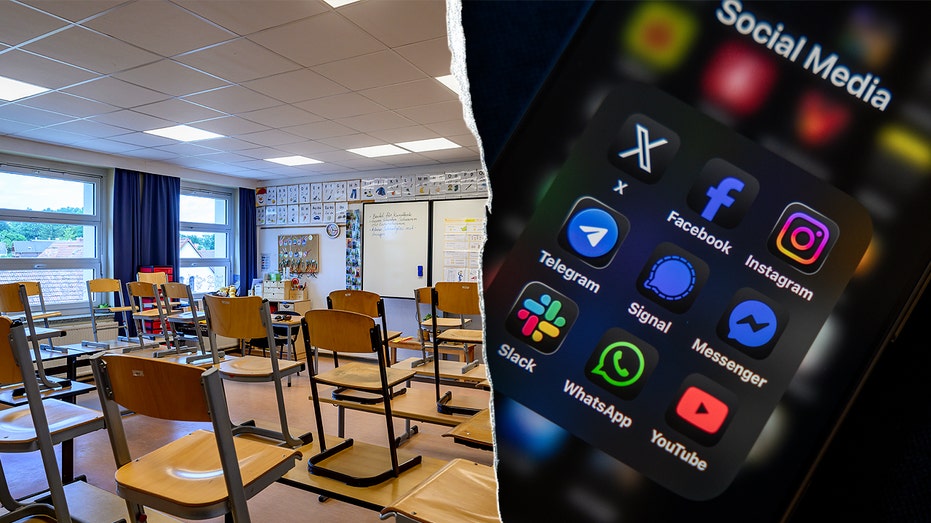
The 69% support for banning phones in classrooms shows that voters are not just worried about content but about distraction and academic decline. The timing matters: post‑pandemic learning loss, plunging test scores, and teacher reports that they are competing with TikTok for students’ attention are reshaping public expectations of schooling.
Internationally, phone bans in schools have become common. France, the Netherlands, parts of the U.K., and now multiple U.S. districts have implemented versions of no‑phone policies. That global trend makes the idea feel less radical and more like overdue housekeeping.
3. The parenting burden and the demand for structural help
Parents are often told to “just set limits” on screens, but the reality is they are trying to do that in an environment designed to defeat them: 24/7 access, addictive design features, peer pressure, and homework increasingly tied to online tools. The survey’s equal support levels among parents and non‑parents signal a shift from blaming individual parenting to seeking structural guardrails — much like we eventually did with secondhand smoke, car seats, and age‑restricted products.
Australia’s Ban: A Real-World Test Case
Australia’s new law, barring anyone under 16 from having a social media account, is the policy embodiment of what many American voters say they want. It requires platforms to take “reasonable steps” to stop under‑16s from opening accounts, to remove existing underage users, and to block re‑registration attempts. Non‑compliance can cost a platform up to 49.5 million Australian dollars (about U.S. $32 million).
This is important for the U.S. debate for three reasons:
- Proof of concept: It’s no longer theoretical to ask whether major platforms can be forced to implement age controls — another advanced democracy is doing it.
- Technical precedent: Australia’s requirement to use “age‑assurance tools” and detect VPN workarounds will generate data on what actually works and what creates new privacy risks.
- Political cover: U.S. lawmakers now have a concrete model to point to when arguing that Congress has been too slow to act.
But it also lays bare the core contradictions: any robust age verification system risks either collecting more sensitive data (e.g., IDs, biometrics) or creating a two‑tier internet where anonymity — long a cornerstone of online speech — becomes harder to maintain.
What the Data Actually Say About Kids and Social Media
The Fox poll sits alongside a growing body of data, some of it referenced in the article:
- A 2025 Pew Research Center report found that nearly half of teens say social media has a mostly negative effect on people their age.
- A 2023 Gallup survey of more than 1,500 adolescents showed 51% of U.S. teens spend at least four hours a day on social media, with an average of 4.8 hours across seven platforms.
- Usage increases with age: 13‑year‑olds average 4.1 hours daily; 17‑year‑olds, 5.8 hours.
- Girls spend nearly an hour more per day online than boys (5.3 vs. 4.4 hours).
These numbers matter because they point to both scale and vulnerability. For many 13‑ to 17‑year‑olds, social media isn’t just a hobby; it competes with sleep, in‑person interaction, and schoolwork. The gender gap aligns with research showing that girls are especially susceptible to appearance‑based comparison and online social exclusion, linked to higher rates of anxiety and depression.
However, what often gets lost in simplified media narratives is that the research literature is still contested. Some studies find modest average effects, others highlight specific high‑risk subgroups. The nuance is this: it’s not that social media inevitably harms every teen, but that it creates an environment where particularly vulnerable kids can be exposed to relentless, algorithm‑driven reinforcement of their insecurities or self‑harm ideation.
What This Moment Really Signals: A Shift in Regulatory Philosophy
The most consequential aspect of this poll is not the exact support percentage, but what it reveals about public willingness to embrace a more paternalistic approach to digital life. For years, governments treated online platforms as neutral intermediaries and adults as fully responsible for their own (and their children’s) digital choices. That logic is crumbling.
We are likely moving toward a framework that treats social media for minors more like alcohol or gambling: a potentially harmful product whose risks justify age checks, strict design constraints, and liability for companies that fail to protect young users.
At recent Senate hearings, lawmakers floated exactly this shift — tougher accountability, stronger age restrictions, and potential changes to Section 230 to narrow platforms’ immunity when they fail to mitigate foreseeable harms to minors. Bipartisan bills like the emerging GUARD Act and earlier proposals such as the Kids Online Safety Act reflect a new consensus: the “hands‑off” era is over.
Expert Perspectives: Harm Reduction vs. Prohibition
Behind the scenes, there’s a serious debate among child development specialists, free‑speech advocates, and tech policy experts about whether outright bans are the right tool.
Dr. Candice Odgers, a developmental psychologist who has studied teens and technology, has often cautioned against overly simple narratives: many teens benefit from online communities, especially marginalized youth who find support networks they lack offline. The risk, she and others argue, is that blunt bans could remove lifelines along with harms.
Dr. Jonathan Haidt, a social psychologist whose work has popularized the idea of a “great rewiring of childhood,” takes a different view, emphasizing the unprecedented nature of constant smartphone‑mediated social comparison and advocating for stronger age limits and phone‑free schools as a necessary reset.
Legal scholars add another layer: any U.S. law replicating Australia’s approach would immediately face First Amendment challenges. Courts have historically treated minors as having constitutional rights, though not identical to adults’. The Supreme Court in Brown v. Entertainment Merchants Association (2011) struck down a California law restricting the sale of violent video games to minors, signaling skepticism about government‑defined categories of “harmful” media.
That case didn’t involve data‑driven algorithmic feeds or real‑time social feedback loops. The question now is whether courts will see social media as just another communications medium or as something closer to an addictive, highly personalized behavioral manipulation system — a distinction that could justify a different regulatory approach.
What’s Being Overlooked: Design, Not Just Age
Most of the current debate centers on who is allowed to use social media (age), not how these platforms are designed. That may turn out to be the biggest blind spot.
If we only raise age limits, platforms still have an incentive to maximize engagement among those over 16 — and teens just above that threshold are hardly invulnerable. The algorithms, infinite scroll, push notifications, and engagement‑based ranking systems that optimize for time‑on‑site will continue to drive addictive usage patterns and amplify extreme or emotionally charged content.
A more comprehensive approach would combine age restrictions with:
- Limits on algorithmic amplification of self‑harm, eating disorder, and hate content.
- Default settings that reduce notifications and eliminate features like streaks that exploit psychological vulnerabilities.
- Transparency requirements for recommendation systems used on minors.
- Independent auditing of harms, not just self‑reported safety metrics from the platforms themselves.
Without design‑focused regulation, a ban may simply push younger teens to lie about their age, use VPNs, or migrate to less regulated, more opaque platforms — precisely where oversight is weakest.
Looking Ahead: Three Scenarios to Watch
As public support for restrictions hardens, several paths are emerging.
1. The Australia Effect
If Australia’s law is enforced aggressively and produces measurable improvements — fewer reports of cyberbullying, self‑harm content exposure, or teen mental health crises — it could become the template for a wave of similar laws across liberal democracies, including parts of the U.S. Even partial success will embolden regulators elsewhere.
2. Patchwork U.S. Regulation
Absent federal consensus, expect more state‑level experiments: some states may emulate Australia with strict age limits and verification, while others focus on school‑based phone bans or targeted safety regulations. This patchwork will create compliance headaches for platforms and raise questions about interstate consistency, much like early privacy laws did.
3. Quiet Industry Redesign
Under mounting political pressure, major platforms may voluntarily implement stronger age checks, kids’ modes, and design changes to stave off harsher regulation. Think of it as the “food labeling” phase: companies adjust just enough to argue formal bans are unnecessary, while policymakers decide whether those moves are genuine or cosmetic.
The Bottom Line
The fact that nearly two‑thirds of American voters — across party lines — now support banning social media for children under 16 marks a turning point. It signals that the public no longer sees youth social media use as a neutral or inevitable part of growing up, but as a risk that may justify heavy-handed state intervention.
The challenge now is to translate that anxiety into policy that actually protects children without sliding into overreach, eroding privacy, or inadvertently harming the very kids it aims to help. The next few years will determine whether we treat this as a narrow age‑gate issue or as the catalyst for a fundamental rethinking of how much power we’re willing to give attention‑harvesting algorithms over the most vulnerable users in our society.
Topics
Editor's Comments
One critical tension largely missing from mainstream coverage is the class and access dimension of under-16 social media bans. Teens with engaged, well-resourced parents will be better positioned to navigate new restrictions, find alternative offline activities, and access in-person mental health support. For lower-income youth or those in unstable homes, online spaces sometimes function as a primary social outlet or informal support network. A blanket ban could inadvertently widen existing inequalities unless policymakers simultaneously invest in community-based programs, school counselors, and safe physical spaces for teens to gather. Another underexamined question is who profits from the regulatory response: a heavy emphasis on commercial age verification could entrench large incumbents who can absorb compliance costs, while squeezing out smaller platforms that might be willing to experiment with healthier designs. The risk is that we simply harden the dominance of the same companies that helped create the problem, while patting ourselves on the back for ‘protecting kids.’
Like this article? Share it with your friends!
If you find this article interesting, feel free to share it with your friends!
Thank you for your support! Sharing is the greatest encouragement for us.