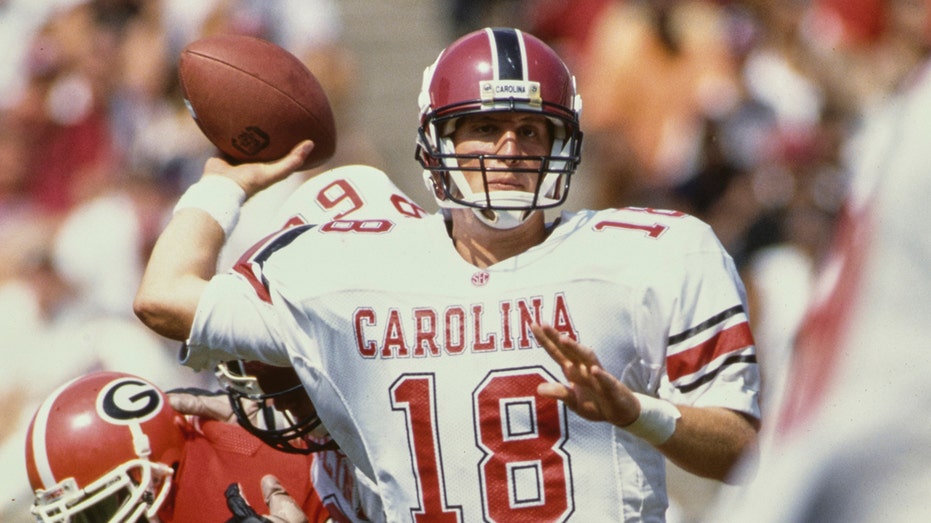
Brett Favre, Social Media, and the New ‘Wild West’ Reshaping College Sports

Sarah Johnson
December 16, 2025
Brief
Brett Favre’s critique of social media and loyalty in college sports reveals a deeper power shift driven by NIL, transfers, and digital attention economics. This analysis unpacks what’s really changing—and who benefits.
Brett Favre, Social Media, and the New "Wild West" of College Sports
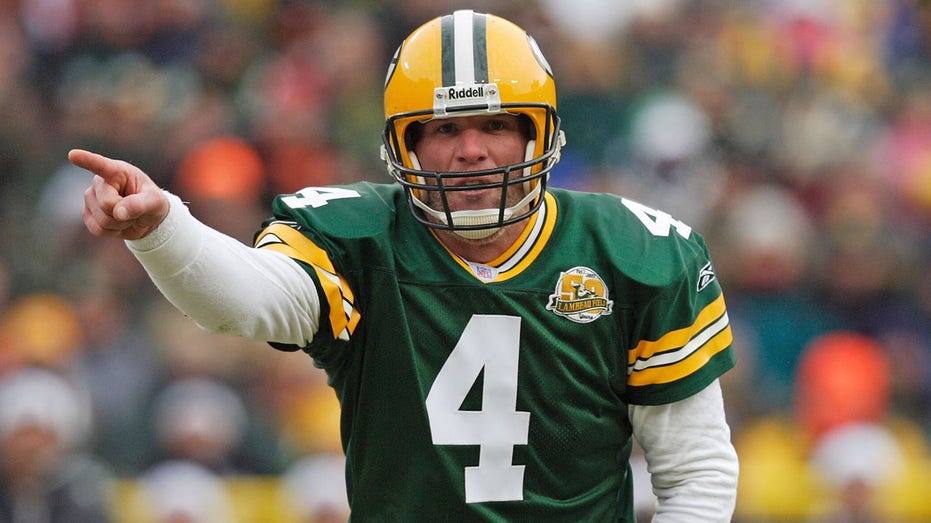
When Brett Favre calls today’s social media landscape the “wild, wild west,” it’s tempting to hear it as just another retired star pining for a simpler past. But buried in his frustration is a revealing snapshot of how digital culture, big money, and shifting power dynamics are transforming not only college sports, but American social norms themselves.
Favre’s comments about instant gratification, click-chasing, and eroding loyalty in college athletics point to a deeper question: what happens when a system built on long-term relationships and institutional power suddenly collides with platforms and incentives designed for speed, visibility, and individual gain?
From Loyalty to Liquidity: How College Sports Entered the Market Era
For most of the 20th century, college sports operated on a fairly rigid social contract. Players were expected to show loyalty to their school, often sitting for years behind older players, while coaches and universities wielded near-total control over athletes’ mobility and earning power. Transfers required waivers. Earning money off one’s own name or image was prohibited. The NCAA framed this as preserving “amateurism”; in practice, it preserved institutional power.
That model began to crack under both legal and cultural pressure. Key turning points include:
- O’Bannon v. NCAA (2014): A former UCLA basketball star challenged the NCAA’s use of player likenesses in video games without compensation, opening the door to questioning the amateurism model.
- State NIL laws (2019–2021): States like California passed laws allowing athletes to profit from their name, image, and likeness (NIL), forcing the NCAA to adapt or risk legal chaos.
- NCAA’s 2021 NIL policy shift: The association formally allowed athletes to earn money from endorsements, social media, and other commercial deals.
- Transfer portal liberalization: Rules were eased so athletes could switch schools once without sitting out a season, dramatically increasing mobility.
The result: a system that used to prize patience and loyalty now increasingly operates like a fluid labor market. Favre’s lament that “it’s about how well you can do now … and move on to bigger and better things” is accurate—but what he describes as a cultural decline is also, for many players, long-delayed economic and personal agency.
The Social Media Engine: Visibility as Currency
Favre links this shift to what he calls a culture of “how many clicks you can get immediately.” In today’s college sports ecosystem, that’s not hyperbole; visibility is literally convertible into cash.
Social media has turned attention into a measurable, monetizable asset. An athlete with 500,000 followers doesn’t just have a fan base; they have a bargaining chip. NIL deals often track directly with online reach:
- A standout women’s basketball player or gymnast with a strong TikTok or Instagram presence can out-earn male counterparts in revenue sports because of superior engagement.
- Recruiting battles now routinely involve how a school can help “build the brand” of a player across platforms.
- Collectives and boosters monitor players’ social media as part of their evaluation of endorsement value.
Favre’s criticism—“It’s more about how popular I can get instantaneously rather than really good content”—captures a broader anxiety. But it also reveals a generational and structural blind spot: in today’s market, popularity is the product. Whether that’s good for society is a fair question; that it’s happening is not.
The Hypocrisy Question: Coaches, Contracts, and One-Way Loyalty
One of the most important pieces in Favre’s conversation is almost a throwaway: the fact that coaches have long been able to leave schools “without consequences,” while players were historically locked into restrictive systems. Social media and NIL didn’t create disloyalty; they exposed how asymmetrical it already was.
For decades:
- Coaches routinely broke contracts to chase better jobs and paydays, sometimes leaving recruits in precarious positions.
- Universities and conferences negotiated billion-dollar media deals while players received no cut of that revenue.
- Transfers were stigmatized as selfish or disloyal, even as institutions reshuffled conference affiliations for money.
What’s changed is that players now have some of the same tools—mobility, visibility, monetization—that institutions and coaches have long enjoyed. Favre is right that we’re seeing “a sign of the times,” but the sign may be less about collapsing values and more about power finally being distributed more evenly, however chaotically.
Instant Gratification vs. Structural Insecurity
There is a genuine cultural shift towards immediacy. Social platforms reward short-term spikes in engagement. Algorithms favor outrage, novelty, and virality over slow-building trust or loyalty. For young athletes, that creates real pressure:
- To constantly post, perform, and cultivate a persona.
- To chase short-term opportunities rather than long-term development.
- To measure self-worth and success through likes, followers, and NIL deals.
But attributing all of this to moral decline ignores a structural reality: college athletes operate in a precarious environment. Scholarships are not guaranteed multiyear contracts. One injury can end a career. Coaches can be fired overnight. Conference realignments can upend schedules, travel, and exposure.
In a system this unstable, the “instant gratification” Favre critiques often looks like rational risk management. If you have a narrow window to earn money and secure your future, waiting patiently can be economically irrational. The logic of social media—maximize attention now—aligns perfectly with the logic of a short, uncertain athletic career.
The “Wild, Wild West”: Chaos or Transition?
Favre’s “wild, wild west” metaphor is becoming a cliché in discussions of NIL and transfers, but it points to something real: a regulatory vacuum. Rules are catching up to new realities, and in the gap, opportunists and bad actors inevitably thrive.
Areas where the chaos is most visible:
- Booster collectives: Loosely regulated groups promise NIL money to attract recruits, blurring the line between legitimate endorsement and pay-for-play.
- Unequal access: High-profile programs with wealthy donors can offer far more NIL opportunities than smaller schools, potentially widening competitive gaps.
- Player exploitation: Without strong guidance, young athletes can sign unfair contracts, mismanage money, or be pushed into decisions that prioritize short-term cash over health or education.
However, “wild west” periods are also historically transitional. In the late 19th century American West, law and norms eventually caught up with new economic realities. The same is likely here: clearer NIL rules, agent regulation, contract standards, and mental health support will almost certainly tighten the current free-for-all.
What Favre Gets Right—and What He Misses
Favre’s perspective taps into a broader public concern that social media is hollowing out the values of commitment, patience, and substance. He’s not wrong to notice:
- A culture of performance and self-promotion that can overshadow craft and team identity.
- The psychological toll of constant online scrutiny on young athletes.
- The erosion of shared, in-person community as digital engagement becomes central.
But his framing largely overlooks three crucial dynamics:
- Longstanding institutional hypocrisy: Loyalty has rarely been reciprocal in college sports. Players were expected to sacrifice while institutions cashed in.
- Economic justice: NIL is, at its core, about allowing athletes—many from working-class or marginalized backgrounds—to benefit from the value they clearly generate.
- Digital literacy gap: Those who “don’t have TikTok” may underestimate how deeply online platforms structure social and economic opportunity for younger generations.
In other words, Favre is diagnosing symptoms without fully engaging the underlying disease: a commercialized, high-pressure system that long relied on unpaid labor and now faces the consequences of granting that labor some leverage.
Expert Perspectives: Beyond the Nostalgia
Digital culture and sports economists have been dissecting these trends for years. Several themes recur:
- On NIL and power: Scholars note that NIL shifts bargaining power without fundamentally changing the commercial nature of college sports; it simply makes that commercial reality more honest.
- On social media incentives: Communication researchers warn that algorithm-driven visibility can skew behavior toward extremes—flashy plays, trash talk, brand-building—at the expense of long-term development.
- On mental health: Sports psychologists increasingly see social media management as a core part of athlete support, not an optional add-on.
Across these perspectives, one point is consistent: nostalgia for a pre-digital, pre-NIL era often glosses over who benefited and who paid the price.
What To Watch Next: Regulation, Backlash, and Adaptation
The “wild west” Favre sees is unlikely to last in its current form. Expect several developments:
- Stricter NIL frameworks: Either through federal law or more detailed governing body rules, we’ll likely see standardized contracts, transparency requirements, and clearer boundaries for booster involvement.
- Enhanced player support: More programs will offer financial literacy training, brand management education, and mental health resources tailored to the pressures of being both athlete and influencer.
- Cultural rebalancing: As the initial NIL gold rush normalizes, some athletes and programs will differentiate themselves by emphasizing development, team culture, and long-term value over pure visibility.
- Continued generational friction: Retired stars and older fans may keep framing these shifts as moral decline, while players see them as overdue fairness. That tension will shape public narratives.
The Overlooked Story: Who Gets Left Behind?
One aspect missing from Favre’s critique, and much mainstream coverage, is the uneven impact of the new system. Attention-based economies are inherently unequal:
- High-profile quarterbacks and skill players can attract major deals; offensive linemen or athletes in non-revenue sports often cannot.
- Women’s sports see both new opportunity and new pressure; a handful of stars thrive while many others struggle to gain visibility.
- Smaller schools and lower-income athletes may lack access to the networks and advisors needed to navigate NIL safely.
If the “wild west” analogy holds, the risk is that we end up with a few barons and many precarious participants. The challenge for regulators and institutions is to ensure that expanded freedom doesn’t simply re-create old inequalities in a shinier, more digital form.
The Bottom Line
Favre’s lament about social media and loyalty resonates because it touches real anxieties about a culture that often prizes visibility over depth and speed over substance. But the transformation of college sports is not just a story of moral drift; it’s the collision of old power structures with new tools that finally give athletes leverage.
The “wild, wild west” of NIL, transfers, and social media is messy, and not without real harms. It’s also, for many players, the first time the system has acknowledged their economic value. The real question isn’t whether we can return to a more loyal past—we can’t—but whether we can build a more regulated, equitable future where freedom, fairness, and long-term development can coexist with the realities of a digital attention economy.
Topics
Editor's Comments
What’s striking about Favre’s remarks is how representative they are of a broader backlash from older generations toward an increasingly transactional, visibility-driven culture. Yet the narrative of lost loyalty subtly erases who benefited from the old system. For decades, universities and coaches monetized players’ labor and likenesses under the banner of amateurism, enforcing loyalty on one side while reserving flexibility on the other. NIL and the transfer portal haven’t invented selfishness; they have redistributed leverage in a way that makes longstanding self-interest more obvious and more evenly shared. The real challenge now isn’t to moralize about ‘kids these days,’ but to confront uncomfortable questions: How do we design guardrails that protect young athletes without reimposing paternalistic control? How do we reconcile billion-dollar media deals with claims of educational mission? And perhaps most importantly, can we build a model where athlete autonomy, institutional stability, and genuine community can coexist in an attention economy that rewards speed, spectacle, and constant self-promotion?
Like this article? Share it with your friends!
If you find this article interesting, feel free to share it with your friends!
Thank you for your support! Sharing is the greatest encouragement for us.