Steve Taneyhill’s Death and the Vanishing Era of the Local College Football Legend

Sarah Johnson
December 16, 2025
Brief
Steve Taneyhill’s death at 52 is more than a tragic headline. It exposes how college football, Southern identity, and the idea of a local sports hero have radically changed over three decades.
Steve Taneyhill’s Death at 52: What a Cult-Classic Quarterback Reveals About Modern College Football and Southern Identity
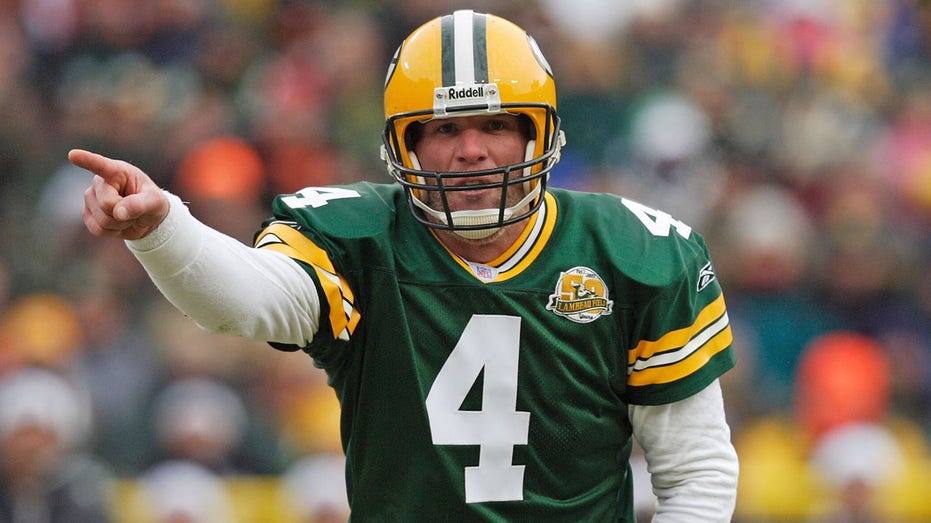
News of Steve Taneyhill’s death at 52 has hit South Carolina like the loss of a family member, not just a former quarterback. To outsiders, he was the mulleted gunslinger with the “home run swing” touchdown celebration. To Gamecock fans, he was something more subtle and enduring: a bridge between old-school college football and the hyper-commercial, brand-driven era we live in now.
His story isn’t just about a colorful player who never made the NFL. It’s a window into how regional identity, college football culture, and the economics of the sport have transformed over the last three decades—and what’s at risk of being lost in that evolution.
From Longshot to Legend: Why Taneyhill Mattered in the First Place
When Steve Taneyhill arrived in Columbia in the early 1990s, South Carolina football was defined more by frustration than glory. The program had only recently joined the SEC (in 1992) after decades as a football independent. Its trophy case was thin. Its national profile lagged behind Southern powerhouses like Alabama, Florida, Tennessee, and Georgia.
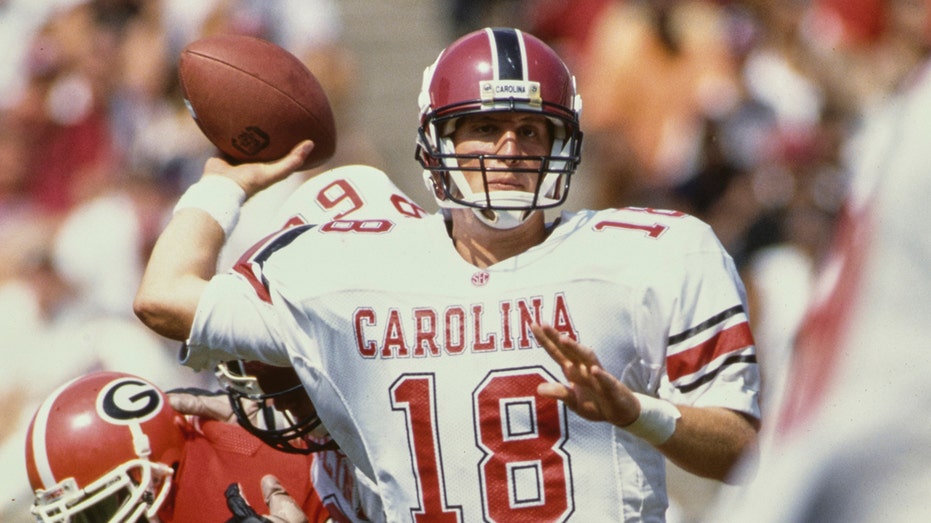
Taneyhill, a kid from Altoona, Pennsylvania, walked into that context with a mullet, a live arm, and a swagger that bordered on defiant. He wasn’t a five-star recruit in a social-media-saturated era; he was a quarterback whose reputation grew the old-fashioned way—through big games and bigger moments. That made his legend uniquely organic.
Two things solidified his place in Gamecock lore:
- South Carolina’s first-ever bowl win (1994 Carquest Bowl), a psychological and symbolic breakthrough for a program long treated as an SEC undercard.
- The “home run swing” celebration after touchdown passes, a theatrical gesture that turned individual plays into cultural memory.
Statistically, he was more than a character. He graduated with school records in completions (753) and passing touchdowns (62), and he still owns three of the top four single-game passing yardage marks in Gamecock history, including 471 yards against Mississippi State in 1995. In an era before the SEC’s full-on transition into a pass-happy league, those numbers were notable and forward-leaning.
The Bigger Story: College Football’s Shift From Local Icon to National Content
Taneyhill’s career straddled a major pivot point in college football:
- Pre-BCS, pre-playoff era: Bowl games were more regional and prestige-based than playoff gateways.
- Limited TV exposure: National games were weekly events, not wall-to-wall content across multiple platforms.
- No NIL, no transfer portal: Player movement was constrained; local heroes tended to stay put and build multi-year arcs with one fan base.
Within that ecosystem, someone like Taneyhill could become a regional folk hero—hugely important inside state lines, largely unknown at the national level. In today’s media and NIL environment, his persona would likely be monetized and amplified far beyond Columbia: brand partnerships, social media, possibly a national cultural footprint. Back then, the only real currency was memory and local legend.
That difference matters because it underscores a key tension in college football today: as the sport becomes more nationally standardized and commercially optimized, the room for quirky, intensely local figures shrinks. Taneyhill-type stories are still possible, but they’re now forced to compete with a national content machine that rewards viral moments over slow-built, community-rooted myth.
Why His Celebration Still Resonates: The Performance of Identity
Taneyhill’s “home run swing” was more than a cute bit of showmanship. In the early-to-mid 1990s, expressive celebrations were still contested territory—often framed by older commentators as disrespectful or excessive. The NFL would later formalize this tension through rules and fines for “excessive celebration.”
By swinging an imaginary bat after touchdowns, Taneyhill did three things:
- Claimed space for individuality in a system that preached conformity and “act like you’ve been there before.”
- Turned scoring into narrative, creating a signature moment that fans anticipated and attached emotion to.
- Unified the crowd; fans knew what was coming and felt part of the performance.
In a very real sense, he anticipated what we now call “personal branding.” The difference is that his brand was deeply tied to a specific place: South Carolina, the new SEC kid trying to punch above its historical weight. The celebration symbolized that chip-on-the-shoulder posture.
The NFL Door That Never Opened—and What That Reveals
Taneyhill never played an NFL snap, getting only a brief shot as an undrafted free agent with the Jacksonville Jaguars in 1997. That outcome is typical from a statistical standpoint—most college stars don’t make it—but it clashes with modern fan expectations shaped by draft coverage and highlight-driven evaluations.
His case illustrates an enduring truth: college football and the NFL are fundamentally different ecosystems. Traits that make a college quarterback beloved—personality, fit with a specific scheme, cultural connection to a campus—don’t always translate into pro measurables.
At the same time, Taneyhill’s post-college trajectory—high school coach, small-business owner—reflects a model of athlete life that is less visible but far more common than the NFL dream. He won three straight state titles at Chesterfield High (2007–2009), impacting young players’ lives in ways that don’t register on national highlight shows but profoundly shape local communities.
His story pushes back against the idea that an NFL career is the only valid endpoint of athletic success. For many communities in the South, the high school coach who once starred on Saturdays is more consequential than the pro backup who rarely sees the field.
The Southern Football Psyche: Why This Loss Feels So Personal
To understand the response to Taneyhill’s death, you have to understand what college football is in states like South Carolina: a civic religion, a cultural anchor, and often a stand-in for broader aspirations.
When a program like South Carolina finally breaks through to win its first bowl game, it isn’t just a box checked on a media guide. It becomes a shared memory that fans use to tell stories about who they are, where they were, and how far they’ve come. Taneyhill was the face of that memory.
In this context, the death of a 52-year-old former quarterback isn’t framed simply as a sports obituary. It’s a reminder of time passing, of a particular era of SEC football fading into nostalgia. For fans who came of age in the 1990s, Taneyhill is tied to their own youth—to Thursday night games on ESPN, to the early years of the SEC East, to a conference that felt more regional and less corporatized.
Health and Mortality: The Quiet Question Behind the Headlines
Though no cause of death has been released, a former high-level athlete dying in his early 50s inevitably raises questions about long-term health outcomes in football. Researchers have documented elevated rates of certain conditions among former players, particularly at the pro level, including cardiovascular issues and neurological disorders. The data on long-term health for college-only players is still developing, and it would be irresponsible to link Taneyhill’s death to any specific factor without evidence.
But his passing fits into a broader public conversation: how do we reconcile the enormous cultural value placed on football with the physical cost of playing it? As more research emerges on chronic traumatic encephalopathy (CTE) and other long-term health issues, deaths of relatively young former players—even when causes are unknown—become part of a larger narrative about risk, responsibility, and care for retirees.
What Today’s Players Can Learn from Taneyhill’s Era
Taneyhill’s journey offers several lessons for the current generation of college athletes navigating NIL deals, transfer options, and a national spotlight:
- Legacy isn’t only about level – He never played in the NFL but remains one of the most beloved figures in South Carolina sports history.
- Rooting yourself in a community matters – By coaching high school and running businesses in-state, he doubled down on the place that embraced him.
- Personality can be an asset—if it’s authentic – His celebrations and mullet never felt manufactured; they came across as expressions of who he actually was.
In a college football world increasingly driven by short-term decisions and national branding strategies, Taneyhill’s trajectory is a reminder that being an icon somewhere can be more rewarding than being a fleeting face everywhere.
Looking Ahead: The Memory Economy of College Sports
As college football moves into an era of expanded playoffs, superconferences, and escalating NIL arms races, figures like Steve Taneyhill test how much room there is for localized legends in a nationalized sport.
Several things are worth watching in the wake of his death:
- How South Carolina institutionalizes his memory – Will the school deepen its recognition beyond Hall of Fame status, perhaps through scholarships, field namings, or annual commemorations?
- How programs curate their history – As rosters churn faster via the transfer portal, schools may rely more heavily on past icons to maintain a sense of continuity and identity.
- How fans respond to future “characters” – Will highly expressive players be embraced as Taneyhill was, or treated more as content than as community figures?
In many ways, the battle for college football’s soul isn’t just about revenue distribution or playoff formats. It’s about whether players like Taneyhill will still be possible—athletes whose stories are deeply embedded in one place, one fan base, one era.
The Bottom Line
Steve Taneyhill’s death at 52 is a personal loss for his family, friends, former players, and the South Carolina community. But it’s also a cultural marker. His life tracks the transformation of college football from a regionally-rooted tradition into a national entertainment industry.
He was a quarterback who symbolized a program finally breaking through, an early practitioner of expressive on-field branding, and a reminder that impact doesn’t have to be measured by NFL snaps. As college football accelerates into its next commercial phase, Taneyhill’s legacy raises a quiet but urgent question: in the push for bigger TV deals and broader audiences, can the sport still make room for the kind of local legends that made people fall in love with it in the first place?
Topics
Editor's Comments
What stands out about Steve Taneyhill isn’t just the affection South Carolina fans still feel for him, but how increasingly rare his type of legacy may become. In an era of NIL deals, rapid transfers, and a looming super-league structure for college football, the idea of a player staying in one place long enough to become woven into the civic fabric is under pressure. That doesn’t mean modern athletes can’t forge deep bonds with their schools, but the incentives now pull strongly toward mobility and short-term leverage. Taneyhill’s story invites an uncomfortable question for college administrators and television partners: if the sport continues to prioritize national spectacle and fluid rosters, will it unintentionally erode the very local, generational loyalties that make college football so valuable in the first place? The reaction to his death suggests that the true asset isn’t just media rights—it’s the emotional equity built by players whose careers are inseparable from a specific community’s history.
Like this article? Share it with your friends!
If you find this article interesting, feel free to share it with your friends!
Thank you for your support! Sharing is the greatest encouragement for us.