Evanston vs. Border Patrol: What a Street Showdown Reveals About the Next Phase of America’s Immigration Fight

Sarah Johnson
December 18, 2025
Brief
The Evanston clash between Mayor Daniel Biss and Border Patrol Cmdr. Gregory Bovino reveals how America’s immigration fight is shifting into blue suburbs, pitting federal authority against local legitimacy and activist politics.
Border Patrol vs. Progressive Mayor in Evanston: A Street Showdown That Signals the Next Phase of America’s Immigration Wars
What happened on a cold Evanston street this week was not just a tense exchange between a Border Patrol commander and a progressive mayor. It was a preview of how the next chapter of America’s immigration fight will play out: not at the southern border, but in affluent, educated suburban communities that have long imagined themselves as morally apart from the enforcement apparatus they now find at their front doors.
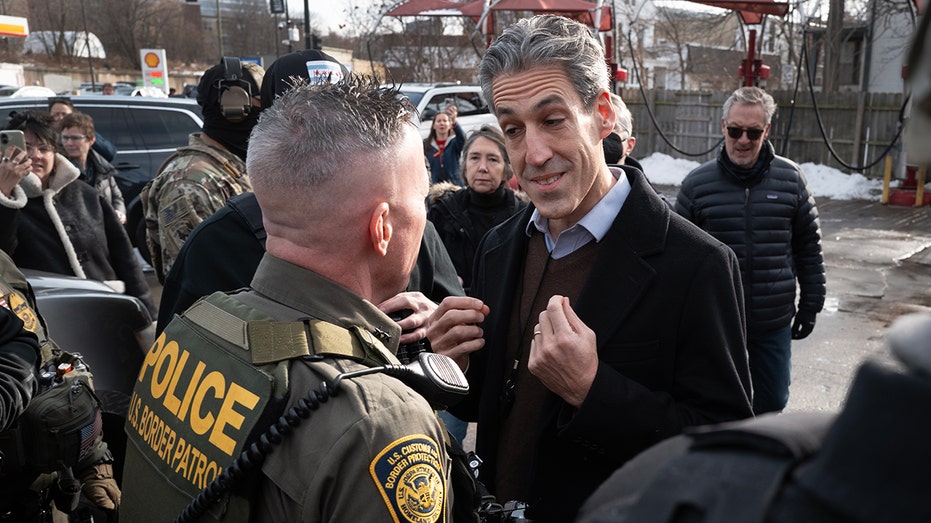
Mayor Daniel Biss, a progressive Democrat and congressional candidate, publicly confronting Border Patrol Cmdr. Gregory Bovino during a Title 8 operation is less important for the individual barbs exchanged than for what the images symbolize. You have federal agents in tactical gear and masks, municipal police holding a corridor for federal vehicles, and a sitting mayor physically inserting himself into an active enforcement scene while protesters attempt to obstruct the roadway. Each actor in that tableau represents a different center of power: federal authority, local governance, activist pressure, and an anxious public caught in between.
The bigger picture: How we got to an immigration showdown in a Chicago suburb
To understand why Evanston matters, you have to zoom out from that intersection at Green Bay Road and Dodge Avenue and trace two converging storylines: the evolution of federal-local immigration cooperation, and the political transformation of suburbs from Republican-leaning to deeply Democratic, activist-friendly territory.
Federal-local friction has been building for nearly two decades.
- In the early 2000s, programs like 287(g) and later Secure Communities expanded cooperation between local law enforcement and federal immigration agencies, particularly through information-sharing and jail-based detainers.
- Under the Obama administration, Secure Communities became deeply controversial, especially in blue cities, after data showed large numbers of non-criminal or low-level offenders being funneled into deportation. That led to the rise of so-called “sanctuary” policies in places like Chicago, New York, and San Francisco.
- The Trump years hardened the split: federal agencies ramped up workplace raids and at-large arrests, while many blue jurisdictions further restricted cooperation. State and local leaders cast themselves as shields between their immigrant communities and federal enforcement.
- Even under Biden, despite a more targeted enforcement posture on paper, the visible presence of federal agents in interior cities has remained politically explosive, as asylum backlogs, record border encounters, and migrant busing have pushed immigration into the daily life of communities far from the border.
Meanwhile, the suburbs changed. Evanston is not a random backdrop. It’s a wealthy, highly educated, racially diverse city with a strong progressive identity—it has pioneered local reparations programs and sanctuary-style measures. Over the past decade, suburbs like Evanston have become the backbone of Democratic electoral strength, supplying both votes and candidates, including people like Biss, who is now seeking higher office as a “pragmatic progressive.”
The result: federal enforcement strategies designed for a polarized national environment are colliding with local political ecosystems where residents expect their elected officials to actively resist what they see as abusive or racist practices. When those two logics meet in real time on a city street, you get exactly what we saw on video: confrontation, competing narratives, and an instant national symbol.
What this really means: Competing realities on the same block
The Evanston incident exposes at least three deeper conflicts that are often flattened in national coverage.
1. Safety vs. harm: Two clashing definitions of “community protection”
Bovino’s statement that agents were there “to make his city a safer place through Title 8 immigration enforcement” and his description of an “excellent day in Evanston” sit in direct opposition to Biss calling the agents a “violent mob” of “masked thugs” who “terrorized innocent people.” They are not just disagreeing about tone; they are operating with fundamentally different frameworks for what constitutes safety.
- Federal framing: Safety means removing specific individuals who are allegedly violating immigration law and, according to DHS in other operations, may have criminal records. Interior enforcement is presented as targeted, intelligence-driven, and aimed at “bad actors.”
- Progressive local framing: Safety encompasses psychological security, non-criminalization of immigrant communities, and trust in government. Visible, militarized operations in neighborhoods are viewed as a form of state-inflicted harm, regardless of who is specifically targeted.
Neither side is just posturing for cameras; they are responding to entirely different constituencies and risk calculations. For federal agents, the risk is failing to remove someone who later commits a high-profile crime. For the mayor and protesters, the risk is eroding community trust, an incident of excessive force, or a deportation that tears apart a family.
2. The optics of power: Why “masked thugs” language is not accidental
Biss’ rhetoric—calling Border Patrol personnel a “violent mob” of “masked thugs”—is unusually sharp for a sitting mayor talking about federal law enforcement. That language does several deliberate things:
- It inverts the usual script: traditionally, “mobs” are protesters and “order” is associated with uniformed officers. Here, Biss casts the federal agents as the destabilizing force and the residents as defenders of community order.
- It taps into post-2020 protest imagery, where masked, heavily equipped officers became symbols of state overreach. The word “thugs” also echoes language some federal officials have used about protesters—another inversion.
- It helps Biss draw a sharper contrast for his congressional run: he is not merely a manager of city services but someone willing to physically stand between his residents and federal power.
Bovino’s response—that the day was “excellent” and that Biss leaned on “divisive talking points”—is equally strategic. He is signaling to his own rank-and-file and to national audiences that Border Patrol will not be politically cowed by local critics, and that the operation met its objectives despite resistance.
3. Legal authority vs. local legitimacy
Title 8 gives federal authorities broad power to enforce immigration law nationally, including operations “far from the border” when targeting specific individuals. On paper, there is little ambiguity over who has the legal upper hand: immigration is a federal domain.
But legitimacy is not purely legal; it’s social and political. When dozens of residents gather, some attempt to block the roadway, and the city’s own mayor publicly tells federal agents, “Don’t come back,” the message is clear: whatever the statute books say, this community is withdrawing its consent for this style of enforcement on its streets.
That gap between legal authority and local legitimacy is where future flashpoints will emerge. Federal officers can complete missions with the help of local police for traffic control, as they did in Evanston—but at mounting political cost, especially in election years.
Expert perspectives: Why Evanston resonates beyond Illinois
Immigration law experts and political scientists see the Evanston confrontation as part of a broader pattern.
Dr. Cecilia Menjívar, a sociologist who has studied immigration enforcement’s impact on communities, has long argued that interior operations have a “chilling effect” far beyond those actually detained, suppressing everything from crime reporting to school attendance. That is precisely the harm Biss is implicitly pointing to when he says Evanston is “safe in spite of ICE/CBP, not because of it.”
On the other side, former DHS officials note that public, visible operations are sometimes intended to have a deterrent effect. If word spreads that federal agents can and will act beyond the border, the thinking goes, it might discourage repeat illegal re-entry or reduce the sense of impunity among those with outstanding removal orders.
Political science research adds another layer: suburban communities that have become strongly Democratic over the last decade are also among the most mobilized on issues like racial justice, policing, and immigration. As Prof. Daniel Hopkins has shown in his work on nationalization of American politics, local officials increasingly behave as national political actors, knowing that their rhetoric can resonate far beyond city limits. Biss confronting Bovino with cameras rolling fits that pattern.
Data and context: How unusual is this, really?
The Evanston standoff can seem like an isolated, dramatic scene, but it fits into several larger data-backed trends:
- Interior enforcement continues, even amid political backlash. While overall deportation numbers fell from Trump-era peaks, Immigration and Customs Enforcement (ICE) and Border Patrol continue to conduct at-large arrests and targeted operations in interior cities. DHS data in recent years has shown a policy shift toward focusing on people with criminal records, but advocates argue that the net often still includes people with minor offenses or no convictions at all.
- Local restrictions are spreading. By the early 2020s, dozens of jurisdictions had policies limiting cooperation with ICE—restricting when local jails honor detainers, whether officers can ask about immigration status, or how city resources can be used in enforcement. Evanston’s response hints at the next step: not just institutional limits, but direct political confrontation.
- Public opinion on immigration is polarized but nuanced. National polling consistently shows majorities supporting both stronger border controls and legal protections for long-settled undocumented residents. That ambivalence creates a volatile environment: visible enforcement can be applauded in one community and denounced in another, even within the same metro area.
Looking ahead: What to watch after Evanston
The Evanston incident is likely to have ripple effects well beyond the individuals detained that day.
- More mayors stepping into the frame. Expect other progressive mayors and county executives to emulate Biss, especially those with national ambitions. Physical presence at enforcement scenes provides powerful imagery for social media and campaign ads, and aligns with activist expectations.
- Federal agencies rethinking operational tactics. In high-profile, politically sensitive areas, federal authorities may weigh whether interior operations are worth the risk of public confrontation. That does not mean they will stop, but they may adjust timing, visibility, or coordination with local police.
- Legal friction over obstruction and interference. Incidents where local officials or protesters are perceived as interfering with operations could spark legal showdowns. We have already seen cases where federal agencies accused elected officials of joining “rioting crowds” or obstructing mass arrests.
- Campaign narratives hardening. For Republicans, Evanston will likely be cited as evidence that Democrats are “soft” on enforcement and willing to undermine federal agents. For progressives, it will be used to illustrate “overreach” by militarized agencies and to rally support for deeper structural immigration reform.
The bottom line
The Evanston street showdown matters less for the number of people detained and more for what it reveals: immigration fights are moving decisively into the heart of blue suburban America, where federal power, local politics, and community activism collide in real time.
When a border commander declares an “excellent day” in a city whose mayor tells him “don’t come back,” you are not just watching a disagreement over tactics—you are watching two visions of law, safety, and legitimacy trying to occupy the same space. That tension is not going away. It is becoming the new normal.
Topics
Editor's Comments
One underexamined dimension in the Evanston clash is class and geography. For years, the most aggressive immigration enforcement has been concentrated in working-class neighborhoods, agricultural regions, and border communities—places with less media attention and less political clout. What makes the Evanston episode feel different is not just that a progressive mayor intervened, but that the operation unfolded in a relatively affluent, highly educated suburb closely tied to elite institutions like Northwestern University. When federal agents show up there, the pushback carries more national resonance, both because the local leadership is media-savvy and because it disrupts the comfort of voters who may have supported humane immigration rhetoric without ever seeing the mechanics of enforcement up close. That raises uncomfortable questions: Will interior enforcement only become politically untenable when it enters privileged spaces? And if so, what does that mean for communities that have been living with these operations, largely out of sight, for decades? Those questions don’t have easy answers, but they should be part of any serious discussion about how and where immigration law is enforced.
Like this article? Share it with your friends!
If you find this article interesting, feel free to share it with your friends!
Thank you for your support! Sharing is the greatest encouragement for us.