Iowa Guard Deaths in Syria: What the Palmyra Ambush Reveals About America’s ‘Invisible’ War

Sarah Johnson
December 16, 2025
Brief
The Palmyra ambush that killed Iowa National Guard soldiers exposes deeper flaws in America’s low-visibility war in Syria, from ISIS resilience to National Guard burdens and fragile local alliances.
Iowa Guard Deaths in Syria: What This Ambush Reveals About America’s ‘Invisible’ War
The killing of two Iowa National Guard soldiers and an American civilian interpreter in Palmyra, Syria, is being framed as a tragic but contained incident — a lone ISIS gunman, a presidential vow of “very serious retaliation,” and the familiar language of counterterrorism. But beneath that narrative lies a much larger story about how the United States fights wars now, who bears the risk, and why ISIS still has room to maneuver in a country that has been the target of intensive military operations for nearly a decade.
This attack is not just about one gunman or one patrol gone wrong. It exposes structural vulnerabilities in the U.S. mission in Syria, raises hard questions about the long-term viability of a small-footprint deployment against a persistent insurgent threat, and underscores how National Guard units — citizen-soldiers from states like Iowa and West Virginia — have become central to U.S. power projection in conflict zones that most Americans rarely think about.
The Bigger Picture: A War That Never Really Ended
Although U.S. leaders have repeatedly declared ISIS “defeated” since 2019, the organization’s transformation from territorial caliphate to dispersed insurgency has kept Syria unstable. Estimates by military and independent analysts suggest that ISIS retains several thousand fighters and a broader support network across Syria and Iraq. The group has shifted from conventional operations to a classic insurgent playbook: ambushes, targeted killings, propaganda, and opportunistic attacks on security forces.
Palmyra, where this ambush occurred, is symbolically important. The city has changed hands multiple times during the Syrian civil war and became a showcase for both ISIS brutality and international military intervention. The fact that an ISIS-linked attacker could strike U.S. and partner forces there in 2025 is a reminder that territorial control does not equal durable security.
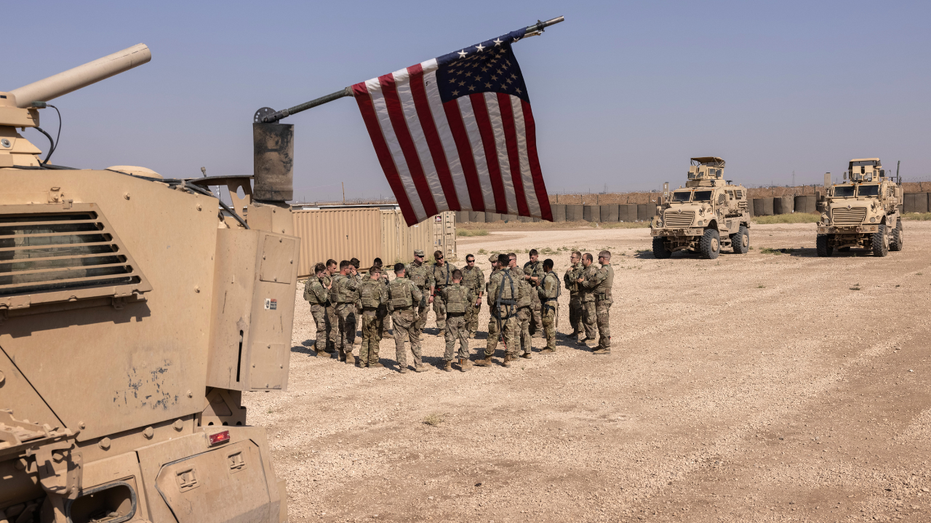
Historically, U.S. missions that are declared “over” often continue in another form: advisory roles, training missions, intelligence cooperation, and “force protection” deployments. In Syria, the current footprint — roughly 900 U.S. troops, often working with local Syrian partners — is designed to be light, politically low-profile, and focused on preventing ISIS resurgence. But that light footprint comes with its own risks: small, dispersed units in complex, often hostile environments, relying heavily on local partners and interpreters to navigate ever-shifting alliances and loyalties.
National Guard on the Front Lines: From Disaster Relief to Combat Ambushes
The attack also highlights how the U.S. National Guard has evolved far beyond its traditional image of domestic disaster response and emergency support. Since 9/11, Guard units have been repeatedly mobilized for overseas combat deployments. According to Department of Defense data, Guard and Reserve forces have filled 40–45% of deployed manpower in some phases of the Iraq and Afghanistan wars.
In Syria and Iraq, National Guard units frequently rotate through key roles: security, logistics, training local forces, and supporting special operations. For states like Iowa and West Virginia, this means that small communities with little direct stake in Middle East politics are routinely sending citizen-soldiers into high-risk environments.
The recent ambush near the White House that left a West Virginia National Guard soldier dead underscores another uncomfortable reality: Guard members are simultaneously exposed to targeted violence at home and overseas. The symbolism is stark — the same part-time soldiers who help their communities recover from floods or pandemics are also the ones facing ISIS gunfire in a Syrian desert or a targeted attack on a U.S. street.
What This Really Means: A Blurred Battlefield and Fragile Alliances
One detail in this attack should worry policymakers: preliminary indications that the shooter had previously been a low-level member of Syrian government security forces before aligning with ISIS. U.S. officials are emphasizing that this was not a “green-on-blue” attack because he was not part of the partnered delegation. But the deeper issue is the permeability of Syria’s armed actors — and the difficulty of vetting, tracking, and managing risk across overlapping militias, regime forces, defectors, and extremists.
In practice, the Syrian conflict has produced a vast gray zone of combatants who have shifted allegiances over time. Some have moved from pro-regime units to opposition factions, from local militias to ISIS, or from ISIS to other armed groups as the balance of power changed. That fluidity makes any narrow definition of insider attacks somewhat misleading; the attacker’s prior affiliation with state security forces speaks to a longer arc of fragmentation and radicalization within Syria’s security landscape.
Operationally, the attack suggests two troubling possibilities:
- Persistent ISIS intelligence networks: The ability to mount an ambush on a mixed U.S.–Syrian patrol in a known hotspot implies local reconnaissance, knowledge of patrol patterns, or at least real-time spotting. ISIS may be weaker, but it is still embedded in parts of the local terrain.
- Gaps in force protection: Lightly staffed missions, heavy reliance on local partners, and the need to “show presence” in contested cities like Palmyra can create predictable vulnerabilities — especially when the U.S. operates under political constraints that limit larger, more robust deployments.
Politically, the attack arrives in a U.S. environment where there is fatigue with “forever wars” but no consensus on what a responsible exit looks like. A presidential promise of “very serious retaliation” may satisfy the immediate demand for toughness, yet the strategic question remains: retaliate to what end? Targeted strikes, special operations raids, and drone attacks can punish ISIS cells, but they do not answer whether the underlying mission — a small, semi-permanent presence in eastern and central Syria — is sustainable.
Expert Perspectives: A War of Attrition in the Shadows
Counterterrorism and Middle East experts have long warned that ISIS would not disappear with the loss of its territorial caliphate:
“We’re in a classic phase of insurgent persistence — ISIS is weaker, but it’s not defeated. It is a chronic security problem, not an acute existential threat. That makes it politically easy to ignore, until an attack like this forces it back onto the agenda.” — Dr. Daniel Byman, terrorism expert and professor at Georgetown University.
Others emphasize the political cost of an open-ended deployment with periodic casualties:
“Small numbers of troops dying in theaters that most Americans can’t locate on a map are politically explosive. They don’t lead to big protests like Iraq in 2003, but they slowly erode public trust and raise the question: Why are we still there?” — Emma Ashford, senior fellow focusing on U.S. foreign policy.
From a civil-military standpoint, the concentration of risk on Guard units and repeat deployers is a structural concern:
“We’ve shifted from mass mobilization to a professional and reserve force that goes again and again. That makes prolonged conflicts politically sustainable, but it concentrates the psychological and physical costs on a small slice of America — including Guard soldiers from places like Iowa.” — Lt. Col. (Ret.) Jason Dempsey, U.S. Army veteran and civil-military relations scholar.
Data & Evidence: The Numbers Behind the Headlines
Several data points help frame this attack in a broader context:
- U.S. troop presence: Roughly 900 U.S. troops remain in Syria, alongside several thousand in Iraq, primarily focused on counter-ISIS missions, training, and force protection.
- ISIS attack tempo: Independent monitoring groups and U.S. officials have documented dozens of ISIS or ISIS-linked attacks per year in Syria — fewer than during the height of the caliphate, but enough to maintain instability. Many involve roadside bombs, targeted assassinations of local officials, or hit-and-run attacks on security forces.
- National Guard deployments: Since 9/11, hundreds of thousands of Guard members have deployed overseas, with some units seeing multiple combat rotations. The Guard has shifted from a “strategic reserve” to an “operational reserve,” meaning it is routinely integrated into frontline missions.
- Insider and quasi-insider attacks: In Afghanistan, “green-on-blue” attacks by Afghan security forces or infiltrators peaked around 2012–2013, eroding trust in local partners. While the Syrian context is different, the presence of a gunman with prior ties to government security structures raises similar concerns about infiltration and vetting.
Looking Ahead: Retaliation, Reassessment, or Status Quo?
Publicly, the near-term response is clear: some form of military retaliation against ISIS-linked targets in Syria — airstrikes, special operations raids, or both. Such actions can have tactical value, degrading cells involved in the attack and signaling deterrence. But strategically, the U.S. faces a more complex set of choices.
Key questions moving forward include:
- Mission clarity: Is the U.S. presence in Syria narrowly about counter-ISIS operations, or does it also serve broader goals: containing Iranian influence, balancing against Russia, and shaping post-war Syria? The less defined the mission, the harder it becomes to measure success or justify continued risk.
- Force protection vs. engagement: Increasing protection — more armor, less movement, tighter perimeter security — can reduce risk but may also limit the effectiveness of engagement with local partners and communities, which is essential for long-term stability.
- Burden-sharing: How much can and should local Syrian forces carry the burden of counter-ISIS operations, and how reliable are these partners when loyalties and alliances have repeatedly shifted?
- Domestic political sustainability: Will incidents like this ambush drive calls for withdrawal, or will they be used to justify deeper involvement? Historically, both reactions have followed such attacks, often depending on broader political currents at home.
The Bottom Line
The deaths of two Iowa National Guard soldiers and an American interpreter in Palmyra are a stark reminder that the U.S. is still at war, even if it no longer looks like the large, highly visible operations of the early 2000s. The ambush underscores four core realities:
- ISIS remains a resilient insurgent threat, capable of deadly opportunistic attacks despite its territorial defeat.
- The U.S. strategy of small-footprint deployments trades political visibility for operational risk, particularly for National Guard units drawn from communities far from Washington’s foreign-policy debates.
- The fluidity of Syria’s conflict — where former regime personnel can become ISIS gunmen — complicates vetting, partnership, and force protection in ways that defy simple categorization.
- Promises of “very serious retaliation” cannot substitute for a long-term strategy that clearly defines why American troops are in Syria, what success looks like, and how and when this chapter of the post-9/11 wars might finally end.
Unless those strategic questions are confronted directly, the risk is that this ambush will become just one more entry in a long list of largely invisible sacrifices — borne by a small number of American families and communities, while the larger war remains abstract to the rest of the country.
Topics
Editor's Comments
One under-discussed dimension of this story is the moral and political distance between those who decide on deployments and those who absorb the risks. The victims here are Iowa National Guard soldiers and an American interpreter — people who likely joined for a mix of service, education benefits, and community ties, not because they saw themselves as instruments of long-term geopolitical maneuvering in Syria. This is a feature of the all-volunteer force: it allows policymakers to sustain low-level, long-duration conflicts without the galvanizing pressure of a draft. Yet it also narrows the constituency that feels these wars in a visceral way. As long as the costs are concentrated on a small group of families and communities, there is little incentive to resolve the strategic ambiguity that keeps U.S. troops on patrol in places like Palmyra. That structural imbalance, more than any single ambush, is what should trouble us going forward.
Like this article? Share it with your friends!
If you find this article interesting, feel free to share it with your friends!
Thank you for your support! Sharing is the greatest encouragement for us.