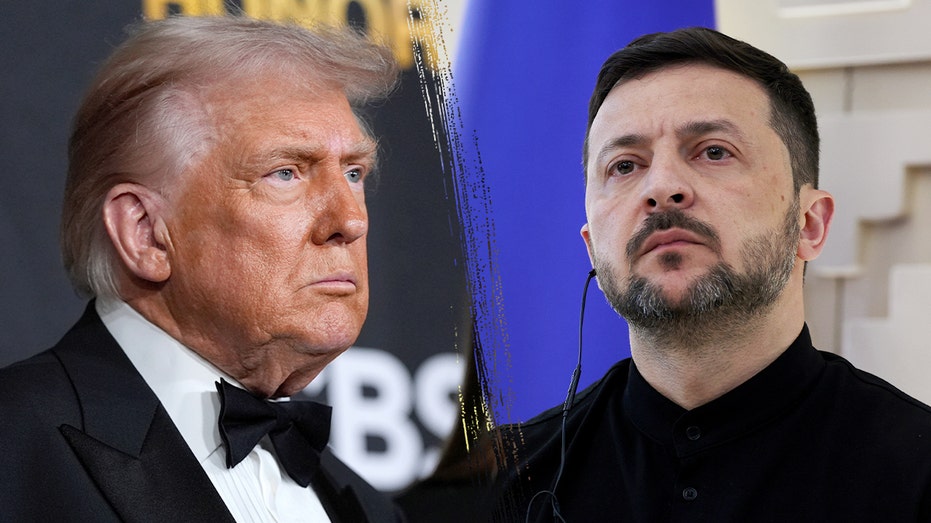
Beyond the ‘Unread’ Peace Plan: How Trump, Putin, and Zelenskyy Are Really Shaping Europe’s Future

Sarah Johnson
December 8, 2025
Brief
Trump’s claim that Zelenskyy hasn’t read his peace plan masks a deeper struggle over who sets Europe’s postwar order, how enforceable any deal would be, and whether Putin is really ready for peace.
Trump’s ‘Peace Plan,’ Putin’s Endgame, and Zelenskyy’s Delay: What the Standoff Really Signals About the Future of the War
Donald Trump’s claim that Volodymyr Zelenskyy has not yet read his updated peace proposal is being reported as a procedural wrinkle in ongoing talks. In reality, it exposes a deeper collision of interests: between Ukraine’s survival, Russia’s expansionist ambitions, U.S. domestic politics, and Europe’s fear of a wider war.
This is not just about a document sitting unread on a presidential desk. It’s about who gets to decide the terms of peace in Europe, what kind of security order will govern the continent after this war, and whether any agreement reached under these conditions can be both sustainable and legitimate.
The bigger picture: peace talks as a continuation of war by other means
To understand these talks, it helps to see them as part of a longer pattern in European security crises.
- Post–Cold War drift: Since the 1990s, there has been no universally accepted security architecture in Europe that includes both NATO and Russia. Disputes over NATO expansion, missile defense, and spheres of influence have simmered for three decades.
- The 2014 precedent: The Minsk agreements that followed Russia’s first intervention in Ukraine (Crimea and Donbas) were negotiated under intense pressure, with Russia occupying territory and the West desperate to “freeze” the conflict. That framework never truly worked: it institutionalized ambiguity and incentivized Russia to keep leverage over Kyiv.
- 2022 full-scale invasion: Russia’s 2022 attack aimed to force Ukraine into a neutral, demilitarized status and effectively veto its Western alignment. When that failed militarily, Moscow pivoted to grinding attrition and political leverage, including energy warfare against Europe and strikes on Ukrainian infrastructure.
Seen in this light, the reported Miami talks and the Kushner/Witkoff–Putin meeting are not an improvisation; they are an attempt to create a new Minsk-type arrangement—only this time with even higher stakes and far more territory at issue. Putin’s own words in India, reiterating maximalist demands in Donbas and insisting on Ukrainian withdrawals, make clear he still views negotiations as a way to convert battlefield gains into political reality.
Why Zelenskyy hasn’t rushed to embrace the plan
Trump says Zelenskyy’s “people love” the proposal but that Zelenskyy himself hasn’t read it yet. That claim may be politically convenient, but the caution in Kyiv is easy to explain:
- Domestic legitimacy and political survival
Any deal that cedes territory or locks in Russian gains would be politically radioactive in Ukraine. Polls by the Kyiv International Institute of Sociology throughout 2023–2024 consistently showed a large majority of Ukrainians opposed to territorial concessions, especially in regions occupied after 2022. Zelenskyy’s legitimacy rests heavily on his refusal to formally surrender land. - Negotiating under bombardment
In just one week, according to Zelenskyy, Russia launched more than 1,600 drones, around 1,200 guided aerial bombs, and nearly 70 missiles. Negotiating while your energy grid and cities are under attack is not a neutral diplomatic setting—it is coercive. Accepting a deal under those conditions risks looking like capitulation, especially if it does not guarantee long-term security. - Military realities vs. diplomatic pressure
Ukrainian commanders know that any lines drawn on a map must be defendable. If the proposal involves Ukrainian withdrawal in the east, or demilitarized zones, Kyiv must calculate whether those lines can be held against a future Russian offensive. Without firm, enforceable security guarantees, a deal could simply give Russia time to rearm. - Dependence on Western backing
Ukraine’s war effort is intertwined with U.S. and European aid. A “U.S.-led peace plan” that is not fully backed by the EU, NATO, and the broader G7 could fracture the coalition and leave Kyiv isolated. Zelenskyy’s planned meeting with European leaders in London before giving a definitive response looks like an attempt to align—or at least not alienate—key partners.
In this context, Zelenskyy’s delay is less about personal reluctance to read a document and more about sequencing: he needs a unified internal assessment (Umerov, Hnatov and the security council), followed by a readout of how far Europe is willing to go in supporting or resisting U.S.-driven terms.
Putin’s calculus: leverage first, peace later
Putin’s stance in New Delhi underscores that Russia’s objectives have not fundamentally changed. He reiterated that the war ends only if Russia controls Donbas or if Ukrainian forces withdraw. This suggests three things:
- Territorial maximalism remains non-negotiable: Moscow wants internationally recognized or at least de facto control over large swaths of eastern and possibly southern Ukraine. Any peace plan not meeting that threshold is, for Putin, only a “starting point.”
- Use of talks as a force multiplier: As a former CIA station chief recently warned, Moscow has a long history of using negotiations to buy time, sow divisions among adversaries, and gather intelligence. The five-hour meeting with Kushner and Witkoff likely served multiple purposes: testing U.S. red lines, mapping internal American divisions, and signaling to Europe that Russia has channels into U.S. politics beyond the current administration.
- Strategic signaling to India and the Global South: By giving this interview during a state visit to India, Putin is positioning himself as a “reasonable” actor willing to engage with American envoys while blaming Kyiv for intransigence. That narrative is aimed at countries that have tried to remain neutral and are weary of Western sanctions and global instability.
The Trump factor: peace as a campaign asset
Trump’s public comments—emphasizing his disappointment in Zelenskyy and asserting that “Russia is, I believe, fine” with the plan—serve several political purposes in the U.S. context:
- Campaign branding: He has repeatedly promised to end the war “quickly” if returned to office. Publicly portraying Zelenskyy as hesitant and Putin as at least open to his plan bolsters the narrative that he alone can deliver peace.
- Pressure on Kyiv: By suggesting that Ukrainian officials like the plan but Zelenskyy is the obstacle, Trump is effectively trying to shape internal Ukrainian politics and public opinion. It’s a classic tactic: divide the leader from the bureaucracy.
- Message to Europe: The implicit subtext is that if European leaders want the war off their doorstep, they should work with or at least not oppose a Trump-driven proposal. That could deepen transatlantic tensions, especially if the plan includes concessions Europe sees as undermining the post-1945 norm against changing borders by force.
What’s unusual here is not that a U.S. political figure is involved in back-channel diplomacy—that’s a longstanding practice—but that it’s happening so publicly and so close to the center of a live conflict in which the U.S. is a major supplier of arms and funding. That creates a perception problem for Washington: are there two American foreign policies on Ukraine, one official and one campaign-driven?
Europe’s bind: between escalation fears and moral red lines
As Zelenskyy heads to London to discuss the U.S.-led plan, European leaders are caught in a strategic dilemma:
- Security vs. stability: Many in Central and Eastern Europe argue that accepting Russian control over large parts of Ukraine would invite further aggression—possibly against Moldova or even NATO’s eastern flank. Meanwhile, some Western European officials worry that prolonging the war risks a direct NATO–Russia clash or destabilizing domestic politics via energy prices and migration.
- Norms vs. pragmatism: The EU has invested enormous political capital in defending the principle that borders cannot be changed by force. Endorsing any plan that legitimizes Russian annexations would undercut decades of European diplomacy and weaken its credibility globally.
- Dependence on U.S. politics: Europe’s ability to support Ukraine at scale is still partly contingent on U.S. security guarantees and industrial capacity. A U.S. political shift toward a “deal” that Europeans see as dangerous or premature would expose how little independent leverage the EU has built in hard security.
What’s being overlooked: enforcement, not just terms
Public debate is focused on what the peace plan might contain—territorial lines, security guarantees, sanctions relief. But history suggests the more decisive question is: who enforces it, and how?
Consider prior deals:
- Dayton (Bosnia, 1995): Worked largely because NATO troops were deployed to enforce it and external powers were aligned.
- Minsk I & II (Ukraine, 2014–2015): Failed because there were no robust enforcement mechanisms, the parties had divergent interpretations, and Russia retained escalation dominance on the ground.
Any Trump-linked peace plan that does not clearly answer these enforcement questions is likely to be fragile:
- Will NATO or a coalition physically guarantee Ukraine’s security along new lines?
- Are there automatic sanctions “snap-backs” if Russia violates the deal?
- Will there be long-term Western military basing, or would Russia insist on Ukrainian demilitarization?
Without concrete answers, any “peace” risks being a temporary armistice—one that allows Russia to consolidate gains and prepare for a second round once conditions are more favorable.
Data points that shape the negotiations
Several hard realities, often underplayed in political rhetoric, loom over these talks:
- Urban and energy destruction: Repeated Russian strikes on energy infrastructure mean Ukraine faces periodic blackouts and mounting reconstruction costs. The World Bank has estimated Ukraine’s reconstruction needs in the hundreds of billions of dollars—and rising with every drone wave.
- Demographic strain: Millions of Ukrainians have fled, many likely permanently. A smaller, older population complicates long-term defense and economic recovery, intensifying pressure to secure some kind of ceasefire.
- Russian resilience: Despite sanctions, Russia has reoriented trade to Asia and the Global South and ramped up defense production, helped by imports of critical components through third countries. This undermines the assumption that time is automatically on Ukraine’s side.
- Western fatigue: Polling across Europe and North America shows rising fatigue with the war, particularly regarding financial costs. Political leaders are watching those numbers closely, even if they rarely say so publicly.
Looking ahead: what to watch
Three developments will determine whether this “peace plan” is a serious diplomatic breakthrough or just another talking point:
- The London consultations: How unified are European leaders after meeting Zelenskyy? Do they publicly back continued maximalist Ukrainian aims, or do they quietly start framing “painful compromises” as inevitable?
- The language from Moscow: Does Putin soften any of his public demands, even rhetorically, or does he continue to insist on Ukrainian withdrawal and recognition of Russian gains? Any visible flexibility would be notable, given his current hard line.
- U.S. political alignment: Does the current U.S. administration distance itself from Trump-linked talks, or does it tacitly allow them to shape expectations? Mixed signals from Washington will make Kyiv’s dilemma far harder.
The bottom line
Zelenskyy’s hesitation isn’t simply about reading a document; it’s about deciding whether any American-brokered deal, shaped partly by a polarizing U.S. political figure and welcomed as a “starting point” by Putin, can offer Ukraine more than a temporary respite. For Ukraine, the trade-off isn’t war versus peace—it’s between a risky, enforced peace that might lock in territorial loss and a grinding war that might still, in the end, produce a similar map under worse conditions.
For the rest of the world, the stakes are larger still: the outcome will signal to would-be aggressors everywhere whether the use of force in the 21st century can still pay, provided you endure sanctions and outlast your opponent’s political will.
Topics
Editor's Comments
What stands out in this episode is not only the substance of the alleged peace plan—still largely opaque—but the process by which it is emerging. You have a frontline state negotiating under bombardment, a major nuclear power using talks as an extension of coercion, and a former U.S. president leveraging the process for political positioning. That combination raises uncomfortable questions: can a truly legitimate settlement be fashioned when the primary guarantor of Ukraine’s security, the United States, is itself split between competing foreign policies? And how should smaller states respond when their fate becomes intertwined with another country’s electoral cycle? The risk is that Ukraine’s future is shaped less by a coherent strategy for European security and more by short-term political imperatives in Washington and Moscow. If that happens, any agreement reached now may be less a blueprint for lasting peace than a provisional truce awaiting the next shift in domestic politics.
Like this article? Share it with your friends!
If you find this article interesting, feel free to share it with your friends!
Thank you for your support! Sharing is the greatest encouragement for us.