Chernobyl’s Blue Dogs: What a Viral Hoax Reveals About Our Nuclear Fears

Sarah Johnson
December 8, 2025
Brief
The viral photos of Chernobyl’s blue dogs weren’t proof of mutation, but they expose how nuclear fears, social media, and forgotten animal victims distort our understanding of radiation and risk.
Chernobyl’s “Blue Dogs” Viral Moment Exposed Something Bigger Than a Dye Spill
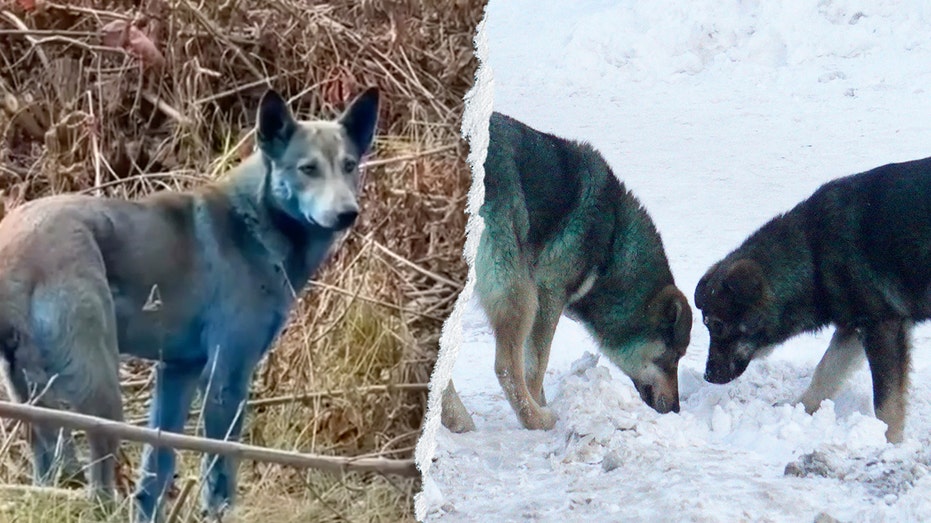
For a few days, the world was convinced Chernobyl had produced a new kind of radioactive creature: stray dogs with bright blue fur roaming the Exclusion Zone. The images went viral, feeding long‑standing fears and fantasies about nuclear mutation. Then came the anticlimax: a scientist revealed the most likely explanation was far more mundane — a tipped-over porta‑potty and dogs rolling in blue chemical dye mixed with waste.
On the surface, this sounds like a quirky, almost comedic news story. But pull back, and it becomes a case study in how we think about radiation, how social media rewards fear over facts, and how the real, ongoing human and ecological costs of Chernobyl are repeatedly overshadowed by spectacle.
The story behind the blue dogs: myth, memory, and the nuclear imagination
Chernobyl has occupied a unique place in the global imagination since the 1986 explosion at Reactor 4. It is at once a real disaster site and a symbolic one — a shorthand for invisible danger, state secrecy, and technological hubris. For decades, popular culture has used Chernobyl as a backdrop for stories of mutants, monsters, and apocalyptic landscapes. So when photos emerged of dogs with vividly blue fur in the Exclusion Zone, they slotted seamlessly into an existing narrative.
The Dogs of Chernobyl program, which works with roughly 700 dogs in the zone, posted the images in October, noting they had not yet captured the animals and didn’t know the cause of the coloration. That uncertainty was enough. Social media did the rest. Within hours, speculation hardened into lore: the blue color must be caused by radiation, mutation, or some exotic environmental chemistry.
The actual explanation offered by biologist Timothy Mousseau — that the dogs likely rolled in blue dye from a toppled portable toilet — cut against what people wanted to believe. It wasn’t cinematic. It didn’t feel appropriately “Chernobyl.” But it was consistent with both dog behavior and what scientists know about the site today.
Why the radiation myth sticks so easily
The speed with which the mutation theory took off tells us more about our collective anxieties than about dogs or dye. Since 1986, the story of Chernobyl has been shaped by three forces:
- Opacity and mistrust of authorities. Soviet officials initially downplayed and concealed the scale of the disaster. That secrecy created a lasting vacuum where rumor, speculation, and worst‑case scenarios thrive.
- The invisibility of radiation. Unlike a hurricane or fire, radiation is not directly perceptible. That gap between threat and visibility makes it easier for people to project fears onto anything visually unusual.
- Decades of “mutant” imagery. From video games to TV series, Chernobyl has been reframed as a kind of post‑nuclear fantasy world. Blue dogs fit better into that fictional universe than a sanitation accident.
So when images of something unexpected appear, the first instinct is to reach for the most lurid, radiation‑based explanation. This is particularly true online, where engagement is the currency and nuance is a liability.
The science: what Chernobyl’s animals actually show
None of this is to say radiation has no impact on the animals of Chernobyl. On the contrary, the region’s wildlife has been intensively studied, and the findings are far more complex — and more concerning — than the blue‑fur meme suggested.
Long‑term fieldwork in the Exclusion Zone has documented elevated rates of cataracts, tumors, reduced fertility, and shortened lifespans in some species exposed to higher radiation levels. Birds in more contaminated sectors have shown increased genetic damage and lower population densities. Dogs near the plant have been found to carry distinct genetic signatures compared with dogs farther away, consistent with chronic exposure.
But these are subtle, statistical shifts, not Hollywood mutations. Radiation’s effects are most often expressed as increased risk — of cancer, reproductive problems, or developmental issues — not neon fur or glowing eyes. In other words, the real harm is less visible than the myths suggest, not more.
In this context, the blue dogs story does something dangerous: it reinforces the false idea that radiation damage should be obvious and dramatic. If it doesn’t look spectacular, people assume it isn’t there.
What we’re missing while we chase viral images
The Chernobyl blue dogs moment is also a window into several overlooked realities.
1. The legacy of abandoned animals as a form of invisible trauma.
When more than 120,000 people were evacuated in 1986, they were told they’d be back in three days. Pets weren’t allowed. Families left behind dogs and cats, often under the impression it was temporary. That “three‑day” promise became permanent exile. Their animals were first culled by soldiers to prevent the spread of contamination and then, in some cases, survived and bred in the ruins.
Today’s stray dogs of Chernobyl — some descended from those original pets — are a living reminder of how quickly human beings and their companions can be severed from home and history. Viral images of blue fur flatten that legacy into a meme, disconnecting it from the human decisions and policies that created this population in the first place.
2. The ongoing responsibilities we have toward contaminated sites.
Dogs of Chernobyl and the Clean Futures Fund vaccinate, sterilize, and feed hundreds of dogs in an environment still shaped by radioactive waste and industrial debris. That a tipped port‑a‑potty can create a global news story shows just how fragile and improvised the basic infrastructure around the site still is.
The Exclusion Zone isn’t a frozen museum piece; it’s a dynamic, managed landscape where workers, scientists, soldiers, tourists, and animals coexist around a still‑dangerous site. The blue dye incident is a reminder that contamination now includes not just radiation but modern pollutants, chemicals, and waste associated with ongoing human presence.
3. How misinformation about science thrives in attention economies.
Social media platforms are tuned to amplify content that triggers strong emotion: fear, awe, disgust. A story about dogs rolling in portable toilet dye doesn’t compete well against a story about radiation‑induced evolution, even if the latter is wrong.
This asymmetry means that scientific corrections, like Mousseau’s, often arrive late and travel poorly. By the time the mundane truth surfaces, the myth has already accumulated millions of impressions, shaped people’s intuitions, and become part of the folklore surrounding Chernobyl.
Radiation, risk perception, and why the mundane matters
From a risk‑communication perspective, the blue dogs incident is textbook. For decades, psychologists have documented that people overestimate risks that are involuntary (like exposure to fallout), invisible (radiation), and associated with catastrophic events (Chernobyl, Fukushima). They also underestimate everyday, familiar risks — including chemical pollutants or sanitation failures.
Ironically, in this case, the “ordinary” hazard — concentrated chemical dye and human waste — may pose more immediate health risks to the dogs than ambient radiation does, at least in this specific incident. But because the dye is familiar and comprehensible, we tend not to worry about it.
This distortion has policy implications. When public attention gravitates toward dramatic but unlikely scenarios, it can distract from more pressing, diffuse threats: poor waste management, ecological degradation, and the slow violence of chronic exposure to low‑dose contaminants.
How experts see the blue dogs story
Radiation biologists and risk‑communication experts see the incident as a missed opportunity, but also a teachable one.
First, it demonstrates the importance of rapid, transparent communication. Once the blue dogs were spotted, the gap before any explanation was available became an open lane for speculation. When scientific organizations work closely with those running programs on the ground — like Dogs of Chernobyl — they can pre‑empt some of this by offering likely hypotheses early, clearly labeled as provisional.
Second, it highlights the need to decouple Chernobyl from pure spectacle. There are genuine scientific questions being investigated in the zone: how chronic radiation shapes genomes over generations, how ecosystems reorganize when humans leave, how feral animal populations adapt to a complex mix of threats and opportunities. Those stories are less clickable than blue fur, but they’re the ones that will matter decades from now.
Finally, it underscores a broader truth about the post‑nuclear world: most of our long‑term problems are now management problems. The catastrophic explosion already happened. What remains is the slow work of stewardship — making sure the sarcophagus stays intact, the waste is contained, the workers are protected, and yes, that the animals that share this space are treated humanely.
Looking ahead: what this incident signals for the future of Chernobyl coverage
Chernobyl is back in the news more frequently, not just because of its history but because of its geography. Russia’s invasion of Ukraine brought military activity to and around the Exclusion Zone, raising fears about damage to containment structures and the potential for renewed contamination. That makes clear, factual communication about what is and isn’t happening there even more critical.
Stories like the blue dogs will keep emerging because they satisfy a powerful narrative: that Chernobyl is not just a past disaster but a continuing anomaly, a place where the rules of nature bend. The challenge for journalists, scientists, and advocates is to use these viral moments as entry points into deeper conversations rather than leaving them as curiosities.
That means asking harder questions:
- How are the animals of the Exclusion Zone really faring over time, and what does that tell us about long‑term low‑dose exposure?
- What social and psychological legacies persist for the people who were told they’d be back in three days and never returned?
- How do we ensure that management of nuclear legacies — from Chernobyl to other contaminated sites worldwide — is adequately funded and transparent?
Those are less shareable than a blue dog meme, but they’re the questions that determine whether disasters like Chernobyl remain contained in memory or echo forward through policy failures and neglect.
The bottom line
Chernobyl’s blue dogs were not evidence of radiation‑driven evolution. They were evidence of something far less spectacular and far more telling: our willingness to believe a dramatic story about nuclear risk before we look for a prosaic explanation.
In the process, we risk missing the real story — not of neon‑colored mutations, but of slow, uneven recovery; of abandoned pets turned into a feral population; of workers and activists managing a poisoned landscape; and of a global public still struggling to understand what nuclear disasters actually do, long after the sirens fall silent.
If we want to honor the true lessons of Chernobyl, that’s where our attention needs to go — beyond the viral image, into the uncomfortable, unphotogenic work of living with the consequences.
Topics
Editor's Comments
What’s striking about the blue dogs story isn’t the eventual explanation — it’s how briefly we were willing to entertain the idea that Chernobyl had produced a new, visually spectacular form of life. That reflex says a lot about how nuclear disasters are remembered: as open-ended horror stories rather than as specific, historically bounded events with measurable, if complex, consequences. It also exposes a deeper asymmetry in our information ecosystem. The images encouraged us to imagine a world where radiation’s effects are obvious and immediate. In reality, most of the damage from Chernobyl is diffuse, probabilistic, and spread over generations. That kind of harm is inherently harder to tell stories about. If we only pay attention when something looks like science fiction, we miss the quieter evidence that should be shaping policy — from increased cancer rates to abandoned communities and stressed ecosystems. The challenge ahead is to build a public narrative that can hold both: our visceral fear of invisible threats and the sober, data-driven understanding we need to govern them.
Like this article? Share it with your friends!
If you find this article interesting, feel free to share it with your friends!
Thank you for your support! Sharing is the greatest encouragement for us.