Deadly Fall at Kuala Lumpur Pickleball Court Exposes a Global Urban Sports Safety Gap

Sarah Johnson
December 14, 2025
Brief
A fatal three-story fall at a Kuala Lumpur pickleball court reveals deeper global flaws in how rapidly growing urban sports facilities are designed, regulated, and managed in high-rise environments.
Pickleball Death in Malaysia Exposes a Quiet Crisis in Urban Sports Safety
A 32-year-old pickleball player’s fatal fall from a third-floor court in Kuala Lumpur could easily be dismissed as a freak accident or an individual lapse in judgment. But that would miss the deeper story. This incident is a window into how fast-growing urban sports, improvised facilities, and regulatory blind spots are converging into a quiet global safety problem.
As cities race to meet demand for new sports like pickleball, padel, futsal, and rooftop fitness, they are increasingly stacking high-risk activities in high-rise environments. The Malaysian tragedy is not just about one torn mesh net; it’s about how we’ve normalized playing inches away from lethal drops – and how design, regulation, and culture have not kept pace with the booming “anywhere can be a court” mentality.
Urban Sports in the Vertical City: How We Got Here
Kuala Lumpur, like many rapidly developing Asian cities, has aggressively built upward. Sports centers on upper floors of malls, mixed-use towers, and parking structures are now common from Kuala Lumpur to Bangkok, Dubai, and Shanghai. The Playa Racquet Club incident fits a broader pattern: recreational activities being retrofitted into buildings that were rarely designed with those specific sports – or their safety needs – in mind.
The rise of pickleball itself adds context. Long a niche American pastime invented in 1965 on a repurposed badminton court, pickleball has exploded globally over the past decade. The sport’s small court footprint and relatively light infrastructure needs make it attractive to operators trying to monetize every square meter of urban real estate. You can install multiple pickleball courts where a single tennis court might have been – or wedge them into terraces, rooftops, and upper-level decks.
In many countries, including Malaysia, building codes historically focused on passive risks (fire, structural integrity, basic rail height) rather than active sports risk: players running at speed, jumping, reaching for balls, or interacting with barriers in ways architects didn’t anticipate. The death in Kuala Lumpur is likely a collision between a building that met basic code and a use-case the original designers never imagined.
The Design Chain of Failure
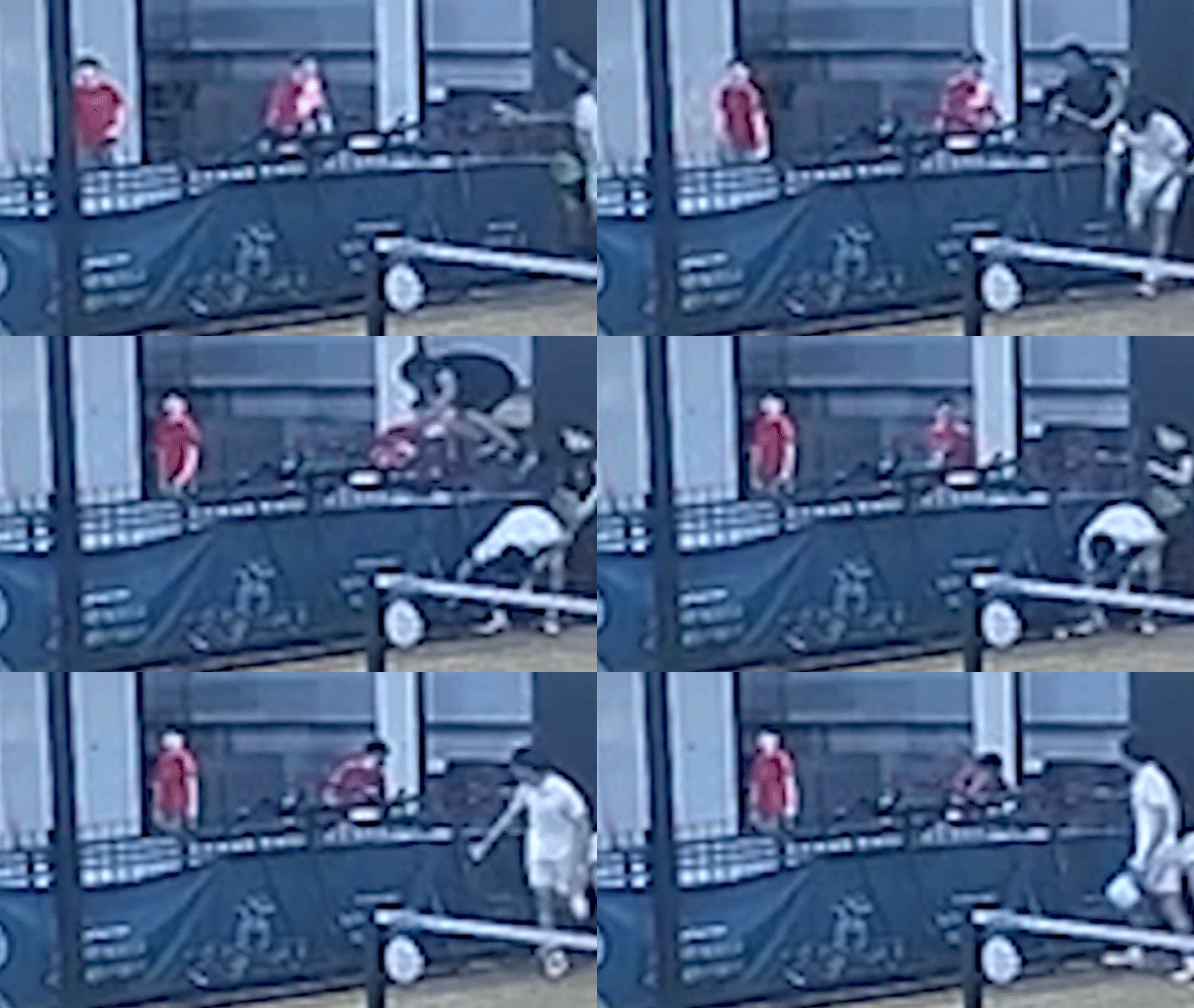
At first glance, the incident appears horribly straightforward: a player climbs over a court fence and relies on mesh netting meant to cover an opening; the net tears; he falls three stories and dies. But several design and decision layers had to fail simultaneously:
- Perceived vs. actual safety: The presence of netting likely signaled to the player that the area was at least somewhat safe to step or land on. In design psychology, this is a classic mismatch between perceived capacity and actual load-bearing capacity.
- Barrier hierarchy: In well-designed high-risk environments (industrial plants, construction sites, elevated walkways), safety systems are layered: robust railings, secondary containment, and clearly marked, physically inaccessible non-load-bearing elements. Here, a single fence and non-structural netting substituted for a multi-layer system.
- Behavioral expectations: Recreational facilities often assume compliant behavior – that players will not climb railings – but sports culture pushes in the opposite direction. In games, retrieving a ball quickly is normal, even competitive, behavior. When a facility’s safety depends on people never doing the obvious thing (reaching or climbing for an in-play ball), that’s a design flaw, not just a user error.
Globally, we’ve seen similar patterns. Rooftop pools and bars have had fatal falls when guests climb or sit on railings. Multi-story shopping malls have experienced deaths where low or easily scalable barriers meet momentary misjudgment. What changes in a sports context is frequency and predictability: balls will go out of bounds, and people will instinctively go after them.
Why This Isn’t Just a “Freak Accident”
The police designation of the case as “sudden death” is procedural, not analytical. The language can obscure systemic issues by framing the incident as an unpredictable tragedy. But nothing about this scenario is truly unpredictable:
- Elevated court + open vertical drop + partially covered gap + accessible fencing = foreseeable risk.
- Sports environment + stray balls = routine motivation to cross boundaries.
- Mesh coverage without clear warning or physical separation = invitation to misinterpret safety.
In safety engineering, the question is not “Why did this happen once?” but “Why hasn’t this happened more often?” The answer is usually luck, underreporting, or the fact that near-miss incidents never reach the news. It’s highly likely that at this and similar facilities, people have climbed railings or stepped on non-load-bearing surfaces before without fatal consequences. That pattern of near misses is exactly what regulators and operators often fail to capture.
A Regulatory Gray Zone: Sports Facilities vs. Building Codes
Most building codes around the world focus on minimum railing heights (often around 1.0–1.1 meters), structural load requirements, and basic fall protection for balconies and open edges. But sports venues are a different animal:
- Players move at speed, sometimes off-balance.
- Attention is focused on a ball, not on surroundings.
- Competitive dynamics encourage risk-taking to save a point.
Safety researchers have long argued that “static” building standards are inadequate for “dynamic” use cases. High-rise futsal and rooftop basketball courts, for example, often need higher and more secure enclosures than traditional terraces. Yet in many jurisdictions, these facilities are approved as routine fit-outs rather than being assessed under a sports-specific safety framework.
Malaysia is not unique here. In the United States, local fights over pickleball have focused on noise complaints far more than safety. In parts of Europe and Asia, authorities often rely heavily on operators’ self-regulation. The result is a patchwork of protections – from fully enclosed, purpose-built rooftop courts to improvised spaces where netting or mesh is added more to prevent balls from dropping onto cars than to protect human life.
Expert Perspectives: Where the Real Risk Lies
Safety and sports design experts have been warning about these intersections for years, even if incidents rarely make headlines.
Sports facility consultant and architect Dr. Geraint John, who has advised on international stadium design, has argued in professional forums that “any sports space more than one story above grade should be treated as a high-risk environment, with containment standards closer to industrial safety than leisure architecture.” The Kuala Lumpur case is almost a textbook example of what happens when that philosophy is not applied.
Risk analyst Prof. Andrew Hale, known for his work on safety culture, has emphasized that “systems that rely on users always doing the ‘right’ thing are not resilient systems.” When the only thing keeping a player from a lethal drop is the expectation that they will not cross a fence to retrieve a ball, the system is inherently fragile.
Sports sociologists also note how norms within recreational communities shape behavior. In racket sports, there is a long-standing ethos of hustle – chasing down every ball, minimizing interruptions. Without clear, enforced rules and visible physical barriers, that culture will routinely override abstract warnings or small signs.
The Hidden Data: How Common Are These Incidents?
Global data on sports-related falls in multi-story environments is limited, in part because such events are classified under broad categories like “falls from height” rather than “sports facility incidents.” However, broader statistics provide important context:
- The World Health Organization estimates that falls account for over 680,000 deaths annually worldwide, with many more serious injuries.
- Urban environments see higher rates of falls from buildings and structures, especially in rapidly growing cities where safety practices lag development.
- Sports and recreation contribute to a significant share of non-fatal injuries requiring emergency care, with environments featuring hard surfaces and elevation presenting the most severe outcomes.
While the exact number of pickleball-related serious injuries globally is still emerging, insurers in North America have noted a sharp rise in claims tied to the sport’s rapid adoption, especially among adults in their 30s and older. Most of that conversation has centered on joint injuries, not vertical risk – but the infrastructure being built to host these games, especially in dense cities, adds a new dimension.
Liability, Culture, and the Blame Game
Facility operators often rely on waivers, posted warnings, and generic disclaimers. But courts in many jurisdictions increasingly distinguish between inherent risks of a sport (sprained ankle, muscle tear) and avoidable environmental hazards (inadequate barriers, deceptive visual cues, or non-load-bearing surfaces near drops).
In this Malaysian case, several questions will be crucial:
- Was the mesh netting installed as a ball-catching measure or as a safety feature – and how was it represented?
- Were there clear, visible warnings that the area beyond the fence and the netting was dangerous and not to be accessed?
- Did local authorities inspect and approve the configuration of the third-floor courts and surrounding protective structures?
Public statements urging people to “refrain from speculation” during investigations are standard, but they can also delay much-needed public scrutiny about whether this is an isolated tragedy or a symptom of broader operator practices in the region’s sports centers.
What Needs to Change: From Facility Design to Player Behavior
This death should serve as a catalyst for a broader rethinking of sports facilities in multi-story settings. Several shifts are overdue:
- Stricter design standards for elevated courts
Regulators should treat any court above ground level as a high-risk site requiring:- Full-height, tamper-resistant enclosures, not just waist- or chest-high fences.
- Clear separation between play areas and any structural openings or non-load-bearing elements.
- Engineering sign-off on any netting or mesh installed near vertical drops.
- Mandatory risk assessments and audits
Sports operators should be required to conduct formal risk assessments when installing courts above the first floor, with periodic audits as usage patterns evolve. - Behavioral rules and enforcement
It should be explicit, verbally and in writing, that players are never to climb barriers or retrieve balls from certain zones. That requires not just signs, but staff enforcement and, where possible, architectural design that makes rule-breaking physically difficult. - Data transparency
Authorities and insurers should track and publish data on sports-facility-related falls and near misses, so risk patterns are visible and policy can be informed by evidence rather than isolated tragedies.
Why This Matters Beyond Pickleball
This story touches on larger global trends:
- Urban densification: As cities grow vertically, more activities – from jogging tracks to climbing walls – are being pushed upward, often without commensurate safety frameworks.
- Commercial pressure: Operators monetize every possible space, converting rooftops, decks, and upper floors into revenue-generating sports venues, sometimes outpacing regulators’ ability to respond.
- Globalization of niche sports: Pickleball’s spread to Asia, Europe, and beyond is happening faster than the development of context-specific safety norms, especially in countries where the sport is new.
Each new sport brings not just new fans, but new risk profiles. Treating these as simple variations of existing sports can be dangerous when ball trajectories, court dimensions, and player demographics differ significantly from more established activities.
Looking Ahead: What to Watch
In the coming months, several developments will signal whether this case becomes a turning point or is quietly filed away:
- Whether Malaysian authorities update safety guidelines for elevated sports facilities or issue new advisories.
- Whether operators across Southeast Asia voluntarily retrofit courts with improved barriers or redesign risky areas.
- Whether insurance companies begin tightening requirements or increasing premiums for multi-story sports facilities lacking specific safety features.
- Whether international sports bodies or pickleball federations issue global guidance on court design in high-rise settings.
The danger is that the headline will fade, the CCTV clip will circulate briefly as shocking content, and then the status quo will resume – until the next event. The opportunity is to treat this as a system failure, not an isolated misstep, and to redesign the environments where millions now play.
The Bottom Line
A young man died in Kuala Lumpur not because he misunderstood the rules of pickleball, but because an entire chain of design, regulation, and culture failed to anticipate a predictable human behavior in a high-risk environment. As urban sports continue to move upward, the safety conversation must move up with them. If we insist on turning rooftops and third-floor decks into courts, we need to stop designing them like ordinary leisure spaces and start treating them like the high-risk arenas they really are.
Topics
Editor's Comments
What stands out in this case is how quickly the language of inevitability surfaces: a ‘sudden death,’ a ‘tragic incident,’ and calls to avoid speculation. That framing is emotionally understandable but analytically evasive. It shifts attention from design and regulatory responsibility to a narrative of misfortune and individual error. We should be asking far more uncomfortable questions: Was this facility’s configuration ever challenged during permitting? Are there financial incentives that encourage operators to accept borderline designs to squeeze courts into marginal spaces? And how many near misses have occurred at similar venues without public reporting because they did not result in death? A contrarian reading of this story is that we should almost expect such incidents under current conditions; the surprise is not that one person fell, but that more have not. Until authorities and operators treat elevated recreational spaces with the same rigor applied to industrial fall hazards, we are relying on luck and personal caution to prevent the next fatality. That is not a sustainable safety strategy in increasingly vertical cities.
Like this article? Share it with your friends!
If you find this article interesting, feel free to share it with your friends!
Thank you for your support! Sharing is the greatest encouragement for us.