From Locker-Room Prank to Global Clip: What the Knicks’ Viral “In 4K” Moment Really Tells Us

Sarah Johnson
December 17, 2025
Brief
A viral prank in the Knicks’ NBA Cup celebration isn’t just locker-room humor. It reveals deeper shifts in NBA culture, masculinity, AI-era credibility, and the league’s push to legitimize its in-season tournament.
Beyond the Viral Clip: What the Knicks’ “In 4K” Moment Reveals About Modern Sports Culture
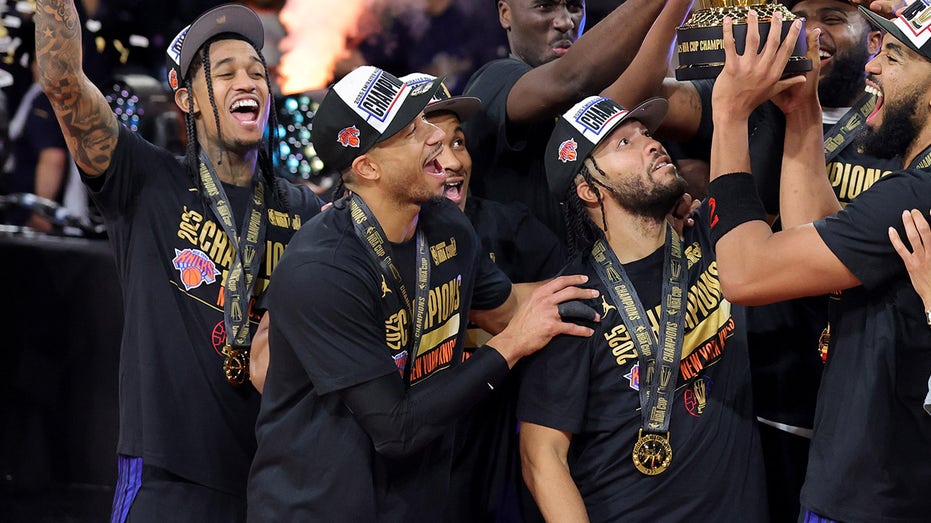
Most outlets will treat Josh Hart’s now-viral gesture toward Jalen Brunson during the Knicks’ NBA Cup celebration as a throwaway locker-room antic – a quick hit for social feeds. But this moment, captured “in 4K” and instantly memed, sits at the intersection of several deeper trends: the NBA’s evolving entertainment strategy, the blurring line between sports and social media comedy, shifting norms around player behavior and masculinity, and the league’s ongoing experiment with the in-season tournament as both a competitive and commercial product.
The Bigger Picture: From Locker Room Pranks to Global Content
What once would have been a private locker-room prank is now a global artifact in seconds. The Knicks’ NBA Cup celebration took place on a stage explicitly designed to be televised, clipped, and shared. That matters.
Historically, the NBA’s most memorable off-court moments were mediated through traditional broadcast: the 1980s champagne-soaked locker rooms, Michael Jordan’s cigar-and-champagne shots in the 1990s, or the Spurs’ choreographed jokes in the 2000s. They were personality snapshots, but they weren’t built for the algorithm.
The Hart–Brunson moment is very much an algorithm-native incident. It is:
- Short and visually clear – perfect for vertical video.
- Physically slapstick but emotionally light – easy to share without heavy context.
- Attached to a trending event – the NBA Cup – which the league desperately wants people to care about.
This is not just about a joke between friends. It’s about how the modern NBA is increasingly understood through micro-moments: reactions, pranks, courtside facial expressions, and tunnel fits that often travel farther than the actual game highlights.
That’s partly intentional. Over the last decade, the NBA has leaned hard into personality marketing: mic’d-up segments, social-team access, behind-the-scenes content, and partnerships with platforms like X, Instagram, and TikTok. Players are encouraged – implicitly and often explicitly – to show personality, to be meme-able, to be more than numbers on a scoreboard.
What This Really Means: Chemistry, Masculinity, and the Modern Locker Room
On the surface, Hart’s gesture is juvenile humor – something that has existed in locker rooms across every sport for decades. But its meaning is different in 2025 for at least three reasons:
1. Public Displays of Intimacy Among Male Athletes
Male athletes have long expressed closeness through physical playfulness, but those interactions were historically shielded from mass audiences. Today, fans are seeing the full range of how teammates relate to each other: hugs, inside jokes, dance routines, TikTok skits, and yes, borderline inappropriate pranks.
This reflects a slow shift in what’s considered acceptable male intimacy in sports. The hyper-macho, stoic athlete archetype is giving way – especially in the NBA – to something looser and more expressive. Players cry openly in postgame interviews, wear risk-taking fashion, and joke with each other in ways that would have been frowned upon 30 years ago.
That doesn’t mean every gesture is healthy or okay; it does mean that the emotional bandwidth on display is wider than it used to be. The Hart–Brunson dynamic is rooted in a decade-long relationship dating back to Villanova, where they won two NCAA titles. Fans are not just watching a prank; they’re watching the shorthand of a long-standing friendship.
2. “Consent” and the Limits of Locker-Room Culture
There’s also a less comfortable layer. In an era where conversations about consent and workplace boundaries have moved from the margins to the mainstream, behavior that was once written off as “boys being boys” is being reassessed.
On one hand, Brunson’s reaction – startled, then laughing – suggests this is a known, mutual dynamic between friends. On the other hand, the power of social norms cuts both ways: just because something is normalized doesn’t mean it’s harmless, especially when it involves intimate contact in a workplace setting, which a basketball court and celebration stage technically are.
If this exact behavior occurred in a typical corporate office – in front of cameras, no less – it would immediately trigger HR protocols. The sports world historically operates under a different, more permissive code, but that gap is narrowing. As leagues push to be seen as progressive and inclusive workplaces, they will eventually be forced to reckon more directly with these blurred lines.
3. The Social Media Spin: “It Was AI”
Hart’s joking defense – posting “IT WAS AI” – is more than a throwaway line. It’s a sign of how deeply generative AI and deepfake discourse have embedded themselves into public consciousness. A few years ago, the standard joke would have been “That wasn’t me” or “The camera angle was bad.” Now, the default gag is to blame AI.
This kind of humor both reflects and trivializes a serious issue: the increasing difficulty of trusting digital images and videos. When athletes casually invoke AI to explain away embarrassing clips, they’re tapping into a real anxiety – that we are heading toward a world where nothing can be trusted – and turning it into a punchline.
It also foreshadows a future where, at some point, an athlete or public figure will genuinely claim a damaging video is AI-generated. Hart’s joke, in that sense, previews a defense strategy we will likely see for real – and puts leagues, broadcasters, and platforms on notice about the need for verification standards.
Data & Stakes: Why the NBA Cup Stage Matters
This incident didn’t happen after a random regular-season game; it happened during celebrations for the NBA’s in-season tournament – branded here as the NBA Cup. That context matters.
The NBA introduced the in-season tournament to address several overlapping problems:
- Fan engagement and viewership: Regular-season ratings have been under pressure, especially in early months when competing with the NFL.
- Load management: Star players frequently sitting out nationally televised games has angered both fans and broadcasters.
- Revenue growth: The league is preparing for its next media rights negotiations, where proof of new, sponsor-friendly events is critical.
By turning a December set of games into a single-elimination, high-stakes mini-tournament, the NBA is trying to simulate playoff intensity – and playoff narrative – before the spring. Knicks coach Mike Brown’s comment that “every game counts” underscores the league-approved messaging: this matters, this is pressure, this is real competition.
But outside the league office, the debate is noisier. Some, like Charles Barkley, have dismissed the tournament as a “cash grab.” They’re not entirely wrong: players receive substantial financial bonuses, and the league gains new inventory to sell to broadcasters and sponsors. At the same time, for franchises like the Knicks that haven’t reached the Finals since 1999, any trophy is a narrative pivot – evidence that the organization is on an upward trajectory.
In that light, the Hart–Brunson clip is doing unpaid marketing work for the NBA Cup. Most people reading about or sharing the incident will also be reminded: the Knicks just won something. The league didn’t plan this moment, but it benefits from the attention halo around it.
Expert Perspectives: Culture, Branding, and Boundaries
Sports sociologists and branding experts see more here than a prank.
Dr. Michael Serazio, a communications professor who has written extensively on sports media and authenticity, has noted in his broader work that teams now “compete not only to win games but to win timelines.” Moments like this, he might argue, are a currency of cultural relevance: a mid-season NBA Cup win is forgettable; a viral personality moment is not.
Dr. Amira Rose Davis, a historian of sport and co-host of the podcast Burn It All Down, has often pointed out how locker-room culture is insulated from scrutiny. Through that lens, this incident invites overdue conversations about the types of physical joking we still normalize – and who is and isn’t protected by that culture. It’s easier to laugh along when both parties are powerful, beloved stars; it’s harder when there is a power imbalance or when someone objects.
Brand strategists, meanwhile, see the upside and risk. Hart’s self-deprecating “In 4K… IT WAS AI” response plays well with younger audiences and humanizes him. But if such behavior escalates or is repeated, team and league sponsors – wary of association with anything that could be framed as harassment – may quietly push for clearer behavioral expectations in public celebrations.
Looking Ahead: Where This Trend Goes Next
Several future implications are worth watching:
- League guidance on celebrations: Don’t be surprised if the NBA quietly nudges teams to brief players on what is and isn’t acceptable during trophy presentations. Leagues rarely react publicly to one-off incidents like this, but they do update behind-the-scenes guidance.
- AI as a cultural punchline – then defense strategy: Hart’s “IT WAS AI” joke foreshadows a coming era in which “That’s AI” becomes a serious legal and PR stance. Sports organizations will need policies for authenticating footage.
- In-season tournament legitimacy: The more emotional, memorable, and meme-worthy these celebrations feel, the more the NBA Cup starts to resemble a real, separate prize rather than a contrived gimmick. The Knicks’ visible joy – and the viral content around it – actually helps the tournament’s long-term credibility.
- Fan expectations of access: Fans are increasingly conditioned to see everything: pregame talks, practice footage, on-bench banter. That raises the question: where, if anywhere, is the line between genuine access and invasive surveillance? Incidents like this blur it further.
The Bottom Line
The clip of Josh Hart sticking his finger in Jalen Brunson’s “sensitive area” will, for most people, exist as a momentary laugh on their feed. But it sits atop deeper shifts: the NBA’s transformation into a personality-driven content machine, evolving norms around masculinity and consent in sports workplaces, the rising role of AI in how we perceive truth, and the league’s struggle to make the NBA Cup feel like more than a corporate invention.
Viral moments are rarely just jokes. They’re small, sharp windows into how power, culture, and commerce are rearranging themselves in real time. This one is no different.
Topics
Editor's Comments
What’s most revealing about the Hart–Brunson moment isn’t the prank itself, but how unremarkable it initially seemed within sports culture – right up until it met the realities of a hyper-online, AI-anxious public. This is a clip that would have been forgotten in a private locker room a decade ago; instead, it becomes a multi-layered artifact: workplace behavior, entertainment product, and inadvertent AI joke all at once. We should resist two easy reactions: the reflexive “lighten up, it’s just a joke” dismissal and the opposite impulse to treat this as a singular scandal. The real story lies in the structural incentives. Leagues push for more cameras and more access because it drives revenue; players are rewarded with attention for being outrageous, funny, or vulnerable. Yet the frameworks governing what’s acceptable on that ever-expanding stage have not caught up. This gap will keep producing moments like this, and the question is less whether they happen than who is protected by the culture around them and who is not.
Like this article? Share it with your friends!
If you find this article interesting, feel free to share it with your friends!
Thank you for your support! Sharing is the greatest encouragement for us.