Mexico’s Congressional Hair-Pulling Brawl Exposes a Deeper Fight Over Transparency and Power

Sarah Johnson
December 16, 2025
Brief
A viral hair-pulling brawl in Mexico’s Congress isn’t just chaos. It exposes deep battles over transparency, institutional control, and democratic backsliding in a system struggling to contain polarization and violence.
Hair-Pulling in Mexico’s Congress Isn’t Just Spectacle — It’s a Warning Signal for the Country’s Democratic Nerves
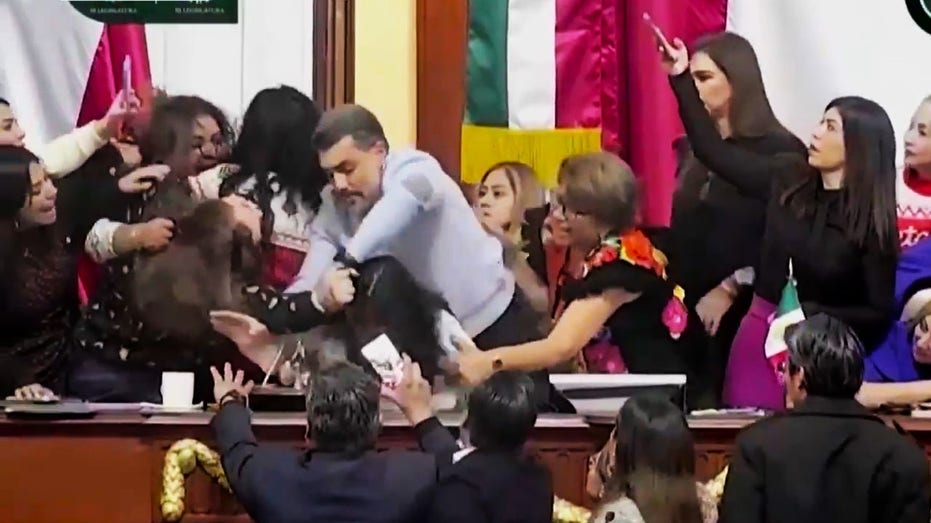
What looks like a viral clip of Mexican lawmakers yanking each other’s hair on the floor of Congress is, at its core, a story about power, transparency, and a political system under increasing strain. The fact that this melee erupted during a debate over reforms to Mexico City’s transparency oversight agency is not incidental — it’s the point.
Similar brawls in legislatures worldwide are often dismissed as political theater. But in Mexico’s current context — with a dominant ruling party, deep polarization, and fragile checks on executive power — episodes like this are better understood as early-warning indicators of institutional stress. When lawmakers literally fight over who controls the microphone in a debate about oversight, it is a sign that the rules of democratic contestation are being tested, if not quietly rewritten.
The bigger picture: How Mexico got here
To understand why a debate about a transparency agency turned physical, you have to situate it in two overlapping trajectories: Mexico’s long struggle to build institutions capable of checking power, and the rapid centralization of political control under the current ruling party, Morena.
From one-party rule to fragile checks and balances
For most of the 20th century, Mexico was effectively a one-party state under the PRI (Institutional Revolutionary Party). Elections were held, but power was tightly managed through patronage and corporatist structures. Corruption was systemic and largely unaccountable. Beginning in the 1990s and accelerating after the 2000 presidential victory of the opposition PAN (National Action Party), Mexico invested heavily in building independent oversight institutions:
- National and local transparency agencies, such as the federal transparency body (now the INAI) and Mexico City’s own watchdog, were created to give citizens a formal right to access public information.
- Electoral authorities were strengthened to reduce fraud and increase competition.
- Autonomous commissions in areas like competition, human rights, and telecommunications attempted to carve out spaces protected from partisan interference.
These bodies were far from perfect, but they became crucial components of Mexico’s post-authoritarian architecture. They gave opposition parties, civil society, and journalists tools to demand documentation and data that used to be locked away. In a country where impunity is pervasive — with conviction rates for many crimes in the single digits — transparency agencies became one of the few practical levers for accountability.
Morena’s rise and the backlash against “autonomous” oversight
Morena’s ascent, beginning with Andrés Manuel López Obrador’s landslide in 2018, was fueled by real popular anger at corruption, inequality, and an unresponsive political class. But once in power, Morena has often framed independent oversight institutions as obstacles rather than safeguards, depicting them as expensive, elitist, or captured by previous regimes.
In recent years, Morena and its allies have:
- Pushed reforms to weaken or restructure the INAI, Mexico’s national transparency institute, by blocking appointments needed for quorum.
- Criticized and attempted to reshape the National Electoral Institute, accusing it of bias while seeking to centralize more control over elections.
- Questioned the value of autonomous regulators, calling them “neoliberal” relics.
Against this backdrop, reforms to Mexico City’s transparency oversight agency are read by the opposition not as technical adjustments, but as another step in a broader project: consolidating political power and diluting the independence of institutions that can expose misconduct or misuse of public funds.
Why a transparency debate turned into a physical confrontation
The scuffle described — PAN lawmakers occupying the podium, Morena representatives trying to dislodge them, and female deputies pulling each other’s hair — reflects three overlapping dynamics.
1. The breakdown of procedural trust
In healthy legislatures, even fierce opponents share a baseline trust in procedure: that rules for debate, voting, and amendment are at least somewhat fair, and that losing today doesn’t close off political space tomorrow. When PAN lawmakers decided to physically occupy the podium, it was an explicit claim that procedural channels were no longer adequate — that the majority was ramming through changes without meaningful debate.
Morena’s response — trying to physically reclaim the podium — mirrors that erosion of trust. Both sides accused the other of “violence” and abandoning argument in favor of force. That mutual narrative matters: when both camps come to see the other as fundamentally illegitimate, parliament shifts from a forum of negotiation to a stage for confrontation.
2. A fight over who controls information in a violent, corrupt environment
Mexico sits near the bottom of the OECD on public trust in government and ranks poorly on corruption indices. Journalists and watchdog groups rely on transparency laws to investigate everything from cartel infiltration of local governments to irregular public contracts. Weakening or politicizing local transparency bodies might not make headlines abroad, but it has concrete effects: fewer answers to information requests, more delays, more discretion for officials to deny access.
In this sense, the fight was about more than a single agency. It was about who decides what the public gets to know, and under what terms. When an opposition party sees a transparency reform as a thinly veiled attempt to control damaging information ahead of future elections, the incentive to escalate — even physically — increases.
3. Gender, optics, and the weaponization of “decorum”
That the most visible aggressions were between women lawmakers is symbolically significant. Mexico has been lauded for its gender parity reforms; Congress and many local legislatures are now close to 50% female. Yet the clip of hair-pulling risks becoming a caricature — used to delegitimize women’s political participation as inherently emotional or chaotic.
Ironically, all sides will likely weaponize the incident:
- The opposition can say: Look how the ruling party resorts to physical force to silence dissent.
- Morena can claim: The opposition no longer debates; it stages disruptions and then cries foul.
- Conservative voices may quietly suggest: Parity has turned Congress into a circus, undermining hard-won gains for women in politics.
The danger is that a real institutional dispute gets reframed in shallow cultural terms instead of focusing on the substantive issue: the integrity and independence of oversight bodies.
What this really means for Mexican democracy
Normalization of physical confrontation in a country already plagued by violence
Mexico is one of the most violent democracies in the world, with politicians regularly threatened or killed, especially at the local level. When violence becomes normalized as a political tool in society at large, the legislature is often one of the last spaces expected to uphold non-violent norms. Scenes like this chip away at that boundary.
This is not an isolated case. There have been earlier brawls in the Senate during debates over U.S. policy on cartels, and confrontations in state congresses across the country. The repetition matters: it gradually shifts expectations of what is “normal” in democratic deliberation. Once physical disruption becomes an accepted tactic, it is very hard to roll back.
Polarization without robust mediating institutions
Mexico’s current polarization is not identical to that of the U.S. or Brazil, but it rhymes. Morena’s narrative of representing “the people” against a corrupt elite, and the opposition’s framing of Morena as undermining democratic rules, have hardened political identities. Normally, courts, independent oversight bodies, and strong party organizations mediate such conflicts. But when those same institutions are targeted, captured, or delegitimized, polarization finds expression in increasingly zero-sum behavior.
What played out on the Congress floor is a microcosm of that logic: if procedures are seen as stacked, the only way to be heard is to stop the process physically. And if one side resorts to that, the other feels justified in meeting force with force.
The transparency paradox
There is a striking irony here: a debate about transparency played out in full view of the public, but the underlying reform details remain largely invisible in the viral narrative. Most citizens will see the video but never read the proposed legal changes. That dynamic benefits whoever controls the framing, not necessarily whoever is right on substance.
The broader transparency paradox is this: Mexico has built legal frameworks that, on paper, are more open than many countries. But implementation is uneven, and enforcement often selective. Tinkering with oversight agencies can be framed as improving efficiency or cutting costs — while actually narrowing the practical space for investigative scrutiny.
Data and evidence: What’s at stake in weakening oversight
Several trends underscore why the fight over a local transparency body matters beyond city limits:
- High levels of perceived corruption: Mexico consistently scores in the lower half of global corruption perception indices, with a large majority of citizens believing corruption is widespread in government.
- Reliance on transparency tools: Tens of thousands of public information requests are filed annually across federal and local agencies. Journalistic exposés on embezzlement, conflicts of interest, and public procurement abuses often start with these requests.
- Judicial weakness: Given chronic under-resourcing and politicization in the judiciary, administrative oversight through transparency and independent watchdogs is often the only realistic accountability mechanism.
Against this backdrop, a seemingly technical reform to a city-level transparency agency can represent a critical inflection point: either strengthening the culture and practice of openness or eroding it under the guise of administrative reform.
Expert perspectives
Several experts on Mexican politics and democratic institutions provide useful lenses for interpreting this episode.
Political scientist Denise Dresser has long warned that dismantling or weakening autonomous institutions “hollows out democracy from within,” leaving the form intact while draining its substance. The physical fight over a transparency agency illustrates that hollowing-out process reaching the very arena meant to channel conflict peacefully.
Security and governance scholars note that in countries with high levels of violence, legislatures are not immune from broader cultural patterns. As one analyst put it in a recent discussion on Mexican politics, “When the state cannot effectively monopolize legitimate violence in society, it struggles to maintain non-violence even within its own formal spaces.” The Congress brawl is a small but telling manifestation of that tension.
Experts on gender and politics might also highlight the dual-edge nature of parity: women are now fully participating in the rough-and-tumble of political struggle, but they are also more visibly exposed to the criticism and ridicule that come with it. The risk is that their missteps — real or perceived — are generalized to question women’s political competence, rather than being seen as part of the broader institutional crisis that affects all legislators.
Looking ahead: What to watch
The hair-pulling clip will eventually fade from social media feeds, but the underlying issues will not. Several developments in the coming months will help determine whether this is a one-off spectacle or a sign of deeper democratic unravelling.
- The final shape of the transparency reform: Do the approved changes (if passed) strengthen independence, resources, and enforcement powers of Mexico City’s oversight agency, or do they politicize appointments and weaken access to information?
- Judicial review and legal challenges: Will opposition parties and civil society groups challenge the reforms in court, and how will judges respond? A judiciary willing to push back could mitigate the damage; a compliant one could accelerate institutional erosion.
- Replicating the model nationally: If Morena succeeds in reshaping the Mexico City body without major political cost, similar strategies may appear in other states or at the federal level, creating a patchwork of weakened oversight institutions.
- Escalation of legislative confrontations: If physical disruption becomes a recurring tactic in Congress — whether by taking over podiums, blocking access, or staging sit-ins — the quality of lawmaking will deteriorate further, and public cynicism will deepen.
The bottom line
A viral video of lawmakers pulling each other’s hair might seem like a side-show in a country grappling with cartel violence, economic inequality, and migration pressures. But dismissing it as mere spectacle misses the warning it carries.
When elected representatives feel that the only way to contest a reform affecting transparency and oversight is to physically seize the podium, it signals that the ordinary mechanisms of democratic negotiation are fraying. When ruling party lawmakers respond in kind, it confirms that both sides are increasingly willing to test the boundaries of acceptable political behavior.
Ultimately, the fight on the Congress floor is not just about who started the shoving. It is about who will control the institutions that decide what the Mexican public gets to see — and what remains hidden. In a democracy already living with high levels of violence and distrust, that is not a marginal issue. It is central to whether Mexico’s fragile system checks power or merely stages conflicts for the cameras while the real decisions are made elsewhere.
Topics
Editor's Comments
What’s striking here isn’t just the physicality of the confrontation, but how quickly public discussion has fixated on the spectacle and largely ignored the substance of the reform. That dynamic is dangerous: it allows both sides to weaponize the optics—Morena as victims of a disruptive opposition, PAN as defenders of democracy under attack—while citizens never see a serious debate about what, concretely, will change in transparency rules. We should be asking very specific questions that much of the coverage sidesteps: Who will appoint the leadership of the reformed oversight agency? How secure are their terms? What appeal mechanisms exist if information is denied? Does the agency retain budgetary independence? Without answers, it’s impossible to judge whether this is a genuine attempt at institutional improvement or a strategic reshaping of the rules in favor of the governing majority. The hair-pulling may fade from memory, but the legal architecture that emerges from this vote will quietly shape how much Mexicans can know about their own government for years to come.
Like this article? Share it with your friends!
If you find this article interesting, feel free to share it with your friends!
Thank you for your support! Sharing is the greatest encouragement for us.