Tyler Shough’s Breakout Win May Have Quietly Rewritten the Saints’ Future

Sarah Johnson
December 8, 2025
Brief
Tyler Shough’s two rushing TDs vs. the Bucs were more than an upset—they exposed shifting quarterback values, NFC South volatility, and a potential identity pivot for the New Orleans Saints.
Tyler Shough’s Breakout Win Doesn’t Just Shake Up the NFC South – It Redefines the Saints’ Future
On paper, a 2-10 team upsetting a division leader in the rain looks like a quirky December blip. In reality, Tyler Shough’s two-touchdown performance against the Tampa Bay Buccaneers is a much deeper story about where the New Orleans Saints are heading, how the NFC South keeps reinventing itself as the NFL’s most volatile division, and why quarterback evaluation in today’s league has quietly shifted from arm talent to adaptability.
This game matters less because it nudged the Bucs and Panthers into a 7-6 deadlock, and more because it hinted that New Orleans may have stumbled into the kind of dual-threat quarterback prototype the franchise has largely avoided since Drew Brees retired: a player whose legs, not just his arm, can reframe how the Saints build their offense and their roster over the next several years.
The bigger picture: A struggling franchise, a chaotic division
The Saints entered this game at 2-10, seemingly playing out the string. Yet their win over a 7-5 Buccaneers team in a tight NFC South race sits at the intersection of three broader trends:
- The NFC South as a revolving door of power. Since Tom Brady’s 2020 arrival and departure in Tampa Bay, no team in the division has managed sustained dominance. The Bucs, Saints, Panthers, and Falcons have all cycled between contention, rebuilds, and uncertainty at quarterback. A 2-10 team materially altering the playoff picture is almost emblematic of this division’s identity: parity mixed with instability.
- Post-Brees identity crisis in New Orleans. Since Brees retired, the Saints have cycled through Jameis Winston, Andy Dalton, Derek Carr and spot starts from backups, all largely in the traditional pocket-passer mold. The offense has looked structurally dated at times compared with more motion-heavy, RPO-oriented systems built around dual-threat QBs.
- The league-wide shift from pure passers to creators. The last decade has rewarded quarterbacks who can turn broken plays into explosives – from Patrick Mahomes to Lamar Jackson, Jalen Hurts, Josh Allen, and C.J. Stroud. Teams are increasingly valuing the ability to manufacture offense outside structure, especially behind imperfect offensive lines.
Against that backdrop, Shough’s performance – modest passing numbers, but game-deciding runs – reads less like a fluke and more like a test case: can the Saints pivot toward a modern, mobility-leveraging offense rather than chasing Brees 2.0 in an era that has moved on?
What this really means: One game, two statements
There were two simultaneous statements embedded in this game:
- The Saints might have something real in Tyler Shough – even if it’s not fully formed yet.
- The Buccaneers’ margin for error with Baker Mayfield is thinner than their record suggests.
Shough’s legs as a strategic weapon, not a desperation move
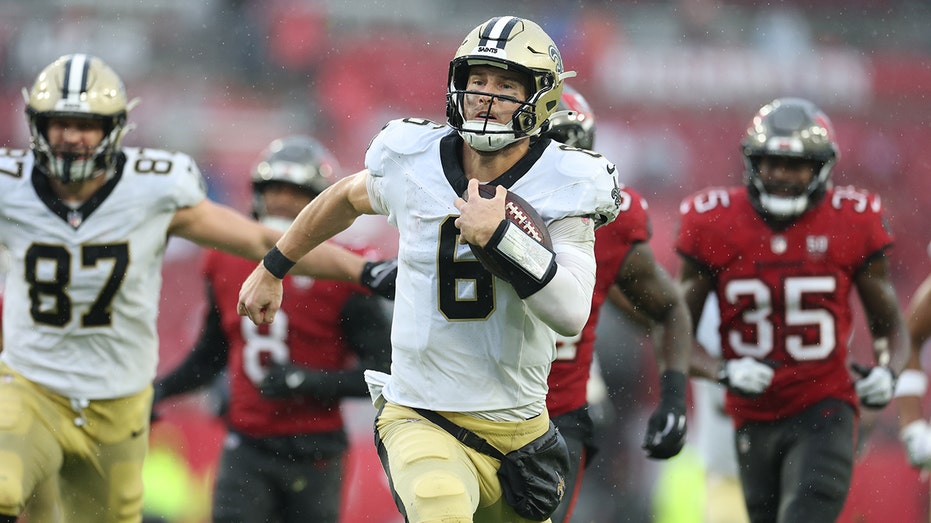
Shough’s stat line – 144 passing yards, one interception, no passing touchdowns, but 55 yards rushing and two critical TD runs – tells a counterintuitive story. Traditional box-score analysis says the quarterback struggled. Yet the defining plays of the game, especially the 13-yard escape-and-sprint touchdown in the fourth quarter, reflect the very skill that modern offenses are increasingly built around: turning losing plays into winning ones.
On that play, almost everyone – in the stadium and on television – assumed a sack was coming. Instead, Shough spun out, broke the pocket, and turned a failing pass concept into a decisive scoring run. In pure EPA (expected points added) terms, those are the kinds of moments that separate average quarterbacks from impact players, even when their raw passing volume is unimpressive.
It also hints at something important in New Orleans: if the Saints embrace this style, they can build an offense that doesn’t require elite receiver separation on every snap. A mobile quarterback can mask offensive line deficiencies, extend plays for developing receivers, and stress defenses horizontally and vertically in ways the Saints simply haven’t done since Brees’ prime.
Devin Neal and the quiet rebuild of the Saints’ backfield
Shough wasn’t alone. Rookie Devin Neal’s 70 yards on 19 carries and a touchdown continue a trend that should worry Alvin Kamara’s long-term role in New Orleans. With Kamara injured, the Saints are unintentionally running a live experiment: can a cheaper, younger backfield – paired with a mobile quarterback – replicate much of Kamara’s production profile?
In a cap-constrained league, the answer matters. If Shough’s legs and Neal’s downhill consistency can form the core of a run-first, play-action-heavy attack, the front office gains leverage in any future decisions about high-priced veterans on offense. A dual-threat QB + committee-back model is where many franchises are heading because it reallocates cap space to premium positions like edge rusher and cornerback.
Baker Mayfield and the ceiling debate
On the other sideline, Mayfield’s 14-of-30 for 122 yards, one touchdown and one interception, in bad weather, reopens a question Tampa Bay has been trying not to ask: is Mayfield a bridge, or a long-term answer?
The weather undeniably affected the passing game, but that cuts both ways. What stands out is that, in a game where their opponent’s rookie quarterback weaponized his mobility, the Bucs’ offense looked rigid. When Mayfield’s rhythm was disrupted, Tampa Bay didn’t have enough schematic counterpunches – designed QB runs, option looks, or misdirection – to shift the math back in their favor.
The dropped would-be touchdown by Emeka Egbuka in the fourth quarter is the kind of moment that can distort narratives. If he catches that ball, the story is about Mayfield’s resilience and a clutch drive. But sustainable quarterback evaluation can’t hinge on one drop. The larger issue is that the Bucs’ offense felt fragile: heavily dependent on everything going right in a tough environment, rather than being adaptable.
Data and trends: Why this game fits a larger pattern
This single game ties into several broader NFL data trends that are reshaping how teams think about offense:
- Quarterback rushing is no longer a luxury. In recent seasons, teams with QBs who add at least 25–30 rushing yards per game tend to produce more efficient offenses, especially in the red zone. Shough’s 55 rushing yards and two rushing touchdowns are exactly the kind of high-leverage contributions that analytics departments value.
- Weather games magnify the importance of mobility. In rain and heavy wind, completion percentages drop and deep passing efficiency plummets. Offenses that can shift toward QB runs, RPOs, and horizontal stretches maintain a higher baseline of expected points. New Orleans did that; Tampa Bay largely did not.
- Defensive sustainability through offensive style. The Saints’ defense closed the game with two critical fourth-down stops, but that’s partly because the offense bought them structure: a stronger run game, clock control, and field position. Teams that run the ball effectively and sustain drives typically see better late-game defensive efficiency, as defensive units are less gassed in the fourth quarter.
Expert perspectives: What football minds will see in this
Several themes from this game align with what coaches, analysts, and front-office executives have been quietly emphasizing.
Offensive strategist and former coach Dan Orlovsky has repeatedly argued that the league is bifurcating into two types of offenses: those that rely on timing, precision, and pre-snap reads, and those that layer that structure with post-snap creativity from mobile QBs. Shough’s performance, even in a limited passing role, clearly leans toward the second archetype.
Analytics-driven commentators like Mina Kimes have also highlighted that young quarterbacks should be evaluated less on their early passing volume and more on their high-leverage playmaking. Escaping sacks, converting broken plays, and producing in late-game situations are often predictive of future growth when paired with good coaching. Shough checked several of those boxes in one afternoon.
For Tampa Bay, roster-building experts would note a different lesson: relying on a quarterback whose game is more toughness and moxie than elite traits can work in spurts, but it demands near-perfect supporting conditions. Bad weather, a key drop, a defense that can’t generate turnovers – any single variable can tilt the entire outcome.
Looking ahead: Why this game might age as a turning point
Several future-facing implications emerge from this otherwise ordinary-looking December contest:
- For the Saints: If Shough stacks even a couple more games where his legs materially alter the outcome, the organization will face a strategic decision: double down on building around his skill set, or treat this as a late-season anomaly and return to the veteran-QB carousel. The former path would require philosophical buy-in from the front office and coaching staff – including more designed runs, RPO packages, and a shift away from the Brees-era playbook DNA.
- For the Buccaneers: The margin for error in the NFC South is now minuscule. With the Panthers also at 7-6, one or two more games like this – where the offense cannot adapt to adverse conditions – could be the difference between hosting a playoff game and resetting the quarterback room in the offseason.
- For the NFC South narrative: This division has been defined by short windows of dominance: the Brees-era Saints, the brief peak of Matt Ryan’s Falcons, the Cam Newton Panthers, then Brady’s Bucs. The next era will likely belong to the franchise that commits earliest and most coherently to a modern offensive identity. Sunday’s game suggested New Orleans might, almost accidentally, have stumbled into the prototype that could lead such a shift.
The bottom line
This wasn’t just a 24-20 upset in the rain. It was a live demonstration of how a mobile, unpolished rookie quarterback can tilt a divisional race, expose the limitations of a conventional offense, and force both franchises to rethink what they want their next three to five years to look like.
If New Orleans embraces what Tyler Shough represents – not just his highlight runs, but the offensive philosophy they imply – this game may be remembered less as a spoiler win and more as the night a 2-10 team accidentally found its future.
Topics
Editor's Comments
What’s most intriguing about this game isn’t that a 2-10 team beat a division leader; that happens every December. It’s that New Orleans accidentally piloted a model many franchises only embrace after years of intentional rebuilding: young, cheap offensive talent paired with a quarterback who can add value beyond the called play. The Saints have been clinging to a Brees-era offensive identity, trying to replicate precise, high-volume pocket passing with veterans who don’t have his processing or accuracy. Shough’s performance forces an uncomfortable but necessary question: is the organization willing to abandon that nostalgia and admit the next Saints contender may look more like a stripped-down, mobility-driven attack than the finely tuned passing orchestra fans remember? On the other side, Tampa Bay’s loss highlights a recurring league-wide blind spot. Teams talk about adaptability and multiple offensive identities, but in high-leverage, adverse situations, many still revert to static game plans overly reliant on execution rather than flexibility. This game is a small but telling case study in which philosophy is better suited to the NFL’s increasingly chaotic reality.
Like this article? Share it with your friends!
If you find this article interesting, feel free to share it with your friends!
Thank you for your support! Sharing is the greatest encouragement for us.