Myles Garrett’s Sack Chase Reveals How the NFL Now Measures Defensive Greatness

Sarah Johnson
December 18, 2025
Brief
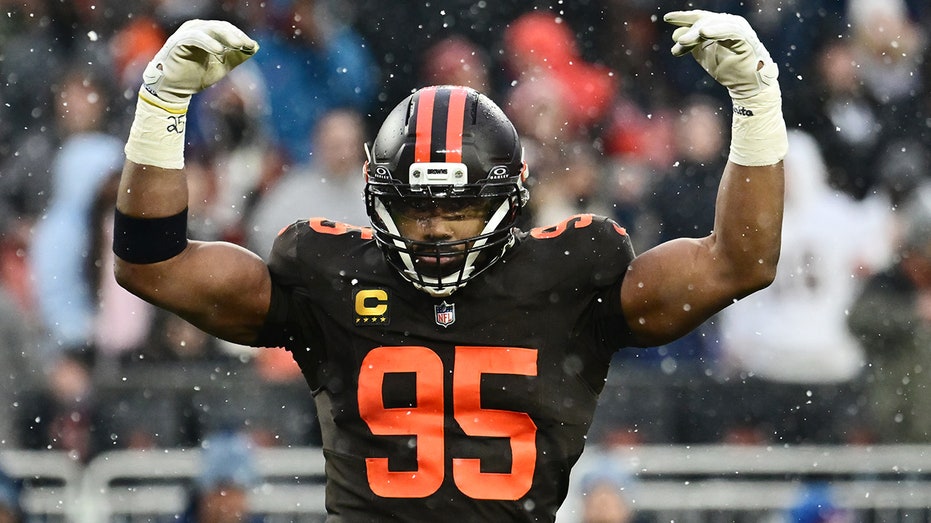
Myles Garrett’s sack chase is more than a record attempt. It exposes how the modern NFL values pass rushers, how context shapes greatness, and how the Browns are wasting a generational talent.
Myles Garrett’s Sack Chase Isn’t Just About a Record — It’s About How the NFL Has Evolved
Myles Garrett closing in on the single-season sack record is being framed as a simple numbers story: one more sack to tie Michael Strahan and T.J. Watt at 22.5, three games left, Hall of Fame trajectory. But what’s happening in Cleveland this season is much bigger than a stat line.
Garrett’s campaign is a lens into how the NFL now values elite pass rushers, how defensive impact is measured in an era of explosive offenses, and how individual greatness can exist inside chronic organizational underachievement. Joe Thomas calling Garrett “the best defensive pass rusher I’ve ever seen” isn’t just a former teammate hyping a star — it’s a sign that we may be undervaluing how historically unusual Garrett’s season is, given the circumstances around him.
Myles Garrett in Historical Context
The single-season sack record has always come with an asterisk-filled conversation. Sacks only became an official NFL statistic in 1982, leaving legends like Deacon Jones with unofficial tallies. Since then, a few seasons have become benchmarks:
- 22.5 sacks – Michael Strahan (2001), T.J. Watt (2021)
- 22.0 sacks – Jared Allen (2011), Mark Gastineau (1984)
- 21.0 sacks – Reggie White (1987, in only 12 games)
These seasons happened in different offensive eras: Strahan in a run-heavier, pre-spread NFL; Watt in a league that passes more than ever but also schemes to neutralize elite rushers with quick throws and RPOs. Garrett’s potential record comes in yet another evolution: an NFL where passing volume is high, but offensive coordinators are obsessively designed to get the ball out faster and neutralize edge threats.
Layer on one more crucial piece: team quality. Many of the most productive pass-rushing seasons historically came on competitive or elite teams that played with a lead. That matters because of game script: when you’re ahead, opponents pass more and deeper, giving pass rushers more time and more chances.
Garrett, by contrast, is putting together his masterpiece on a Browns team that’s 3–11. That flips the usual context on its head.
Why Pass-Rushing Dominance on a Losing Team Is So Unusual
Joe Thomas alluded to a detail that’s easy to gloss over but crucial in understanding Garrett’s season: sacks are often a function of opportunity, not just talent.
When a team is losing, opponents don’t have to chase big plays. They can lean on the run, call quick-game concepts, and prioritize avoiding negative plays. That generally reduces sack opportunities. Thomas put it this way: when teams are losing, they’re more willing to take risks, leave linemen one-on-one, and push the ball downfield — but that normally describes the offense trailing, not the defense’s team.
Yet Garrett is racking up sacks as a member of the trailing team. That suggests a few things:
- He’s winning reps extremely quickly, before quick-game concepts can neutralize him.
- Offenses can’t simply scheme him away without breaking their own rhythm.
- Even in run-heavy or conservative scripts, Garrett is wrecking enough plays to still impact the stat sheet.
Advanced metrics back this up in recent seasons. In 2023, Garrett ranked top-three in pass-rush win rate and pressure rate, despite heavy double-teams. While 2025 numbers are still being compiled in detail, early tracking data has him again among the league leaders, and film study shows consistent two- and sometimes three-man attention on key downs.
In other words, this isn’t just a volume stat driven by favorable situations. It’s a dominance stat being compiled in hostile situations.
The Modern Edge Rusher: From Specialist to System-Definer
Garrett represents the fully modern edge rusher prototype: 6’4”–6’5” range, 270-ish pounds, elite bend, rare explosiveness, and the ability to move up and down the line. Historically, defenses often built around middle linebackers or dominant tackles. In the current NFL, the premium building block on defense is the elite edge.
The contract numbers tell the story. Garrett’s $160 million deal is part of a broader market reset:
- Elite edge rushers now routinely command $25–30+ million per year.
- Their deals are increasingly structured like quarterback-lite contracts: long-term, franchise-defining commitments.
- Teams justify this because pressure has become the defensive equivalent of explosive plays on offense: a swing factor that can alter outcomes in a league built around quarterbacks.
Garrett’s offseason trade request, driven by a stated desire to win, followed quickly by a record-setting deal to stay, illustrates a modern tension: players want both competitiveness and top-of-market pay, but elite defensive talent often finds itself chained to organizations still figuring out how to build around them.
What’s Being Overlooked: The Browns’ Structural Failure Around a Generational Talent
Garrett’s production in a 3–11 season raises a more uncomfortable question: what does it say about the Browns’ roster-building and organizational strategy that a player this dominant has spent most of his prime on a team stuck in neutral?
This situation echoes other wasted peaks in NFL history:
- J.J. Watt in Houston – three Defensive Player of the Year awards, limited playoff success.
- Calvin Johnson in Detroit – Hall of Fame production, chronic underachievement around him.
- Joe Thomas himself in Cleveland – one of the greatest left tackles ever, virtually no postseason presence.
Garrett is on a different side of the ball, but the pattern is familiar: an organization that finds a generational piece but fails to build a complete, sustainably competitive roster around him. The Browns’ persistent instability at quarterback and frequent coaching changes have undercut any continuity needed to turn star power into wins.
The irony is sharp: Cleveland did the hardest part — finding and retaining a true game-wrecker — yet remains unable to translate that into the kind of defensive identity and complementary offense that wins meaningful games.
Reframing the Sack Record: Efficiency, Attention, and Impact
Raw sack totals are a blunt instrument. More nuanced metrics — pressures, hits, double-team rate, pass-rush win rate — tell the fuller story.
In recent seasons, public and private data have shown that:
- Sacks are high-variance events; pressures tend to be more stable year to year.
- Double-team rate correlates heavily with perceived threat. Garrett is consistently near the top of that list.
- On a per-snap basis, Garrett often grades out as the most efficient edge rusher in football, even in years when his sack totals trail the league leaders.
So if he breaks 22.5 in a season where he’s drawing maximum attention, on a losing team, with fewer favorable pass-rush scripts, the record should arguably carry more weight than earlier benchmarks accumulated in friendlier conditions.
That’s the nuance that’s often missing in highlight-driven coverage: not all 20+ sack seasons are created equal. Context matters. Garrett’s context is uniquely hostile — and that’s what makes his chase historically compelling.
How This Shapes the Future Market for Defensive Stars
If Garrett finishes the season with the record or even just near it, a few broader shifts are likely to accelerate:
- Pass-rusher valuation will continue to creep toward quarterback levels.
Teams already know this intellectually, but seeing another historic season in real time reinforces the idea that an elite edge is a foundational, not luxury, position. - Analytics departments will push harder to contextualize production.
Expect more emphasis on double-team data, time-to-sack, and game situation when front offices argue over contracts and awards like Defensive Player of the Year. - Players will have stronger leverage in trade and extension talks.
Garrett requested out, then got paid to stay. Other stars will take note: threaten mobility, then cash in as the “we can’t lose him” cornerstone of the franchise.
Expert Perspectives
Defensive line experts and analysts have been redefining how we talk about edge play for years. While they aren’t commenting directly on this specific article, their published views help frame Garrett’s season:
- Dr. Eric Eager, a data-driven football analyst, has repeatedly argued that pressure rate is more predictive — and more valuable — than sack totals alone, implying that a season like Garrett’s, with both pressures and sacks, is the true gold standard.
- Brian Baldinger, former lineman turned analyst, often highlights Garrett’s ability to win from multiple alignments — wide-9, over the guard, even inside — as a sign of his rare versatility compared with more one-dimensional sack artists.
- Former edge rushers like DeMarcus Ware and Dwight Freeney have stressed how much harder it is now to dominate consistently with modern protections, chips, and quick passing. That puts Garrett’s sustained output in sharper relief.
What to Watch as Garrett Chases the Record
The next three games aren’t just about whether he hits 23 or 24 sacks. A few key questions will shape how this season is remembered:
- Does Cleveland adjust its scheme to hunt the record?
More obvious pass-rush situations, more wide alignments, and more blitz looks that isolate Garrett would signal that the team is leaning into the chase. - Do opponents change their game plans to avoid being “the team he broke it against”?
We could see extra chips, designed rollouts away from his side, and even shorter passing scripts tailored specifically to slow him down. - Can the Browns use this moment to reset their identity?
Leaning into a defense-first, Garrett-centered identity could give a floundering franchise something tangible to build around, rather than treating this as a one-off statistical anomaly.
The Bottom Line
If Myles Garrett breaks the single-season sack record, it won’t just be another milestone in an era of inflated passing stats. It will be one of the rare individual seasons that exposes deeper truths about where the NFL is headed, how defense is valued, and how often generational talent is squandered by unstable franchises.
In a way, Joe Thomas’s praise captures the core dilemma: Garrett may indeed be the best pass rusher he’s ever seen. The real question is whether Cleveland will ever build a team good enough to make that greatness matter in January — not just in the record books.
Topics
Editor's Comments
What’s most striking about Myles Garrett’s season isn’t just the proximity to the sack record; it’s the stark contrast between individual excellence and organizational mediocrity. The Browns have again stumbled into a familiar pattern: discovering a player who could anchor a championship-caliber unit while failing to construct the broader ecosystem necessary to capitalize on that gift. In another franchise — one with stable quarterback play, coherent offensive identity, and continuity in coaching — this kind of defensive season would be framed as part of a Super Bowl window. In Cleveland, it risks becoming another isolated achievement for the record books. The bigger, uncomfortable question is whether the league is becoming more tolerant of this disconnect: treating generational defensive stars as marketable assets and jersey sellers, rather than as centerpieces of a serious title blueprint. Garrett’s year should prompt a reassessment inside the Browns’ building of what it means to truly build around an elite defender, beyond just paying him like one.
Like this article? Share it with your friends!
If you find this article interesting, feel free to share it with your friends!
Thank you for your support! Sharing is the greatest encouragement for us.