
Why Airports Letting Non‑Travelers Past Security Signals a New Phase of Post‑9/11 America

Sarah Johnson
December 18, 2025
Brief
Select U.S. airports are quietly letting non-travelers past security again. This analysis unpacks the security logic, commercial motives, and social implications behind this cautious rollback of post‑9/11 restrictions.
Airports Are Letting Non‑Travelers Past Security Again. It’s About Much More Than Nostalgia.
For the first time in nearly a quarter century, a growing number of U.S. airports are quietly reopening the post‑9/11 curtain—allowing people without boarding passes past security under tightly controlled guest-pass systems. On the surface, it looks like a feel‑good, nostalgia play: grandparents greeting grandkids at the gate, partners saying goodbye at the jet bridge. Underneath, it’s a revealing test of how far the U.S. thinks it has come since 9/11, how airports are trying to reinvent themselves as commercial and civic spaces, and how much security theater the public is still willing to accept.
The move by Oakland International and other airports is not simply about loosening rules. It’s about recalibrating the security‑freedom balance, searching for new revenue streams, and probing whether a risk‑averse federal security apparatus is ready for incremental normalization—without forgetting why those restrictions existed in the first place.
The Bigger Picture: From Open Terminals to Fortress Airports
To understand the significance of these guest passes, you have to rewind to pre‑9/11 aviation. Until September 10, 2001, U.S. airports were largely open environments. Families and friends walked to the gate freely. Schools took field trips to observation decks. Restaurants and shops beyond security served both travelers and locals. Security was present, but far less intrusive and mostly handled by private contractors under Federal Aviation Administration (FAA) oversight.
Everything changed with the attacks of September 11, 2001. In the months that followed:
- The Transportation Security Administration (TSA) was created in November 2001.
- Federal rules began requiring that only ticketed passengers with valid boarding passes could proceed past security checkpoints in most circumstances.
- Airports were physically reengineered: more barriers, more checkpoints, more cameras, and tighter control over access to “secure areas.”
That transformation aligned with a broader shift in U.S. national security thinking: treat commercial aviation as a high‑value target whose protection justifies sweeping constraints on mobility and privacy. The airport became one of the most visible spaces where the public experienced the new security state.
What Oakland, Cleveland, San Antonio, Kansas City, Detroit, and Philadelphia are doing now—issuing limited, vetted guest passes to non‑passengers—is the first meaningful crack in that post‑9/11 consensus inside U.S. airports. While these programs are modest and highly regulated, they signal that the absolute ban on non‑ticketed gate access is no longer sacrosanct.
What This Really Means: Security, Commerce, and Social Life Converge
Behind the warm headlines about families reuniting at the gate are three deeper dynamics reshaping U.S. air travel.
1. A Small but Symbolic Retreat from 24/7 Crisis Mode
The guest‑pass model requires advance online registration, TSA vetting, and Real ID or passport verification. This is not a return to the casual walk‑through of the 1990s, and airports are careful to frame these as discretionary, revocable programs. Oakland’s explicit language that the program can be canceled “at its sole discretion” underscores how conditional this reopening is.
Still, symbolically, it matters. For over two decades, security policy has generally moved in one direction: tighter, not looser. Allowing non‑passengers past checkpoints—even in small numbers—implies several things:
- Confidence in current screening technology and watchlist systems.
- A belief that the primary threat vectors have evolved more toward cyber, insider, and overseas risks than casual visitors at domestic terminals.
- A recognition that permanent emergency posture carries political and social costs.
In other words, this is a cautious experiment in moving from crisis architecture to managed risk.
2. Airports as Shopping Malls and Social Hubs
Modern airports increasingly see themselves not just as transportation nodes but as commercial ecosystems. Concession revenue—restaurants, retail, duty‑free, services—has become critical to airport finances, especially after the shocks of the 2008 financial crisis and the 2020 COVID‑19 collapse in passenger traffic.
By limiting access to only ticketed passengers, airports effectively cut off half of their potential customer base. Guest‑pass programs subtly reopen that market:
- Locals can dine at post‑security restaurants or meet for coffee.
- Non‑flying family members may spend money while waiting at the gate.
- Airports can market themselves as destination spaces, not just transit points.
We’ve already seen this logic abroad. Airports like Singapore’s Changi and Seoul’s Incheon actively position themselves as shopping and entertainment hubs, with attractions that draw non‑travelers. The U.S. is taking a more security‑constrained version of that model—guest passes instead of open access—but the underlying commercial motivation is similar.
3. The Emotional Politics of Travel
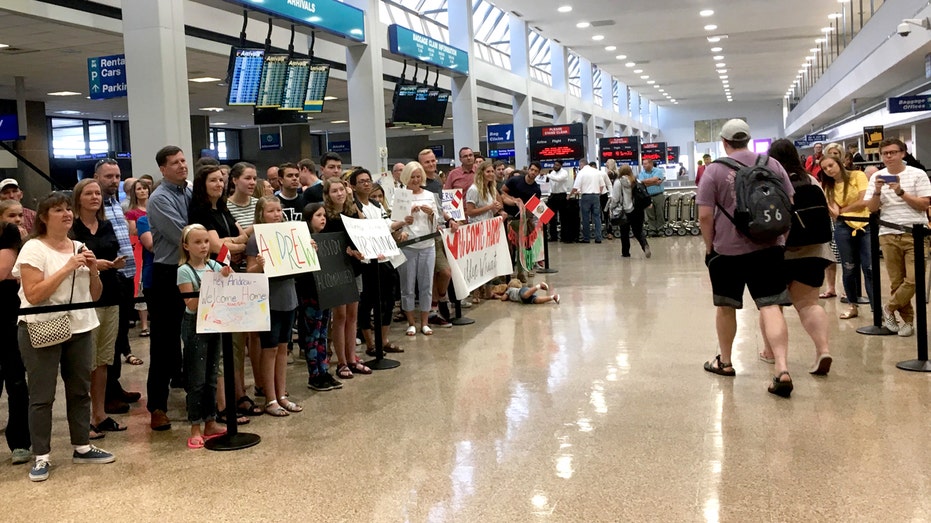
The Reddit nostalgia captured in the original story isn’t trivial. For many people, some of the most emotionally charged moments of their lives—reunions, farewells, deployments—have taken place at airport gates. Post‑9/11 restrictions privatized those moments earlier in the journey, pushing goodbyes to curbside or ticketing halls and turning arrivals into isolated walks from the gate to baggage claim.
By allowing vetted visitors back to the gate, even in limited form, airports are acknowledging an emotional and social loss that has lingered for years. The policy implicitly recognizes that the airport is not just an infrastructure asset but a site of human rituals. That matters in a country where travel has become more stressful, more transactional, and more unequal.
Expert Perspectives: Risk, Rights, and Revenue
Security, civil liberties, and aviation policy experts see overlapping but distinct implications in this shift.
Security analysts stress that access control remains central. The key is whether guest‑pass systems can remain low‑volume and tightly monitored.
Civil liberties advocates tend to focus on the broader pattern: emergency measures becoming permanent and then loosening only at the margins, often in ways that benefit revenue generation more than individual freedom.
Aviation economists, meanwhile, point out that airports are under pressure to diversify income sources and enhance passenger experience, and these programs are an inexpensive experiment toward that end.
Data & Evidence: How Much Risk Are We Really Talking About?
It’s important to separate perception from quantifiable risk.
- Since 9/11, there have been no comparable large‑scale hijackings originating from U.S. airports, despite hundreds of millions of passengers screened annually.
- The primary security failures in recent years have tended to involve insider threats (employees with access badges), attempted attacks on international routes, or security lapses in screening procedures—not casual visitors at terminals.
- Pilot programs at other airports—in cities like Pittsburgh, Tampa, and Seattle in the late 2010s—tested non‑passenger access with relatively few reported security incidents. Most were discontinued or paused for operational or pandemic‑related reasons, not documented attacks.
From a risk‑management standpoint, the marginal risk of allowing a limited number of pre‑vetted non‑passengers through security may be relatively low compared to the baseline threats airports already face. The question is whether the added security workload, potential congestion, and privacy implications are proportional to the benefits.
What’s Being Overlooked
Most mainstream coverage frames these programs as either a charming throwback or a minor security debate. Several deeper issues are often ignored:
- Equity of access: Who is realistically able to apply days in advance and has the required identification? Guest passes may privilege those who are already highly documented and digitally connected, potentially excluding lower‑income or undocumented family members.
- Data and surveillance: Every guest‑pass application generates new data—names, IDs, travel intent—that feeds into TSA and airport systems. This is another expansion of the security data footprint, largely unexamined by the public.
- Operational strain: Checkpoints are already under pressure at peak times. Adding non‑passengers, even in small numbers, may lengthen lines unless carefully capped or channeled.
- Slippery normalization: Temporary programs justified as “pilot” or “revocable” often become semi‑permanent. Once airports and vendors start counting on the revenue, it becomes harder politically to roll them back if the threat environment changes.
Looking Ahead: What to Watch
These guest‑pass programs are likely early tests, not the final form of post‑9/11 airport access. Several developments bear watching:
- Standardization vs. Patchwork: Will TSA eventually formalize a national framework for non‑passenger access, or will the landscape remain airport‑by‑airport? A standardized system could be more transparent but also more expansive.
- Integration with Digital Identity: As the U.S. moves toward full Real ID enforcement and experiments with digital IDs and facial recognition, guest passes could become another node in a broader identity‑tracking infrastructure.
- Metrics on Congestion and Revenue: If airports can show that these programs boost concession sales without significantly increasing wait times or incidents, the commercial case will strengthen quickly.
- Security Incident Response: If a serious security incident ever involves a guest‑pass holder, even indirectly, expect an immediate political backlash and potential nationwide suspension of such programs.
- Public Attitudes: Younger travelers who never knew pre‑9/11 airports may have a different tolerance for security inconvenience than older generations. How they respond to a partial reopening will shape political space for broader reforms.
The Bottom Line
The return of non‑passengers beyond airport security isn’t just a nostalgic gesture. It’s a test case for whether the U.S. can cautiously unwind parts of its permanent security posture, rebalance public space and profit motives, and restore a small slice of the emotional life that used to unfold at the gate. Whether these programs remain niche experiments or evolve into a normalized feature of American airports will depend as much on data and incidents as on how the public decides to value convenience, connection, and risk in the years ahead.
Topics
Editor's Comments
What’s striking about the guest-pass trend is how effectively it blurs the line between restoring a lost freedom and monetizing a controlled privilege. Before 2001, you didn’t need an application, a digital profile, and federal approval to walk your child to the gate. Now, that same act is recast as a discretionary benefit granted by security authorities and leveraged by airports to drive retail revenue. The narrative is one of reconnection and nostalgia, but structurally it’s a story about who controls access to public-adjacent spaces and under what conditions. We should also be asking why incremental, highly managed openings like this are politically feasible, while more direct reforms—shorter watchlist retention, stronger redress mechanisms, tighter limits on data sharing—remain stalled. In that sense, guest passes may function as a pressure valve: offering just enough human warmth to make a deeply securitized system feel tolerable, without meaningfully changing where power resides or how data flows.
Like this article? Share it with your friends!
If you find this article interesting, feel free to share it with your friends!
Thank you for your support! Sharing is the greatest encouragement for us.