Ukraine’s Underwater Drone Strike on a Russian Submarine Is a Preview of Future Naval War

Sarah Johnson
December 18, 2025
Brief
Ukraine’s first-ever underwater drone strike on a Russian submarine in Novorossiysk signals a deeper transformation in naval warfare, port security, and global trade than most coverage acknowledges.
Ukraine’s Underwater Drone Strike on a Russian Submarine: Why This Changes More Than the Battle for the Black Sea
Ukraine’s claimed first-ever underwater drone attack on a Russian Kilo-class submarine in Novorossiysk is more than a headline-grabbing battlefield innovation. It’s a moment that crystallizes how war at sea is being rewritten by cheap, unmanned systems — and how a smaller, besieged state can systematically dismantle a larger navy’s freedom of action without fielding a comparable fleet.
This strike, if damage is confirmed, is strategically significant on four levels: it accelerates the erosion of Russia’s Black Sea dominance; validates undersea drones as a disruptive class of weapons; deepens the militarization of critical global trade routes; and raises the stakes for any future conflict involving naval powers far beyond the Black Sea.
From Sevastopol to Novorossiysk: The Slow Displacement of a Fleet
To understand why hitting a single submarine in Novorossiysk matters, you have to rewind two years and look at the methodical Ukrainian campaign against Russian naval assets.
Historically, Russia’s Black Sea Fleet has been anchored at Sevastopol in occupied Crimea, a base that has served as Moscow’s strategic springboard into the Mediterranean since Czarist times. After Russia’s annexation of Crimea in 2014, the fleet’s role expanded: protecting grain routes, projecting power into Syria, and deterring NATO activity in the region.
Since 2022, Ukraine has attacked that posture in phases:
- 2022–early 2023: Harpoon and Neptune anti-ship missiles, plus spectacular hits like the sinking of the cruiser Moskva, challenged the assumption that Russia could roam the Black Sea with impunity.
- 2023–2024: Ukraine shifted to drone swarms — both aerial and “Sea Baby” surface drones — targeting Sevastopol, logistics ships, and key fleet units.
- By 2024: Repeated strikes made Sevastopol so costly that Russia began relocating high-value assets, including submarines and major surface combatants, to Novorossiysk on Russia’s own Black Sea coast.
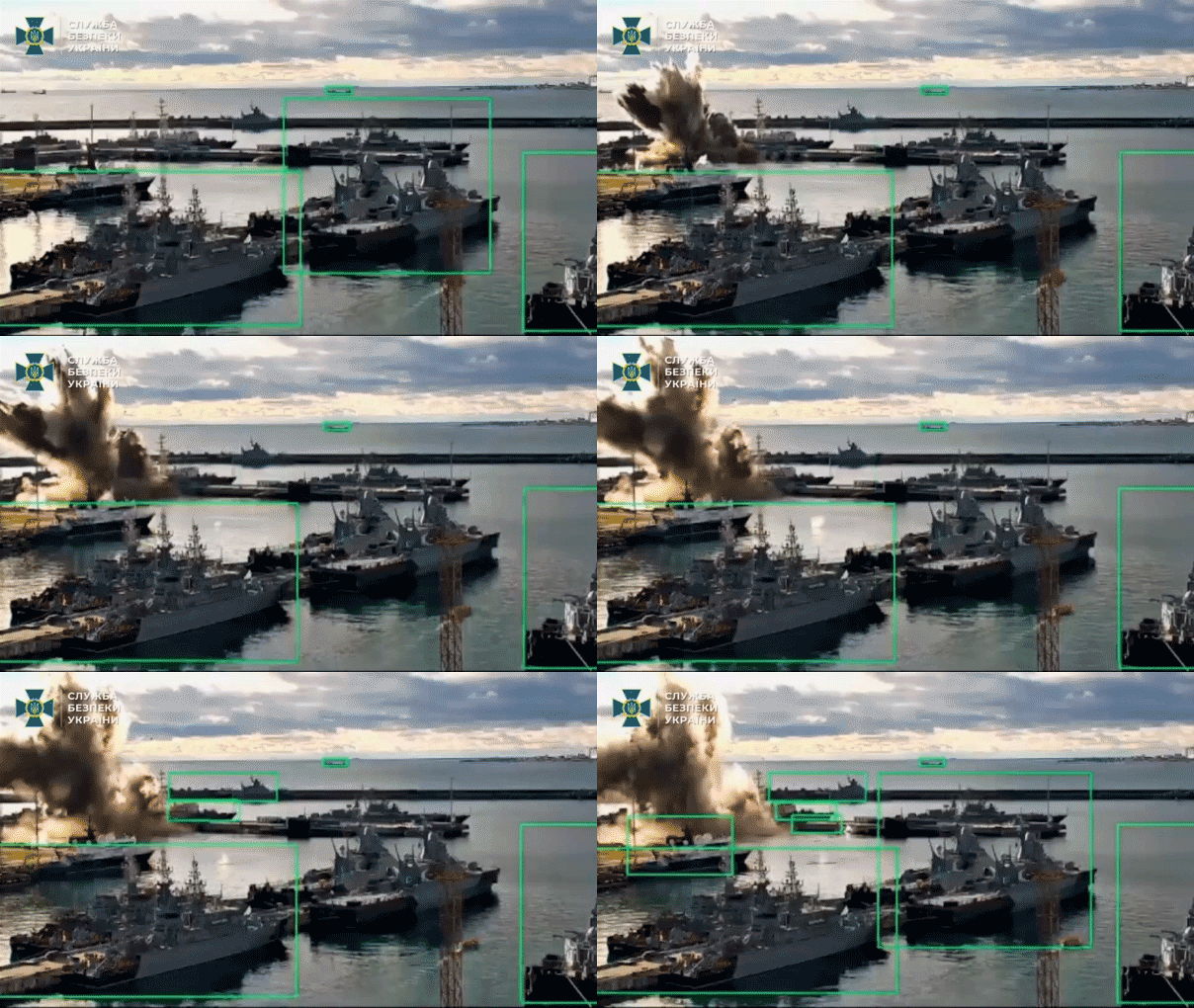
The SBU explicitly frames the new underwater “Sub Sea Baby” attack as the next logical step: if surface drones drove the Black Sea Fleet out of Sevastopol Bay, undersea drones are intended to deny Russia sanctuary in Novorossiysk as well. In other words, Ukraine is attempting not just to damage ships, but to make every Russian harbor in range feel unsafe.
Why a Kilo-Class Submarine Is a High-Value Target
The reported target — a Kilo-class submarine equipped with four Kalibr cruise missile launchers — is central to Russia’s long-range strike capability against Ukraine’s cities and power grid.
Kalibr missiles fired from the Black Sea have repeatedly hit Kyiv, Odesa, and critical infrastructure deep inside Ukraine. Each Kilo-class boat can carry a small but strategically meaningful salvo of these missiles, allowing Russia to launch surprise or saturation strikes without exposing aircraft.
Neutralizing even one such platform has outsized strategic impact:
- It reduces Russia’s strike inventory and flexibility, forcing it to rely more on land-based or air-launched systems that are easier to surveil and sometimes intercept.
- It sends a message to Russia’s naval command that submarines are no longer safe in port, potentially forcing behavior changes and more defensive deployments.
- It reinforces Ukraine’s strategy of attacking the launch platforms rather than just intercepting incoming missiles — a classic “shoot the archer, not the arrow” approach.
Russia’s denial of any damage is predictable. Moscow has consistently downplayed or misrepresented losses at sea, from the Moskva to previous strikes on dry docks and warships. Independent open-source analysts will likely scrutinize commercial satellite imagery and port traffic patterns in the coming weeks for corroboration.
Underwater Drones: The New Strategic Equalizer
Analysts have spent the last decade warning that autonomous and remotely operated systems would transform warfare. Ukraine is now demonstrating what that actually looks like at sea.
We’ve already seen:
- Surface maritime drones used by Ukraine to hit ships and port facilities hundreds of miles from Ukrainian-controlled coastline.
- Aerial drones striking Russian oil facilities and military sites deep inside Russian territory.
The “Sub Sea Baby” system takes this a step further by exploiting the undersea domain, historically dominated by expensive, crewed submarines and sophisticated anti-submarine warfare (ASW) assets.
The key asymmetry here is cost:
- A Kilo-class submarine costs hundreds of millions of dollars and years of construction and crew training.
- An underwater drone is likely in the low six- to low seven-figure range per unit, depending on sophistication — possibly less if built with commercial components.
That means a country with a modest budget can field dozens or hundreds of undersea drones designed to threaten ships that are worth 100–500 times more. This is precisely the “minnows swallow sharks” dynamic drone expert Brett Velicovich referenced: small, fast, smart, expendable systems attacking large, slow, irreplaceable ones.
For navies worldwide, this raises uncomfortable questions:
- How do you defend large, high-signature assets in crowded, shallow coastal waters against swarms of small undersea vehicles?
- What happens when commercial ports, not just naval bases, become accessible targets for states and non-state actors using similar technology?
- How much longer can traditional fleet structures — concentrated in a handful of major bases — remain viable in a world of cheap underwater drones?
The Overlooked Economic and Geographic Vulnerability: Novorossiysk as a Choke Point
Most coverage frames Novorossiysk primarily as a naval base. But it’s also one of Russia’s most important commercial ports, especially for oil exports via the Caspian Pipeline Consortium.
By striking a military target inside this dual-use port, Ukraine is implicitly demonstrating that it can reach a facility that:
- Handles a substantial share of Russia’s crude oil exports.
- Sits close to key Black Sea shipping lanes used by global trade.
So far, Ukraine has been careful to focus on clearly military or dual-use targets linked to the war effort. But the underlying capability — reaching Novorossiysk’s harbor with unmanned systems — introduces long-term risk for insurers, shipowners, and commodity markets.
Even if Ukraine maintains tight targeting discipline, the precedent matters: major energy and grain ports are now demonstrably within reach of relatively inexpensive, hard-to-detect systems. That will:
- Increase security and insurance costs for Black Sea shipping.
- Encourage Russia to harden port security, divert traffic, or shift export routes — moves that carry economic penalties.
- Provide a real-world test case for how global maritime trade adapts to persistent, low-cost undersea threat.
Diplomacy in the Background: Negotiations Under the Shadow of Drones
The timing of the strike is not incidental. While Ukraine experiments with underwater drones, President Volodymyr Zelenskyy has been in Berlin for talks with European leaders, and his team has been meeting U.S. special envoy Steve Witkoff and Jared Kushner about security guarantees.
At the same time, Vladimir Putin has publicly floated Donald Trump’s proposed peace plan as a “starting point,” while warning Ukraine to pull back or face “force.”
Put bluntly, both sides are trying to shape the eventual negotiating table:
- Russia wants to signal that it can sustain large-scale missile and drone strikes indefinitely, making life inside Ukraine costly and uncertain.
- Ukraine wants to demonstrate that it can escalate horizontally — striking deeper into Russia’s logistical and naval infrastructure, and raising the long-term cost of the war for Moscow.
The underwater drone attack feeds directly into Ukraine’s leverage-building strategy. Each successful hit on high-end Russian equipment strengthens Kyiv’s argument that time is not necessarily on Moscow’s side, even if Russia retains numerical advantages in manpower and industrial capacity.
What This Means for Future Naval Warfare
The wider lesson of Novorossiysk is that the traditional hierarchy of naval power is being challenged from below.
Until recently, sea control was almost exclusively a function of large platforms: destroyers, carriers, submarines. Now, we’re approaching an era in which:
- Sea denial can be carried out by states without blue-water navies, using undersea drones, surface drones, and land-based anti-ship missiles.
- Fleet survivability depends much more on dispersion, deception, and electronic warfare than on armor and tonnage.
- Port-centric naval posture is increasingly risky, as harbors become kill zones for low-signature unmanned systems.
For NATO and other maritime powers in the Pacific and Indian Oceans, Ukraine is inadvertently conducting a live-fire laboratory on their behalf. Key takeaways include:
- The need for layered port defenses that extend underwater, combining sonar nets, patrol craft, anti-drone systems, and AI-based anomaly detection.
- The urgency of doctrinal change — fleets may need to move toward more dispersed, smaller combatants and unmanned escorts rather than a few high-value units.
- The inevitability that non-state actors will eventually adopt similar technologies, posing a threat to commercial shipping and offshore infrastructure.
Expert Perspectives: From Tactical Innovation to Strategic Disruption
Naval strategist James Stavridis has long argued that the combination of drones, cyber capabilities, and precision munitions will make the world’s oceans “more transparent and more lethal” for large platforms. The Novorossiysk strike fits that trajectory, highlighting how surveillance, targeting, and strike are converging in real time.
Defense technology scholars like Ulrike Franke have described Ukraine as the first large-scale “drone war” where off-the-shelf components are integrated with military-grade systems. The Sub Sea Baby program mirrors that pattern below the surface: a blend of improvisation, iterative design, and battlefield testing that large, bureaucratic militaries often struggle to match.
Meanwhile, Russian military thinkers face an uncomfortable reality. Doctrinally, Russia has invested heavily in submarines and cruise missiles as asymmetric tools against NATO. If Ukraine — without a blue-water navy — can impose meaningful constraints on those assets in a secondary theater like the Black Sea, the assumption that Russian submarines would operate freely in other contested waters becomes less secure.
Looking Ahead: What to Watch
Over the next 6–12 months, several indicators will show how transformative this event really is:
- Russian redeployments: Do more submarines and high-value ships leave Novorossiysk for other ports, or adopt new defensive postures (e.g., spending more time at sea)?
- Port security upgrades: Satellite imagery and open-source reporting may reveal rapid construction of barriers, nets, sensor arrays, and new patrol patterns around Novorossiysk and other Black Sea bases.
- Ukrainian target set expansion: Does Kyiv begin to use undersea drones against other high-value maritime infrastructure, such as logistics ships, fuel depots, or ancillary military facilities in or near commercial ports?
- Global mimicry: Do other states — particularly those facing superior navies (for example, Iran vis-à-vis the U.S. in the Persian Gulf, or smaller Asian states in the South China Sea) — begin openly investing in similar undersea capabilities?
On the diplomatic front, expect this strike to be a quiet but potent data point in Ukraine’s conversations about long-term security guarantees. Western policymakers will see both the promise and the risk of enabling Kyiv to develop ever more capable long-range drone systems: they increase Ukraine’s self-reliance, but also complicate escalation management with a nuclear-armed adversary.
The Bottom Line
The reported underwater drone strike on a Russian submarine in Novorossiysk is not an isolated tactical success; it’s a preview of how navies, ports, and global trade will be contested in the coming decades.
Ukraine is showing that a mid-sized country, with enough ingenuity and external support, can contest a far larger navy without matching it ship for ship. For Russia, the message is stark: there may be no truly safe harbor within drone range. And for the rest of the world, the lesson is urgent — the age of cheap, expendable, and increasingly autonomous underwater systems has arrived faster than most defense establishments planned for, and the vulnerabilities they expose are not confined to the Black Sea.
Topics
Editor's Comments
One underexamined dimension of the Novorossiysk strike is its long-term impact on how we think about escalation and thresholds at sea. For decades, the implicit assumption in many security doctrines has been that hitting major ports on the adversary’s home territory is a serious escalatory step, one often associated with wider war. Ukraine is carefully threading that needle by focusing on clearly military assets inside dual-use ports, but the technology it is pioneering doesn’t recognize such boundaries. Once underwater drones are widely proliferated, it will be much easier for states to deny involvement or for non-state actors to conduct plausibly deniable attacks on shipping and infrastructure. That blurring of attribution could make crises harder to manage, not easier, because retaliation decisions will have to be made under deeper uncertainty. Policymakers watching the Black Sea should therefore think beyond immediate war aims and start developing norms, signaling mechanisms, and defensive architectures for an era in which cheap, low-signature undersea systems become as ubiquitous — and as politically explosive — as aerial drones are today.
Like this article? Share it with your friends!
If you find this article interesting, feel free to share it with your friends!
Thank you for your support! Sharing is the greatest encouragement for us.