Inside the 1,000-Ship ‘Dark Fleet’ Quietly Rewiring Sanctions, War Finance, and Maritime Risk

Sarah Johnson
December 16, 2025
Brief
A 1,000-ship ‘dark fleet’ moving sanctioned oil for Russia, Iran, and Venezuela is transforming sanctions enforcement, maritime law, and environmental risk. This analysis unpacks the hidden system and its global consequences.
The ‘Dark Fleet’ Oil War: How 1,000 Rogue Tankers Are Rewriting Sanctions, Maritime Law, and Environmental Risk
The emergence of a 1,000-vessel “dark fleet” ferrying sanctioned oil for Iran, Venezuela, and Russia is more than a cat-and-mouse sanctions story. It’s a structural challenge to how the world governs oceans, energy, and war in the gray zone between peace and open conflict. The recent U.S. seizures of tankers and Ukraine’s decision to strike “shadow fleet” ships with sea drones mark a turning point: sanctions enforcement is moving from the courtroom and the Treasury Department into contested waters and, potentially, kinetic confrontation.
The bigger picture: From tanker wars to data wars at sea
Using ships to evade economic pressure isn’t new. In the 1980s, during the Iran–Iraq “tanker war,” oil shipments were attacked to strangle revenue. After the 1990s UN embargo on Iraq, Baghdad relied on ship-to-ship transfers and falsified paperwork. But three structural shifts make today’s dark fleet fundamentally different:
- Digital visibility has become a weapon. The Automatic Identification System (AIS), GPS, and satellite imagery turned global shipping into an open dataset. Tankers now respond by spoofing positions, switching off transponders (“going dark”), and using shell companies to confuse ownership trails. We are witnessing a real-time struggle over who controls the data that governs the seas.
- Sanctions are now a primary tool of great-power competition. The U.S., EU, and allies have relied heavily on financial and oil sanctions against Iran, Venezuela, and especially Russia after the 2022 full-scale invasion of Ukraine. That policy choice almost guaranteed a shadow logistics ecosystem would emerge to keep oil flowing.
- The world is more dependent on seaborne oil trade than during past crises. Roughly 80–90% of global trade by volume moves by sea, and crude oil remains heavily tanker-dependent. When sanctions squeeze supply, the incentive to create a parallel, opaque transport network grows—especially for petro-states whose regimes depend on oil revenue to survive.
In that context, a 1,000-vessel dark fleet is not a side-show; it is a parallel global energy distribution system. It keeps sanctioned economies alive, undercuts Western leverage, and quietly raises the chances of an environmental catastrophe.
How the dark fleet works: Lawful gray zones, unlawful tricks
The vessels highlighted in the report are typically older tankers—often 20–25+ years old—that have been sold out of mainstream commercial service. They operate in a legal and regulatory twilight zone built on several tactics:
- False flagging and fraudulent registries. Around 350–400 of these vessels at any given time reportedly sail under flags of convenience that are either fraudulently obtained or tied to shell registries that barely exist on paper. That creates “stateless” ships in practice: no meaningful flag state oversight, effectively no insurance, and weak accountability.
- AIS manipulation and spoofing. By broadcasting fake locations, switching off AIS, or “borrowing” legitimate IDs, tankers can conduct ship-to-ship transfers of oil in remote waters, then reappear with a different declared origin. The cargo’s “story” is rewritten in the data, even if the molecules originated in Iran, Venezuela, or Russia.
- Shadow corporate webs. Ownership is layered through offshore companies in multiple jurisdictions, making it difficult for sanctions enforcers to prove control by a blacklisted entity. This isn’t unique to sanctions evaders, but it is exploited aggressively in the dark fleet context.
- Over-age hulls and minimal maintenance. Because these ships cannot participate in normal insured trade, there is little market incentive to meet safety standards. Classification societies may drop them, and documents such as “certificates of seaworthiness” become questionable or outright forged.
International maritime law was written with the assumption that most large commercial actors would want to remain in the system—insured, classed, and flagged by a state that cares. The dark fleet flips that assumption: for these tankers, opacity is not a bug; it’s the business model.
Why this matters: Sanctions, war finance, and the limits of Western leverage
The immediate geopolitical stakes are clear: these vessels “are a lifeline” for sanctioned regimes. Oil exports are the principal source of hard currency for Iran, Venezuela, and Russia. Despite formal sanctions, Russia has kept much of its oil flowing to Asia using this shadow fleet, often via complex routing and price-cap dodging. Iran has supplied China and regional partners using similar methods. Venezuela trades with both.
If even a fraction of a 1,000-vessel fleet can move several million barrels per day, the dark fleet becomes a de facto alternative to the regulated tanker market. For Washington and its allies, this erodes the core assumption behind energy sanctions: that cutting official shipping and financing channels will substantially throttle revenue.
That’s why the U.S. is leaning harder on legal tools, like using Article 110 of the UN Convention on the Law of the Sea (UNCLOS) to board stateless vessels, and why Ukraine has taken the more dramatic step of targeting shadow tankers with naval drones in the Black Sea. The goal is not just individual enforcement; it’s to raise the risk and cost of participation in the dark fleet so high that some owners and operators exit the business.
Environmental Russian roulette: One uninsured tanker, a billion-dollar spill
Behind the sanctions story sits a quieter, potentially devastating risk. A fully laden Very Large Crude Carrier (VLCC) can carry 2 million barrels of oil. Bockmann cites a recent Venezuelan-linked tanker with 1.8 million barrels onboard—uninsured and technically stateless—as a “billion-dollar maritime disaster waiting to happen.” That is not hyperbole:
- The 1989 Exxon Valdez spill released about 260,000 barrels.
- The 2010 Deepwater Horizon blowout ultimately spilled an estimated 4 million+ barrels over months.
One catastrophic hull failure or collision involving a dark fleet tanker, especially near a chokepoint like the Bosphorus, the Suez Canal, or busy Caribbean lanes, could simultaneously devastate ecosystems, shut a vital shipping route, and ignite legal chaos over who pays when a ship is uninsured and effectively stateless.
The maritime insurance and classification system exists precisely to manage this risk. By stepping outside that system, the dark fleet shifts the risk burden onto coastal states and, ultimately, taxpayers. The operators capture profits; the public absorbs worst-case losses.
Ukraine’s drone strikes: A new front in the oil logistics war
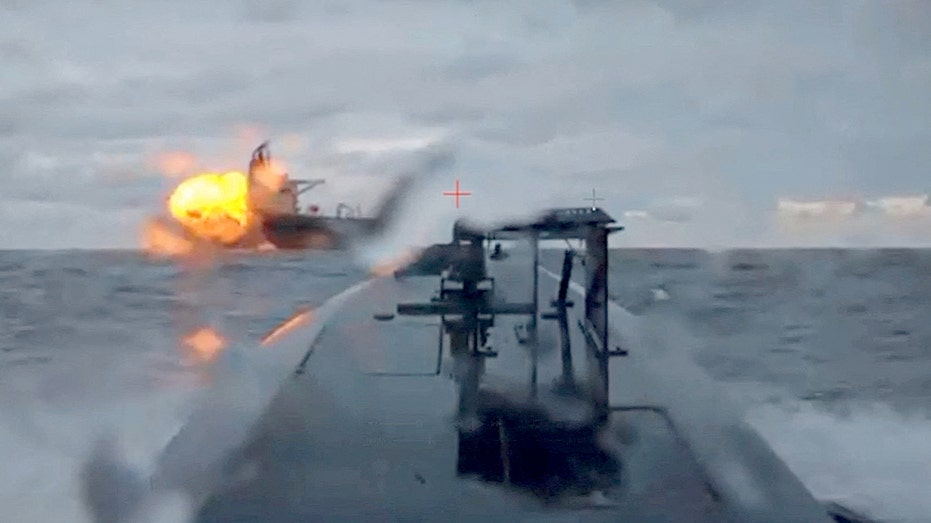
Ukraine’s reported naval drone attacks on several shadow fleet tankers in the Black Sea illustrate how sanctions enforcement is bleeding into battlefield tactics. Notably, the targeted ships were reportedly in ballast—without oil cargo—at the time, minimizing environmental risk. That signals several things:
- Strategic signaling rather than maximum disruption. Ukraine appears to be warning both Moscow and shadow fleet operators: participating in Russia’s sanctions evasion now carries kinetic risk, not just financial penalties.
- Legal and diplomatic calibration. By striking falsely flagged or stateless vessels linked to Russian oil trade, Kyiv can argue it’s hitting legitimate war-supporting logistics rather than civilian commerce. But the line is thin, and Moscow will frame such actions as attacks on global trade.
- A precedent for future conflicts. Once one state normalizes striking commercial logistics networks that support an adversary—even in a targeted way—it becomes easier for others to do the same in future crises. That could reverberate in potential flashpoints from the South China Sea to the Persian Gulf.
From a policy perspective, Ukraine’s actions raise a question Western capitals have largely avoided: if economic warfare is now central to modern conflict, is it realistic—or even desirable—to keep commercial shipping entirely off-limits when it is deliberately used to finance war?
Expert perspectives: Sanctions, shipping, and systemic risk
Sanctions and maritime experts see the dark fleet as a symptom of deeper structural trends.
Dr. Erica Moretti, a sanctions specialist at a European policy institute, emphasizes the limits of current tools: “When you impose sweeping energy sanctions, particularly on a G20 producer like Russia, you are creating a massive arbitrage opportunity. The dark fleet is not a glitch; it’s the market’s answer to constrained supply and continuing demand.”
Maritime safety experts go further. Captain Lars Johansen, a veteran tanker master and safety consultant, notes: “These ships often run with minimal crews, deferred maintenance, and questionable documentation. If they collide, catch fire, or lose power near a busy traffic separation scheme, there may be no P&I club, no insurer, and no responsible flag state to step up. Cleanup and compensation become a diplomatic knife-fight.”
Cyber and data-security analysts also see risk. AIS manipulation and spoofing don’t just hide sanctions evasion; they normalize tampering with the very navigation and traffic systems that keep crowded seas safe. That opens the door to miscalculation—and potentially to malicious interference by state or non-state actors who may decide to weaponize that opacity.
What mainstream coverage often misses
Much reporting frames this as a cat-and-mouse sanctions story: Washington and Kyiv crack down; the tankers dodge and continue. But several important dimensions are under-examined:
- Global South leverage. Many dark fleet activities touch jurisdictions in the Caribbean, West Africa, the Middle East, and parts of Asia—regions that are increasingly wary of being conscripted into Western sanctions campaigns. Their decisions on registry tightening, port access, and enforcement will quietly determine how viable the dark fleet remains.
- Energy price stability. Aggressively shutting down dark fleet capacity could, in the short term, tighten global oil supply and raise prices, especially if alternative routes and insurance can’t be scaled quickly. That creates a political dilemma for consumer states already battling inflation.
- Norms of maritime conflict. Kinetic action against commercial or quasi-commercial shipping, even when justified as targeting war financing, reopens debates that many thought settled after the tanker wars of the 1980s. What is off-limits when logistics directly supports aggression?
- The data governance problem. AIS and maritime data are treated as technical tools, but they are becoming instruments of power. Who controls validation, standards, and enforcement of data integrity at sea will shape future crises well beyond this dark fleet.
Looking ahead: Potential trajectories and pressure points
Several developments are worth watching in the coming months and years:
- Regulatory squeeze on flags and insurers. If key flag states tighten registry practices and major insurers refuse any association—direct or indirect—with over-age, opaque tankers, operating in the dark will become more expensive. That could shrink the fleet or push it even further into completely lawless territory.
- More assertive use of UNCLOS and high-seas boarding. The U.S. and partners may increasingly rely on Article 110 to justify boarding stateless tankers, potentially leading to more seizures like the Skipper in the Caribbean. Expect diplomatic protests from the affected regimes, who will call it “piracy” or “economic warfare.”
- Technological escalation. As enforcement improves AIS analytics and satellite tracking, operators may adopt even more sophisticated spoofing and cyber tactics. This is likely to evolve into a high-tech cat-and-mouse game featuring AI, commercial satellite constellations, and big-data pattern analysis.
- First major spill as a political shock. It may take a disaster—a grounded or ruptured dark tanker—to galvanize coordinated international action. If that happens near a developed coast or strategic chokepoint, expect a rapid push for new conventions tying flagging, AIS integrity, and insurance more tightly together.
- Ukraine conflict spillover. Continued Ukrainian attacks on shadow tankers could deter some operators—but also risk escalation if a misstep hits a ship carrying neutral cargo or crew, or if Russia retaliates against shipping supporting Ukraine.
The bottom line
The dark fleet is not just about sanction-busting. It’s a symptom of three converging realities: the centrality of sanctions in modern geopolitics, the fragility of maritime governance built for an era of greater transparency and trust, and the willingness of states to fight economic wars through the logistics arteries of global trade.
How the U.S., Ukraine, and their allies handle this—balancing enforcement, environmental risk, energy prices, and legal norms—will shape not just the outcome of current crises, but the rules of the road for the next generation of conflicts at sea.
Topics
Editor's Comments
What stands out in this story is how far reality has drifted from the assumptions underpinning maritime law and sanctions policy. Both were built on the idea that most large actors want to remain inside the system: flagged, insured, and broadly compliant. The dark fleet demonstrates that a large, profitable slice of global trade can now operate permanently in the shadows, using data manipulation and jurisdictional arbitrage to avoid those constraints. That raises uncomfortable questions for policymakers. If the system relies on voluntary compliance but no longer offers a compelling incentive to comply, what tools are left beyond coercion—boarding, seizure, and, in Ukraine’s case, outright attack? At the same time, a too-aggressive crackdown risks higher oil prices and diplomatic blowback from states that see Western sanctions as unilateral or politicized. The real challenge may be less about catching individual tankers and more about rebuilding a global consensus that certain minimal standards—honest flagging, AIS integrity, basic insurance—are non-negotiable, regardless of which side of a sanctions regime you’re on.
Like this article? Share it with your friends!
If you find this article interesting, feel free to share it with your friends!
Thank you for your support! Sharing is the greatest encouragement for us.